QUESTION IMAGE
Question
Question was provided via image upload.
Brief Explanations
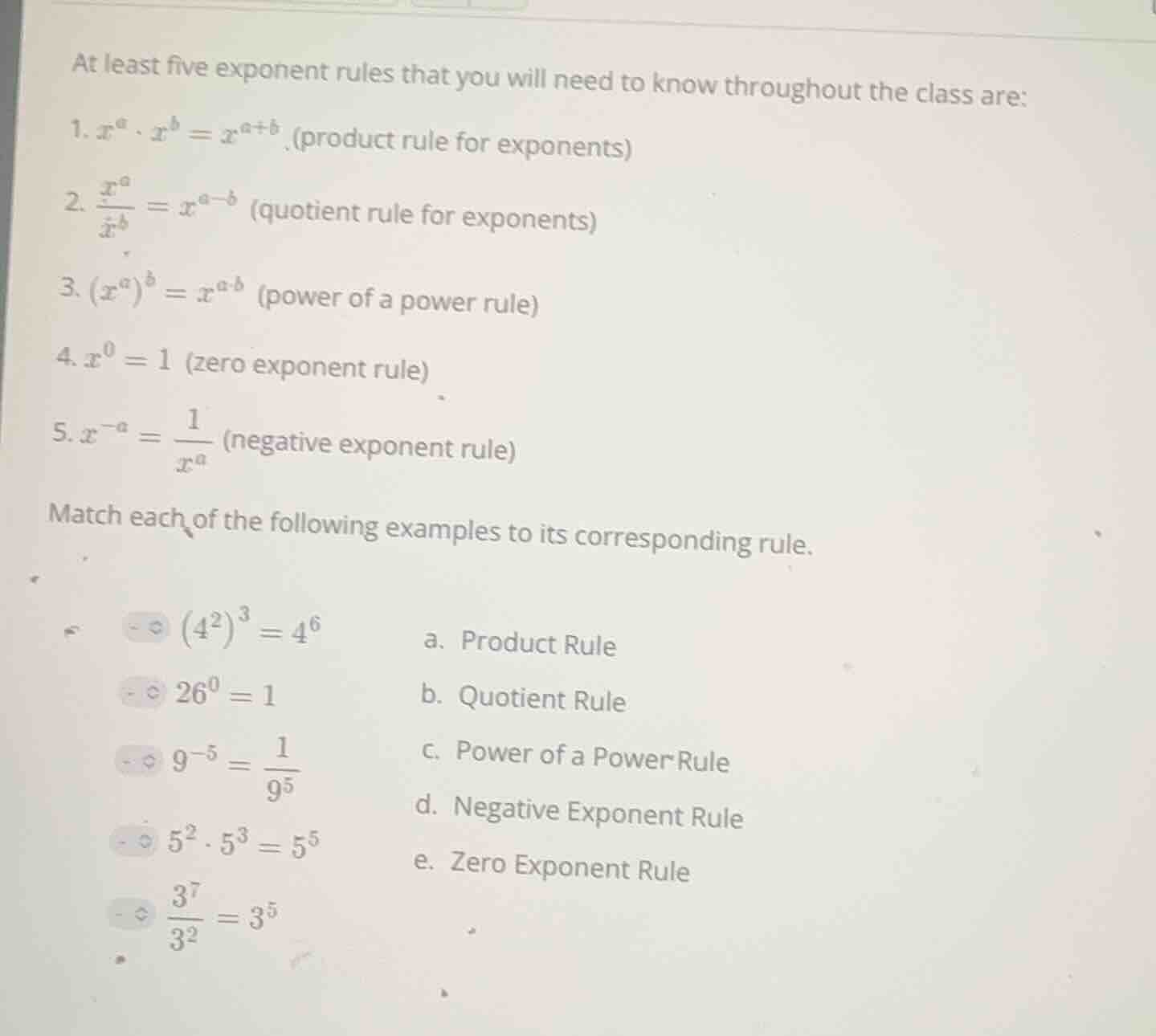
- $(4^2)^3=4^6$ follows the pattern of raising a power to a power, which matches rule 3.
- $26^0=1$ follows the pattern of any non-zero number to the 0 power being 1, which matches rule 4.
- $9^{-5}=\frac{1}{9^5}$ follows the pattern of converting a negative exponent to a positive reciprocal, which matches rule 5.
- $5^2 \cdot 5^3=5^5$ follows the pattern of multiplying like bases and adding exponents, which matches rule 1.
- $\frac{3^7}{3^2}=3^5$ follows the pattern of dividing like bases and subtracting exponents, which matches rule 2.

Snap & solve any problem in the app
Get step-by-step solutions on Sovi AI
Photo-based solutions with guided steps
Explore more problems and detailed explanations
- $(4^2)^3=4^6$: c. Power of a Power Rule
- $26^0=1$: e. Zero Exponent Rule
- $9^{-5}=\frac{1}{9^5}$: d. Negative Exponent Rule
- $5^2 \cdot 5^3=5^5$: a. Product Rule
- $\frac{3^7}{3^2}=3^5$: b. Quotient Rule