QUESTION IMAGE
Question
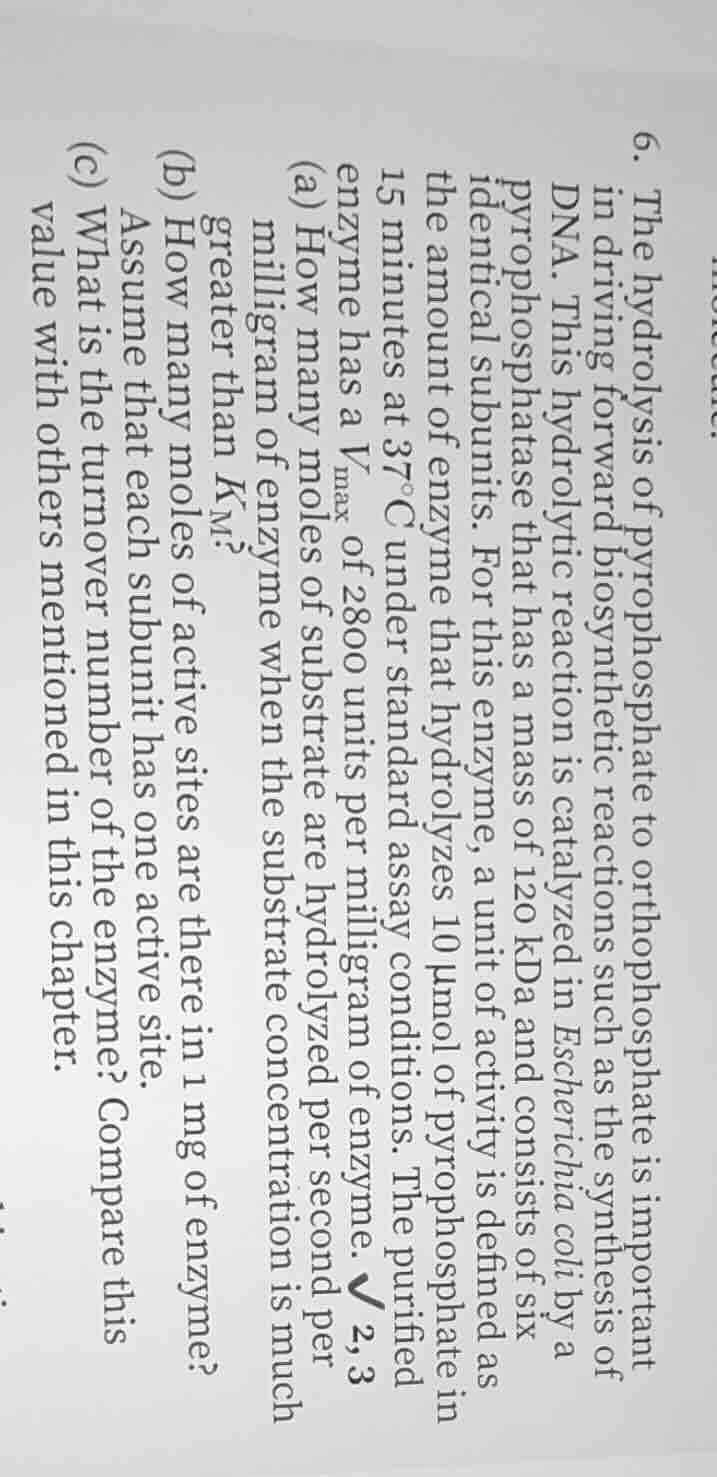
- the hydrolysis of pyrophosphate to orthophosphate is important in driving forward biosynthetic reactions such as the synthesis of dna. this hydrolytic reaction is catalyzed in escherichia coli by a pyrophosphatase that has a mass of 120 kda and consists of six identical subunits. for this enzyme, a unit of activity is defined as the amount of enzyme that hydrolyzes 10 μmol of pyrophosphate in 15 minutes at 37°c under standard assay conditions. the purified enzyme has a ( v_{\text{max}} ) of 2800 units per milligram of enzyme.\\( \boldsymbol{sqrt{2,3}} \\)\\( \boldsymbol{\text{(a)}} ) how many moles of substrate are hydrolyzed per second per milligram of enzyme when the substrate concentration is much greater than ( k_m )?\\( \boldsymbol{\text{(b)}} ) how many moles of active sites are there in 1 mg of enzyme? assume that each subunit has one active site.\\( \boldsymbol{\text{(c)}} ) what is the turnover number of the enzyme? compare this value with others mentioned in this chapter.
Step1: Define unit activity
1 unit = hydrolyze 10 μmol in 15 min
Step2: Convert to per second
1 unit = $\frac{10\ \mu\text{mol}}{15\ \text{min} \times 60\ \text{s/min}} = \frac{10}{900}\ \mu\text{mol/s} = \frac{1}{90}\ \mu\text{mol/s}$
Step3: Calculate total activity at $V_{max}$
$V_{max} = 2800$ units/mg, so per mg:
$\text{Total rate} = 2800 \times \frac{1}{90}\ \mu\text{mol/s} = \frac{2800}{90}\ \mu\text{mol/s} \approx 31.11\ \mu\text{mol/s}$
Convert to mol/s: $31.11 \times 10^{-6}\ \text{mol/s}$
---
Step1: Calculate enzyme molar mass
6 subunits × 120 kDa = 720 kDa = $720 \times 10^3\ \text{g/mol}$
Step2: Find moles of enzyme in 1 mg
$\text{Moles of enzyme} = \frac{1 \times 10^{-3}\ \text{g}}{720 \times 10^3\ \text{g/mol}} = \frac{1}{7.2 \times 10^8}\ \text{mol} \approx 1.39 \times 10^{-9}\ \text{mol}$
Step3: Calculate active sites (1 per subunit)
$\text{Active sites} = 6 \times 1.39 \times 10^{-9}\ \text{mol} = 8.33 \times 10^{-9}\ \text{mol}$
---
Step1: Define turnover number $k_{cat}$
$k_{cat} = \frac{V_{max}}{[\text{Enzyme active sites}]}$
Step2: Substitute $V_{max}$ and active site moles
$[\text{Active sites}] = 8.33 \times 10^{-9}\ \text{mol}$ per mg, $V_{max} = 31.11 \times 10^{-6}\ \text{mol/s}$ per mg
$k_{cat} = \frac{31.11 \times 10^{-6}\ \text{mol/s}}{8.33 \times 10^{-9}\ \text{mol}} \approx 3735\ \text{s}^{-1}$
This is a typical turnover number for enzymes (most fall between $10^2$ to $10^4\ \text{s}^{-1}$).

Snap & solve any problem in the app
Get step-by-step solutions on Sovi AI
Photo-based solutions with guided steps
Explore more problems and detailed explanations
(a) $\boldsymbol{\approx 3.11 \times 10^{-5}\ \text{mol/s}}$ per milligram of enzyme
(b) $\boldsymbol{\approx 8.33 \times 10^{-9}\ \text{mol}}$ of active sites
(c) $\boldsymbol{\approx 3735\ \text{s}^{-1}}$, which is within the typical range of enzyme turnover numbers (hundreds to thousands of reactions per second per active site).