QUESTION IMAGE
Question
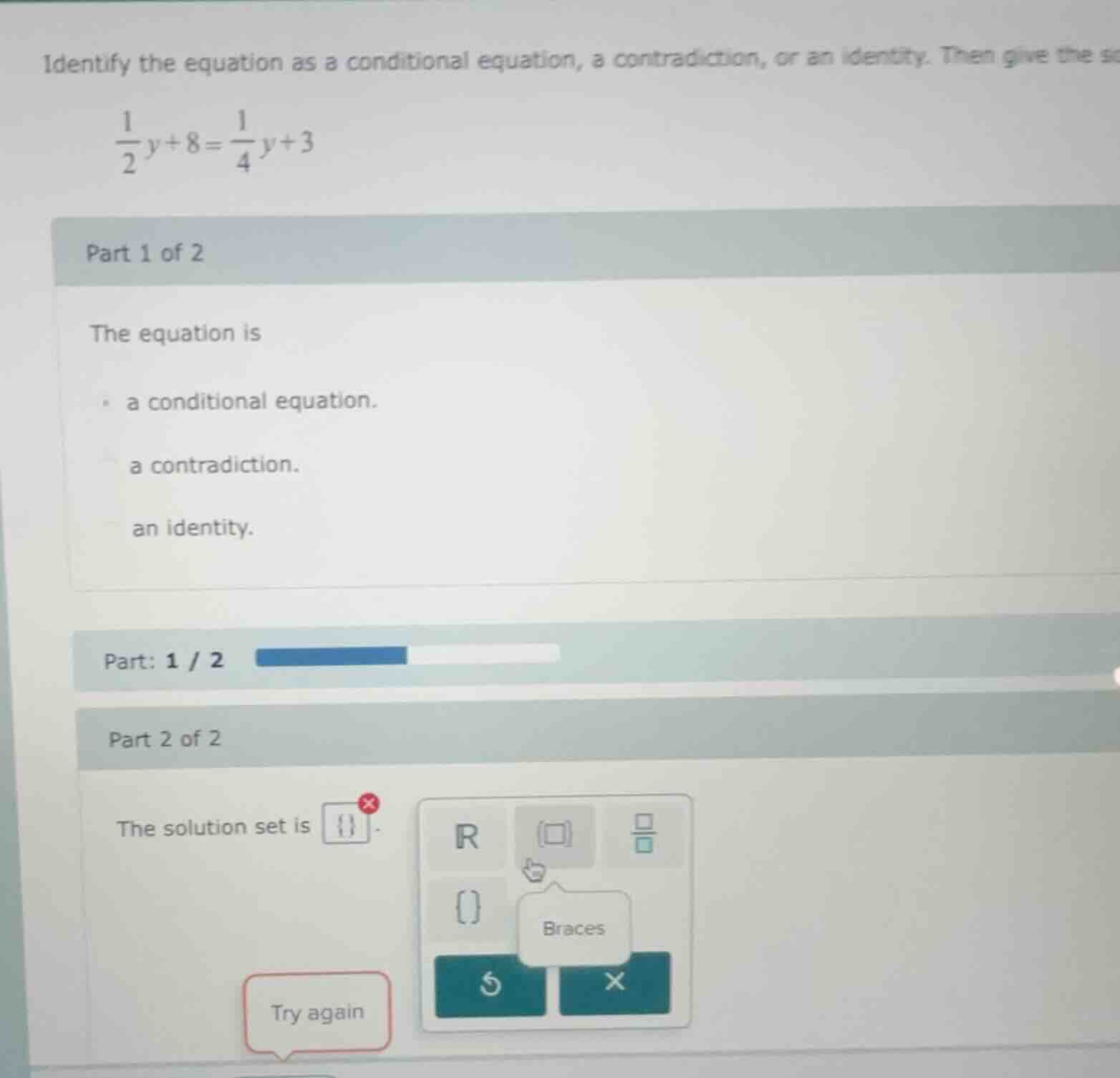
identify the equation as a conditional equation, a contradiction, or an identity. then give the so\\(\frac{1}{2}y + 8=\frac{1}{4}y + 3\\)\
part 1 of 2\
the equation is\
· a conditional equation.\
a contradiction.\
an identity.\
part: 1 / 2\
part 2 of 2\
the solution set is \\{\\}.
Part 1 of 2
Step1: Recall definitions
- A conditional equation is true for some values of the variable.
- A contradiction is never true.
- An identity is always true.
Step2: Solve the equation $\frac{1}{2}y + 8=\frac{1}{4}y+3$
Subtract $\frac{1}{4}y$ from both sides: $\frac{1}{2}y-\frac{1}{4}y + 8=\frac{1}{4}y-\frac{1}{4}y+3$
Simplify: $\frac{2}{4}y-\frac{1}{4}y+8 = 3$ $\Rightarrow$ $\frac{1}{4}y+8=3$
Subtract 8 from both sides: $\frac{1}{4}y+8 - 8=3 - 8$ $\Rightarrow$ $\frac{1}{4}y=- 5$
Multiply both sides by 4: $y=-20$
Since the equation is true only when $y = - 20$ (not always true and not never true), it is a conditional equation.
From the solution in Part 1, we found that $y=-20$ is the solution of the equation $\frac{1}{2}y + 8=\frac{1}{4}y+3$. So the solution set contains only the element $-20$.

Snap & solve any problem in the app
Get step-by-step solutions on Sovi AI
Photo-based solutions with guided steps
Explore more problems and detailed explanations
a conditional equation.