QUESTION IMAGE
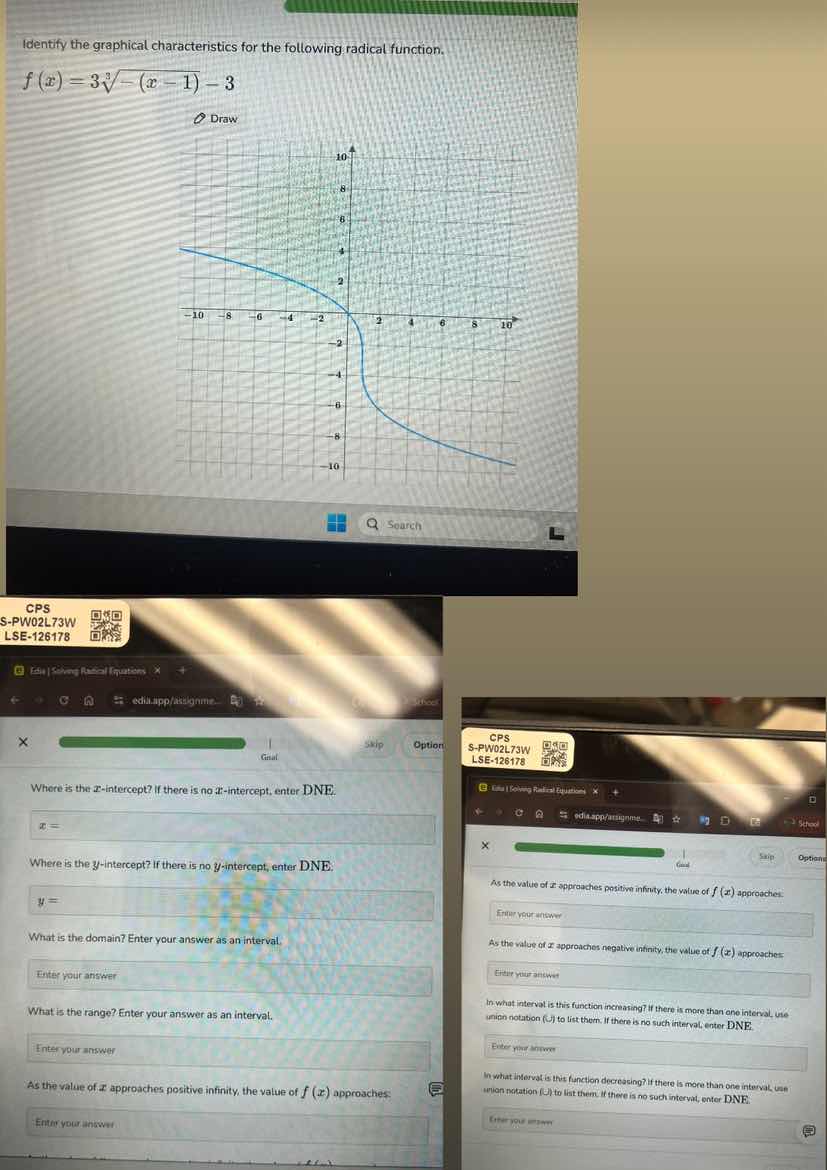
Question
identify the graphical characteristics for the following radical function.
$f(x)=3\sqrt3{-(x - 1)}-3$
where is the $x$-intercept? if there is no $x$-intercept, enter dne.
$x = $
where is the $y$-intercept? if there is no $y$-intercept, enter dne.
$y = $
what is the domain? enter your answer as an interval.
enter your answer
what is the range? enter your answer as an interval.
enter your answer
as the value of $x$ approaches positive infinity, the value of $f(x)$ approaches:
enter your answer
as the value of $x$ approaches positive infinity, the value of $f(x)$ approaches:
enter your answer
as the value of $x$ approaches negative infinity, the value of $f(x)$ approaches:
enter your answer
in what interval is the function increasing? if there is more than one interval, use union notation (,) to list them. if there is no such interval, enter dne.
enter your answer
in what interval is the function decreasing? if there is more than one interval, use union notation (,) to list them. if there is no such interval, enter dne.
enter your answer
Step1: Find x-intercept (f(x)=0)
Set $3\sqrt[3]{-(x-1)} - 3 = 0$
$\sqrt[3]{-(x-1)} = 1$
$-(x-1) = 1^3 = 1$
$-x + 1 = 1$
$x = 0$
Step2: Find y-intercept (x=0)
$f(0) = 3\sqrt[3]{-(0-1)} - 3 = 3\sqrt[3]{1} - 3 = 3(1)-3=0$
Step3: Determine domain
Cube roots accept all real $x$, so domain is $(-\infty, \infty)$
Step4: Determine range
Cube roots output all real numbers, so range is $(-\infty, \infty)$
Step5: Limit as $x\to+\infty$
$\sqrt[3]{-(x-1)} = \sqrt[3]{-x+1} \to -\infty$
$3(-\infty)-3 \to -\infty$
Step6: Limit as $x\to-\infty$
$\sqrt[3]{-(x-1)} = \sqrt[3]{-x+1} \to +\infty$
$3(+\infty)-3 \to +\infty$
Step7: Find increasing/decreasing intervals
Rewrite $f(x) = 3(-(x-1))^{1/3} - 3 = 3(1-x)^{1/3} - 3$
Take derivative: $f'(x) = 3 \cdot \frac{1}{3}(1-x)^{-2/3}(-1) = -\frac{1}{(1-x)^{2/3}}$
$f'(x) < 0$ for all $x
eq 1$, so function is always decreasing.

Snap & solve any problem in the app
Get step-by-step solutions on Sovi AI
Photo-based solutions with guided steps
Explore more problems and detailed explanations
- $x$-intercept: $x = 0$
- $y$-intercept: $y = 0$
- Domain: $(-\infty, \infty)$
- Range: $(-\infty, \infty)$
- As $x\to+\infty$, $f(x)$ approaches: $-\infty$
- As $x\to-\infty$, $f(x)$ approaches: $+\infty$
- Increasing interval: DNE
- Decreasing interval: $(-\infty, \infty)$