QUESTION IMAGE
Question
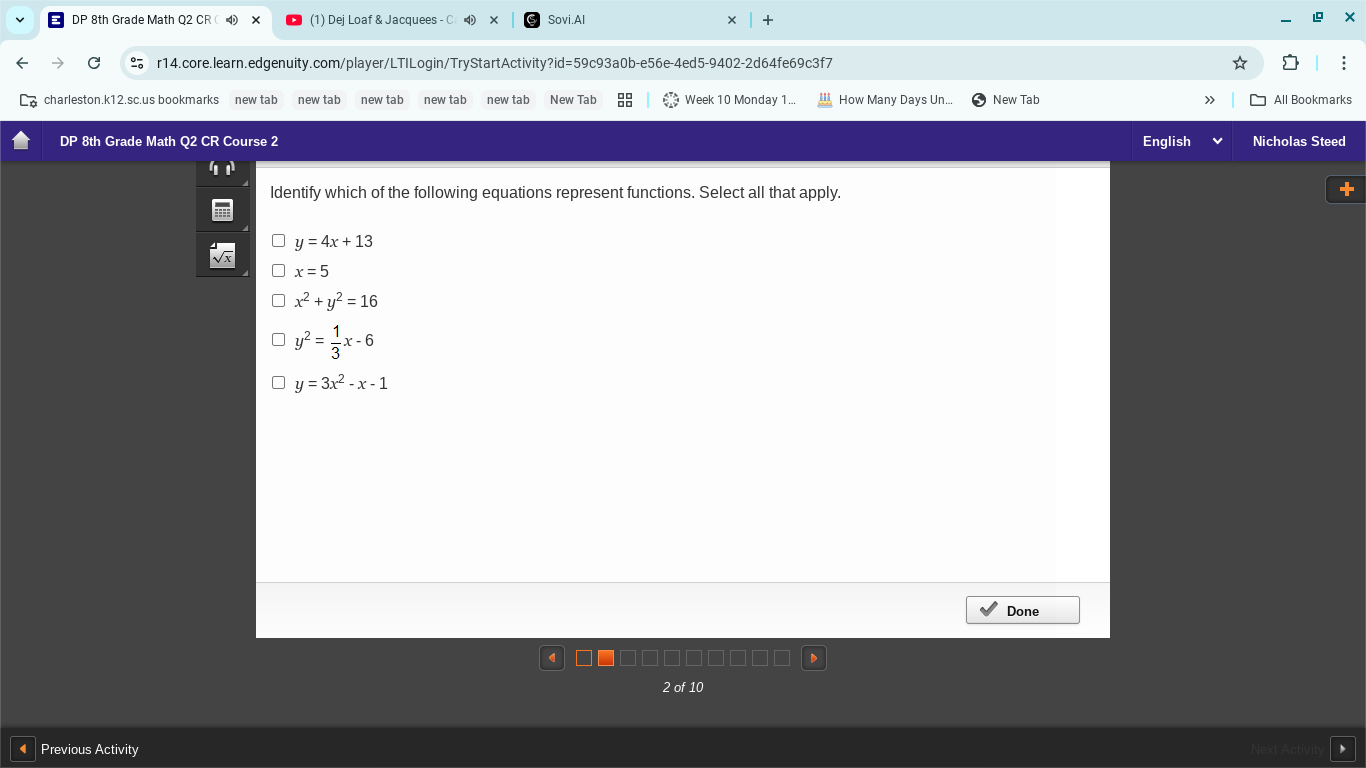
identify which of the following equations represent functions. select all that apply.
- ( y = 4x + 13 )
- ( x = 5 )
- ( x^2 + y^2 = 16 )
- ( y^2 = \frac{1}{3}x - 6 )
- ( y = 3x^2 - x - 1 )
To determine if an equation represents a function, we use the vertical line test: a relation is a function if no vertical line intersects its graph more than once.
Step1: Analyze \( y = 4x + 13 \)
This is a linear equation in slope - intercept form (\( y=mx + b \)). For every \( x \)-value, there is exactly one \( y \)-value. So, it passes the vertical line test.
Step2: Analyze \( x = 5 \)
The graph of \( x = 5 \) is a vertical line. A vertical line will intersect this graph at infinitely many points (all points with \( x = 5 \)). So, it fails the vertical line test and is not a function.
Step3: Analyze \( x^{2}+y^{2}=16 \)
This is the equation of a circle with radius \( r = 4 \) and center at the origin \((0,0)\). If we solve for \( y \), we get \( y=\pm\sqrt{16 - x^{2}}\). For a given \( x \)-value (between \(- 4\) and \(4\)), there are two \( y \)-values (one positive and one negative). So, it fails the vertical line test and is not a function.
Step4: Analyze \( y^{2}=\frac{1}{3}x - 6 \)
If we solve for \( y \), we get \( y=\pm\sqrt{\frac{1}{3}x - 6}\). For a valid \( x \)-value (where \(\frac{1}{3}x-6\geq0\) or \(x\geq18\)), there are two \( y \)-values (one positive and one negative). So, it fails the vertical line test and is not a function.
Step5: Analyze \( y = 3x^{2}-x - 1 \)
This is a quadratic equation. For every \( x \)-value, we can calculate exactly one \( y \)-value using the formula. So, it passes the vertical line test.

Snap & solve any problem in the app
Get step-by-step solutions on Sovi AI
Photo-based solutions with guided steps
Explore more problems and detailed explanations
The equations that represent functions are \( y = 4x + 13 \) and \( y = 3x^{2}-x - 1 \), so the correct options are:
- \( y = 4x + 13 \)
- \( y = 3x^{2}-x - 1 \)