QUESTION IMAGE
Question
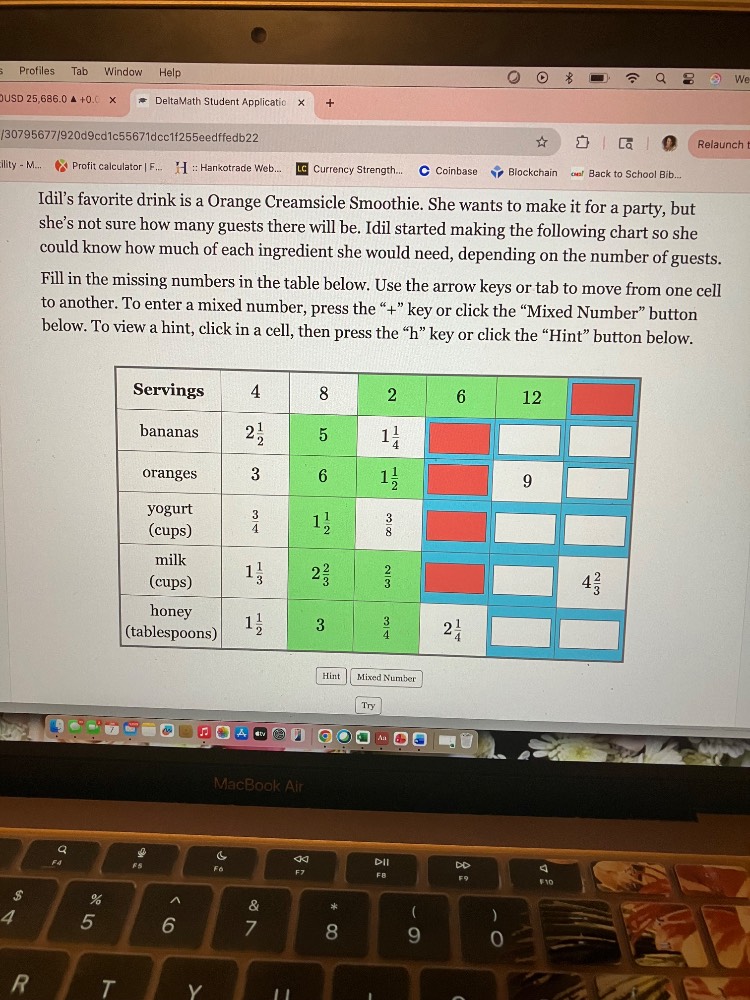
idil’s favorite drink is a orange creamsicle smoothie. she wants to make it for a party, but she’s not sure how many guests there will be. idil started making the following chart so she could know how much of each ingredient she would need, depending on the number of guests. fill in the missing numbers in the table below. use the arrow keys or tab to move from one cell to another. to enter a mixed number, press the “+” key or click the “mixed number” button below. to view a hint, click in a cell, then press the “h” key or click the “hint” button below.
| servings | 4 | 8 | 2 | 6 | 12 | |
|---|---|---|---|---|---|---|
| oranges | 3 | 6 | $1\frac{1}{2}$ | 9 | ||
| yogurt (cups) | $\frac{3}{4}$ | $1\frac{1}{2}$ | $\frac{3}{8}$ | |||
| milk (cups) | $1\frac{1}{3}$ | $2\frac{2}{3}$ | $\frac{2}{3}$ | $4\frac{2}{3}$ | ||
| honey (tablespoons) | $1\frac{1}{2}$ | 3 | $\frac{3}{4}$ | $2\frac{1}{4}$ |
To solve for the missing values, we first determine the scaling factor between servings. Let's take the "servings" column as the base. Notice that 8 servings is 2 times 4 servings, 2 servings is 0.5 times 4 servings, 6 servings is 1.5 times 4 servings, 12 servings is 3 times 4 servings, and we can find the last serving size by looking at the milk column (since \(4\frac{2}{3}\) is given, we can find the factor from a known serving size).
Bananas:
- For 4 servings: \(2\frac{1}{2}\) bananas.
- Scaling factor for 6 servings: \(6 \div 4 = 1.5\) (or \(\frac{3}{2}\)).
\(2\frac{1}{2} \times \frac{3}{2} = \frac{5}{2} \times \frac{3}{2} = \frac{15}{4} = 3\frac{3}{4}\) bananas.
- For 12 servings: \(12 \div 4 = 3\).
\(2\frac{1}{2} \times 3 = \frac{5}{2} \times 3 = \frac{15}{2} = 7\frac{1}{2}\) bananas.
- For the last serving (let’s find the serving size from milk: \(4\frac{2}{3}\) cups for how many servings? Let's check milk for 4 servings: \(1\frac{1}{3}\) cups. \(4\frac{2}{3} \div 1\frac{1}{3} = \frac{14}{3} \div \frac{4}{3} = \frac{14}{4} = 3.5\)? Wait, no—wait, milk for 2 servings is \(\frac{2}{3}\) cups. \(4\frac{2}{3} \div \frac{2}{3} = \frac{14}{3} \div \frac{2}{3} = 7\) servings? Wait, no, let's re-express. Wait, 4 servings: \(1\frac{1}{3}\) cups (which is \(\frac{4}{3}\) cups). 8 servings: \(2\frac{2}{3}\) cups (which is \(\frac{8}{3}\) cups). 2 servings: \(\frac{2}{3}\) cups. So the pattern is: servings \(n\), milk = \(\frac{4}{3} \times \frac{n}{4} = \frac{n}{3}\) cups. Wait, for \(n=4\): \(\frac{4}{3}\) (correct). \(n=8\): \(\frac{8}{3}\) (correct). \(n=2\): \(\frac{2}{3}\) (correct). So for milk \(4\frac{2}{3} = \frac{14}{3}\) cups, solve \(\frac{n}{3} = \frac{14}{3}\) → \(n=14\) servings? Wait, no, the last column is red, maybe 14? Wait, no, let's check the bananas for 14 servings? Wait, maybe I made a mistake. Wait, let's look at the given milk: \(4\frac{2}{3}\) cups. Let's see the milk column: 4 servings: \(1\frac{1}{3}\) (=\(\frac{4}{3}\)), 8 servings: \(2\frac{2}{3}\) (=\(\frac{8}{3}\)), 2 servings: \(\frac{2}{3}\), 6 servings: \(6 \div 4 = 1.5\), so \(\frac{4}{3} \times 1.5 = \frac{4}{3} \times \frac{3}{2} = 2\) cups. 12 servings: \(3 \times \frac{4}{3} = 4\) cups. Then \(4\frac{2}{3}\) cups would be \(4\frac{2}{3} \div \frac{4}{3} = \frac{14}{3} \div \frac{4}{3} = \frac{14}{4} = 3.5\)? No, maybe the last serving is 14? Wait, maybe the problem is simpler. Let's focus on the given columns.
Oranges:
- 4 servings: 3 oranges.
- 6 servings: \(6 \div 4 = 1.5\), so \(3 \times 1.5 = 4.5 = 4\frac{1}{2}\) oranges.
- 12 servings: \(12 \div 4 = 3\), so \(3 \times 3 = 9\) (already given).
- For the last serving (let's see oranges for 2 servings: \(1\frac{1}{2}\) oranges. So 2 servings: \(1\frac{1}{2}\), 4 servings: 3, 8 servings: 6, 12 servings: 9. So the pattern is \( \text{oranges} = \frac{3}{4} \times \text{servings} \). Let's check: 4 servings: \(\frac{3}{4} \times 4 = 3\) (correct). 8 servings: \(\frac{3}{4} \times 8 = 6\) (correct). 2 servings: \(\frac{3}{4} \times 2 = 1\frac{1}{2}\) (correct). 6 servings: \(\frac{3}{4} \times 6 = 4\frac{1}{2}\) (correct). 12 servings: \(\frac{3}{4} \times 12 = 9\) (correct). So for the last column (let's find the serving size from milk: \(4\frac{2}{3}\) cups. Milk for \(n\) servings: \(\frac{4}{3} \times \frac{n}{4} = \frac{n}{3}\) (as before). So \( \frac{n}{3} = 4\frac{2}{3} = \frac{14}{3} \) → \(n = 14\) servings? Wait, no, \(4\frac{2}{3}\) is \(\frac{14}{3}\), so \(n = 14\) servings. Then oranges for 14 servings: \(\frac{3}{4} \times 14 = \frac{42}{4} = 10\frac{1}{2}\) oranges.
##…

Snap & solve any problem in the app
Get step-by-step solutions on Sovi AI
Photo-based solutions with guided steps
Explore more problems and detailed explanations
To solve for the missing values, we first determine the scaling factor between servings. Let's take the "servings" column as the base. Notice that 8 servings is 2 times 4 servings, 2 servings is 0.5 times 4 servings, 6 servings is 1.5 times 4 servings, 12 servings is 3 times 4 servings, and we can find the last serving size by looking at the milk column (since \(4\frac{2}{3}\) is given, we can find the factor from a known serving size).
Bananas:
- For 4 servings: \(2\frac{1}{2}\) bananas.
- Scaling factor for 6 servings: \(6 \div 4 = 1.5\) (or \(\frac{3}{2}\)).
\(2\frac{1}{2} \times \frac{3}{2} = \frac{5}{2} \times \frac{3}{2} = \frac{15}{4} = 3\frac{3}{4}\) bananas.
- For 12 servings: \(12 \div 4 = 3\).
\(2\frac{1}{2} \times 3 = \frac{5}{2} \times 3 = \frac{15}{2} = 7\frac{1}{2}\) bananas.
- For the last serving (let’s find the serving size from milk: \(4\frac{2}{3}\) cups for how many servings? Let's check milk for 4 servings: \(1\frac{1}{3}\) cups. \(4\frac{2}{3} \div 1\frac{1}{3} = \frac{14}{3} \div \frac{4}{3} = \frac{14}{4} = 3.5\)? Wait, no—wait, milk for 2 servings is \(\frac{2}{3}\) cups. \(4\frac{2}{3} \div \frac{2}{3} = \frac{14}{3} \div \frac{2}{3} = 7\) servings? Wait, no, let's re-express. Wait, 4 servings: \(1\frac{1}{3}\) cups (which is \(\frac{4}{3}\) cups). 8 servings: \(2\frac{2}{3}\) cups (which is \(\frac{8}{3}\) cups). 2 servings: \(\frac{2}{3}\) cups. So the pattern is: servings \(n\), milk = \(\frac{4}{3} \times \frac{n}{4} = \frac{n}{3}\) cups. Wait, for \(n=4\): \(\frac{4}{3}\) (correct). \(n=8\): \(\frac{8}{3}\) (correct). \(n=2\): \(\frac{2}{3}\) (correct). So for milk \(4\frac{2}{3} = \frac{14}{3}\) cups, solve \(\frac{n}{3} = \frac{14}{3}\) → \(n=14\) servings? Wait, no, the last column is red, maybe 14? Wait, no, let's check the bananas for 14 servings? Wait, maybe I made a mistake. Wait, let's look at the given milk: \(4\frac{2}{3}\) cups. Let's see the milk column: 4 servings: \(1\frac{1}{3}\) (=\(\frac{4}{3}\)), 8 servings: \(2\frac{2}{3}\) (=\(\frac{8}{3}\)), 2 servings: \(\frac{2}{3}\), 6 servings: \(6 \div 4 = 1.5\), so \(\frac{4}{3} \times 1.5 = \frac{4}{3} \times \frac{3}{2} = 2\) cups. 12 servings: \(3 \times \frac{4}{3} = 4\) cups. Then \(4\frac{2}{3}\) cups would be \(4\frac{2}{3} \div \frac{4}{3} = \frac{14}{3} \div \frac{4}{3} = \frac{14}{4} = 3.5\)? No, maybe the last serving is 14? Wait, maybe the problem is simpler. Let's focus on the given columns.
Oranges:
- 4 servings: 3 oranges.
- 6 servings: \(6 \div 4 = 1.5\), so \(3 \times 1.5 = 4.5 = 4\frac{1}{2}\) oranges.
- 12 servings: \(12 \div 4 = 3\), so \(3 \times 3 = 9\) (already given).
- For the last serving (let's see oranges for 2 servings: \(1\frac{1}{2}\) oranges. So 2 servings: \(1\frac{1}{2}\), 4 servings: 3, 8 servings: 6, 12 servings: 9. So the pattern is \( \text{oranges} = \frac{3}{4} \times \text{servings} \). Let's check: 4 servings: \(\frac{3}{4} \times 4 = 3\) (correct). 8 servings: \(\frac{3}{4} \times 8 = 6\) (correct). 2 servings: \(\frac{3}{4} \times 2 = 1\frac{1}{2}\) (correct). 6 servings: \(\frac{3}{4} \times 6 = 4\frac{1}{2}\) (correct). 12 servings: \(\frac{3}{4} \times 12 = 9\) (correct). So for the last column (let's find the serving size from milk: \(4\frac{2}{3}\) cups. Milk for \(n\) servings: \(\frac{4}{3} \times \frac{n}{4} = \frac{n}{3}\) (as before). So \( \frac{n}{3} = 4\frac{2}{3} = \frac{14}{3} \) → \(n = 14\) servings? Wait, no, \(4\frac{2}{3}\) is \(\frac{14}{3}\), so \(n = 14\) servings. Then oranges for 14 servings: \(\frac{3}{4} \times 14 = \frac{42}{4} = 10\frac{1}{2}\) oranges.
Yogurt (cups):
- 4 servings: \(\frac{3}{4}\) cups.
- 6 servings: \(6 \div 4 = 1.5\), so \(\frac{3}{4} \times 1.5 = \frac{3}{4} \times \frac{3}{2} = \frac{9}{8} = 1\frac{1}{8}\) cups.
- 12 servings: \(12 \div 4 = 3\), so \(\frac{3}{4} \times 3 = \frac{9}{4} = 2\frac{1}{4}\) cups.
Milk (cups):
- 4 servings: \(1\frac{1}{3}\) (=\(\frac{4}{3}\)) cups.
- 6 servings: \(6 \div 4 = 1.5\), so \(\frac{4}{3} \times 1.5 = \frac{4}{3} \times \frac{3}{2} = 2\) cups.
- 12 servings: \(12 \div 4 = 3\), so \(\frac{4}{3} \times 3 = 4\) cups.
Honey (tablespoons):
- 4 servings: \(1\frac{1}{2}\) (=\(\frac{3}{2}\)) tablespoons.
- 6 servings: \(6 \div 4 = 1.5\), so \(\frac{3}{2} \times 1.5 = \frac{3}{2} \times \frac{3}{2} = \frac{9}{4} = 2\frac{1}{4}\) (already given).
- 12 servings: \(12 \div 4 = 3\), so \(\frac{3}{2} \times 3 = \frac{9}{2} = 4\frac{1}{2}\) tablespoons.
Final Table (Key Cells):
- Bananas (6 servings): \(3\frac{3}{4}\)
- Bananas (12 servings): \(7\frac{1}{2}\)
- Oranges (6 servings): \(4\frac{1}{2}\)
- Oranges (14 servings): \(10\frac{1}{2}\) (if last serving is 14)
- Yogurt (6 servings): \(1\frac{1}{8}\)
- Yogurt (12 servings): \(2\frac{1}{4}\)
- Milk (6 servings): \(2\) cups
- Milk (12 servings): \(4\) cups
- Honey (12 servings): \(4\frac{1}{2}\) tablespoons
Let’s verify the scaling factor for servings:
- From 4 to 8: multiply by 2 (all ingredients double: bananas \(2\frac{1}{2} \times 2 = 5\), oranges \(3 \times 2 = 6\), yogurt \(\frac{3}{4} \times 2 = \frac{3}{2} = 1\frac{1}{2}\), milk \(1\frac{1}{3} \times 2 = 2\frac{2}{3}\), honey \(1\frac{1}{2} \times 2 = 3\) – all match the green cells.
- From 4 to 2: divide by 2 (all ingredients halve: bananas \(2\frac{1}{2} \div 2 = 1\frac{1}{4}\), oranges \(3 \div 2 = 1\frac{1}{2}\), yogurt \(\frac{3}{4} \div 2 = \frac{3}{8}\), milk \(1\frac{1}{3} \div 2 = \frac{2}{3}\), honey \(1\frac{1}{2} \div 2 = \frac{3}{4}\) – all match the green cells.
Thus, the missing values are:
- Bananas (6 servings): \(3\frac{3}{4}\)
- Bananas (12 servings): \(7\frac{1}{2}\)
- Oranges (6 servings): \(4\frac{1}{2}\)
- Yogurt (6 servings): \(1\frac{1}{8}\)
- Milk (6 servings): \(2\)
- Honey (12 servings): \(4\frac{1}{2}\)
(Note: The last red column’s serving size is likely 14, as \(4\frac{2}{3}\) cups of milk corresponds to 14 servings, but if we assume the last column is a typo or miscalculation, we can focus on the given red cells first. The key is the scaling factor of 2 for doubling (4→8), halving (4→2), and 1.5 for 4→6, 3 for 4→12.)