QUESTION IMAGE
Question
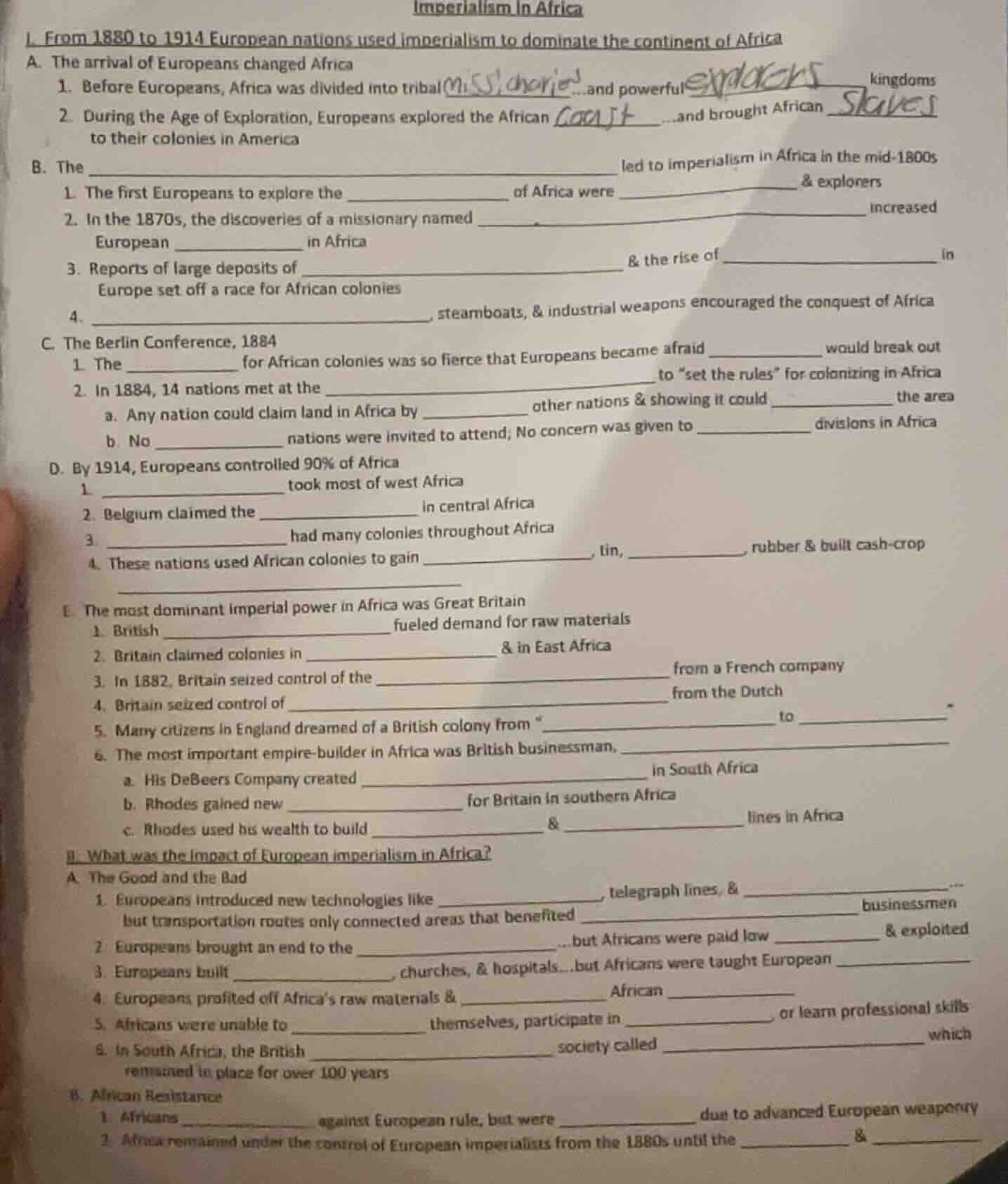
imperialism in africa
i. from 1880 to 1914 european nations used imperialism to dominate the continent of africa
a. the arrival of europeans changed africa
- before europeans, africa was divided into tribal ____ and powerful ____ kingdoms
- during the age of exploration, europeans explored the african ____ and brought african ____ to their colonies in america
b. the ______ led to imperialism in africa in the mid - 1800s
- the first europeans to explore the ____ of africa were ____ & explorers
- in the 1870s, the discoveries of a missionary named ____ increased european ____ in africa
- reports of large deposits of ____ & the rise of ____ in europe set off a race for african colonies
- ______, steamboats, & industrial weapons encouraged the conquest of africa
c. the berlin conference, 1884
- the ____ for african colonies was so fierce that europeans became afraid ____ would break out
- in 1884, 14 nations met at the ______ to “set the rules” for colonizing in africa
a. any nation could claim land in africa by ____ other nations & showing it could ____ the area
b. no ____ nations were invited to attend; no concern was given to ____ divisions in africa
d. by 1914, europeans controlled 90% of africa
- ______ took most of west africa
- belgium claimed the ______ in central africa
- ______ had many colonies throughout africa
- these nations used african colonies to gain ____, tin, __, rubber & built cash - crop ____
e. the most dominant imperial power in africa was great britain
- british ______ fueled demand for raw materials
- britain claimed colonies in ______ & in east africa
- in 1882, britain seized control of the ______ from a french company
- britain seized control of ______ from the dutch
- many citizens in england dreamed of a british colony from “____ to ____”
- the most important empire - builder in africa was british businessman, ______
a. his debeers company created ______ in south africa
b. rhodes gained new ______ for britain in southern africa
c. rhodes used his wealth to build ____ & ____ lines in africa
ii. what was the impact of european imperialism in africa?
a. the good and the bad
- europeans introduced new technologies like ____, telegraph lines, & __ but transportation routes only connected areas that benefited ____ businessmen
- europeans brought an end to the ____ but africans were paid low ____ & exploited
- europeans built ____, churches, & hospitals but africans were taught european ____
- europeans profited off africa’s raw materials & ____ african ____
- africans were unable to ____ themselves, participate in ____ or learn professional skills
- in south africa, the british ____ society called ____ which remained in place for over 100 years
b. african resistance
- africans ____ against european rule, but were ____ due to advanced european weaponry
- africa remained under the control of european imperialists from the 1880s until the ____ & ____
This is a fill-in-the-blank worksheet about European imperialism in Africa, covering key causes, events, participants, and impacts. The answers are based on standard historical facts about this period.

Snap & solve any problem in the app
Get step-by-step solutions on Sovi AI
Photo-based solutions with guided steps
Explore more problems and detailed explanations
I. From 1880 to 1914 European nations used imperialism to dominate the continent of Africa
A. The arrival of Europeans changed Africa
- Before Europeans, Africa was divided into tribal societies and powerful independent kingdoms
- During the Age of Exploration, Europeans explored the African coast and brought African enslaved people to their colonies in America
B. The spread of European industrialization led to imperialism in Africa in the mid-1800s
- The first Europeans to explore the interior of Africa were missionaries & explorers
- In the 1870s, the discoveries of a missionary named David Livingstone increased European interest in Africa
- Reports of large deposits of gold and diamonds & the rise of nationalism in Europe set off a race for African colonies
- Improved transportation, steamboats, & industrial weapons encouraged the conquest of Africa
C. The Berlin Conference, 1884
- The competition for African colonies was so fierce that Europeans became afraid war would break out
- In 1884, 14 nations met at the Berlin Conference to "set the rules" for colonizing in Africa
a. Any nation could claim land in Africa by notifying other nations & showing it could control the area
b. No African nations were invited to attend; No concern was given to existing tribal divisions in Africa
D. By 1914, Europeans controlled 90% of Africa
- France took most of west Africa
- Belgium claimed the Congo Free State in central Africa
- Great Britain had many colonies throughout Africa
- These nations used African colonies to gain gold, tin, copper, rubber & built cash-crop plantations
E. The most dominant imperial power in Africa was Great Britain
- British industrialization fueled demand for raw materials
- Britain claimed colonies in West Africa & in East Africa
- In 1882, Britain seized control of the Suez Canal from a French company
- Britain seized control of South Africa from the Dutch
- Many citizens in England dreamed of a British colony from "Cairo to Cape Town"
- The most important empire-builder in Africa was British businessman, Cecil Rhodes
a. His DeBeers Company created a diamond monopoly in South Africa
b. Rhodes gained new territories for Britain in southern Africa
c. Rhodes used his wealth to build railroads & telegraph lines in Africa
II. What was the impact of European imperialism in Africa?
A. The Good and the Bad
- Europeans introduced new technologies like railroads, telegraph lines, & medicine... but transportation routes only connected areas that benefited European businessmen
- Europeans brought an end to the slave trade...but Africans were paid low wages & exploited
- Europeans built schools, churches, & hospitals...but Africans were taught European culture and values
- Europeans profited off Africa's raw materials & undermined African economies
- Africans were unable to govern themselves, participate in politics, or learn professional skills
- In South Africa, the British segregated society called apartheid which remained in place for over 100 years
B. African Resistance
- Africans fought against European rule, but were defeated due to advanced European weaponry
- Africa remained under the control of European imperialists from the 1880s until the 1950s & 1960s