QUESTION IMAGE
Question
5.4 independent practice
teks 7.6.c, 7.6.h, 7.6.i
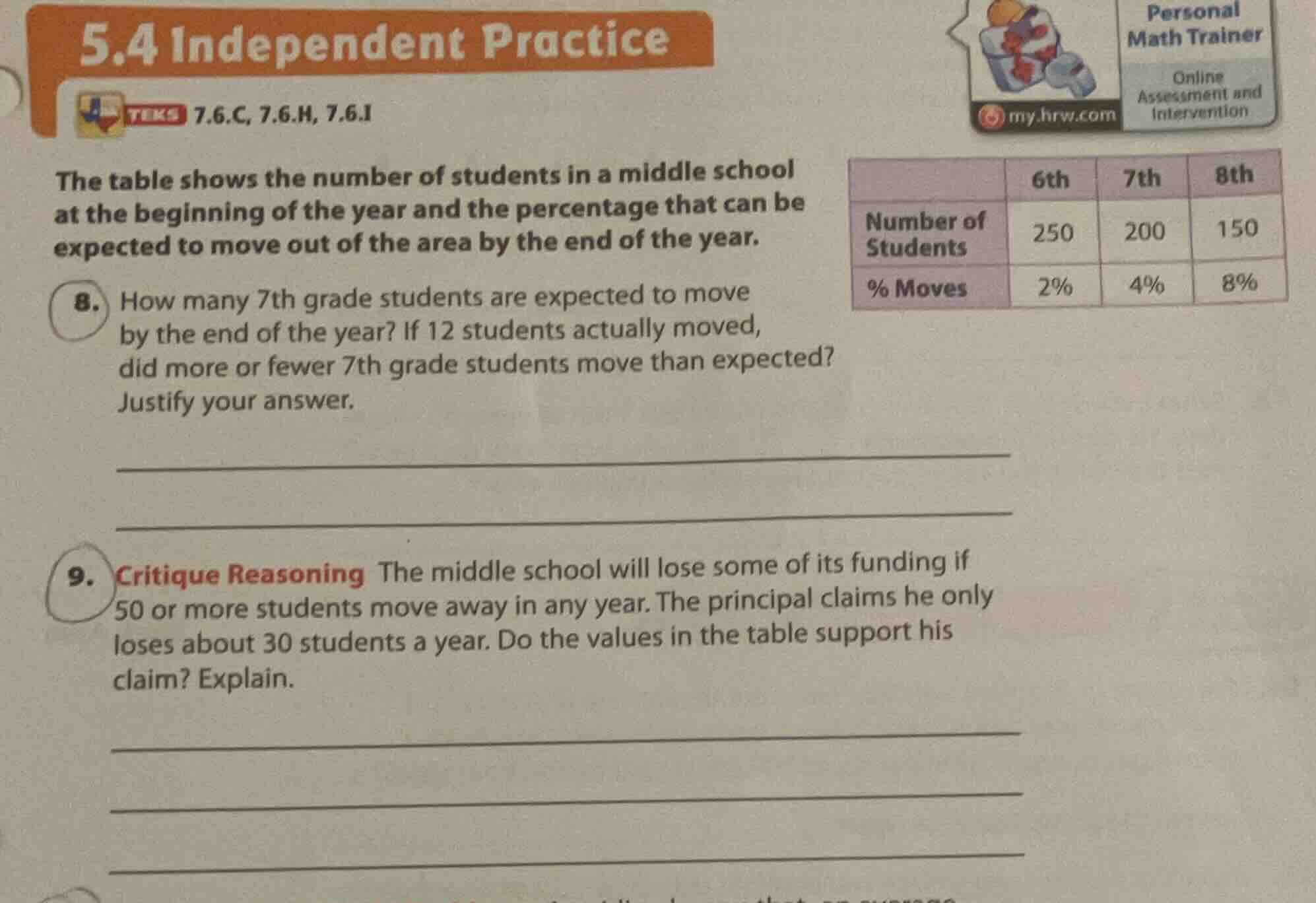
the table shows the number of students in a middle school at the beginning of the year and the percentage that can be expected to move out of the area by the end of the year.
- how many 7th grade students are expected to move by the end of the year? if 12 students actually moved, did more or fewer 7th grade students move than expected? justify your answer.
- critique reasoning the middle school will lose some of its funding if 50 or more students move away in any year. the principal claims he only loses about 30 students a year. do the values in the table support his claim? explain.
| 6th | 7th | 8th | |
|---|---|---|---|
| % moves | 2% | 4% | 8% |
Question 8
Step1: Calculate expected 7th grade moves
To find the expected number of 7th grade students to move, we use the formula: \( \text{Expected} = \text{Number of Students} \times \text{\% Moves (as a decimal)} \). For 7th grade, number of students is 200 and % moves is 4% or 0.04. So, \( 200 \times 0.04 = 8 \).
Step2: Compare actual and expected
Actual moves are 12. Since \( 12 > 8 \), more students moved than expected.
Step1: Calculate total expected moves
- 6th grade: \( 250 \times 0.02 = 5 \)
- 7th grade: \( 200 \times 0.04 = 8 \)
- 8th grade: \( 150 \times 0.08 = 12 \)
Step2: Sum the expected moves
Total expected moves: \( 5 + 8 + 12 = 25 \)
Step3: Compare to principal's claim
The principal claims about 30, but the total expected is 25. However, 25 is close to 30, but actually less. Wait, wait, recalculate: 2500.02=5, 2000.04=8, 1500.08=12. Sum: 5+8=13, 13+12=25. So total expected is 25, which is less than 30? Wait, no, the principal says "about 30", but the calculation shows 25. Wait, maybe I miscalculated. Wait 2502%: 2500.02=5. 2004%=8. 1508%=12. 5+8=13, 13+12=25. So total expected is 25, which is less than 30? But the principal claims he loses about 30. Wait, maybe the question is if the total is 50 or more, but here we calculate total expected moves. So total expected is 5 + 8 + 12 = 25. The principal claims about 30, but 25 is less than 30? Wait, no, maybe I made a mistake. Wait 2500.02=5, 2000.04=8, 1500.08=12. 5+8=13, 13+12=25. So total expected is 25, which is less than 30. But the principal says "about 30", but the table's values give 25. So the values do not support his claim because the total expected is 25, which is less than 30. Wait, but maybe the principal is wrong? Wait, the question is "Do the values in the table support his claim? Explain." So calculate total expected: 5 (6th) + 8 (7th) + 12 (8th) = 25. The principal claims about 30, but 25 is not about 30 (it's 5 less). So the values do not support his claim because the total expected number of students moving is 25, which is less than 30.

Snap & solve any problem in the app
Get step-by-step solutions on Sovi AI
Photo-based solutions with guided steps
Explore more problems and detailed explanations
Expected: 8 students. More students moved (12 > 8).