QUESTION IMAGE
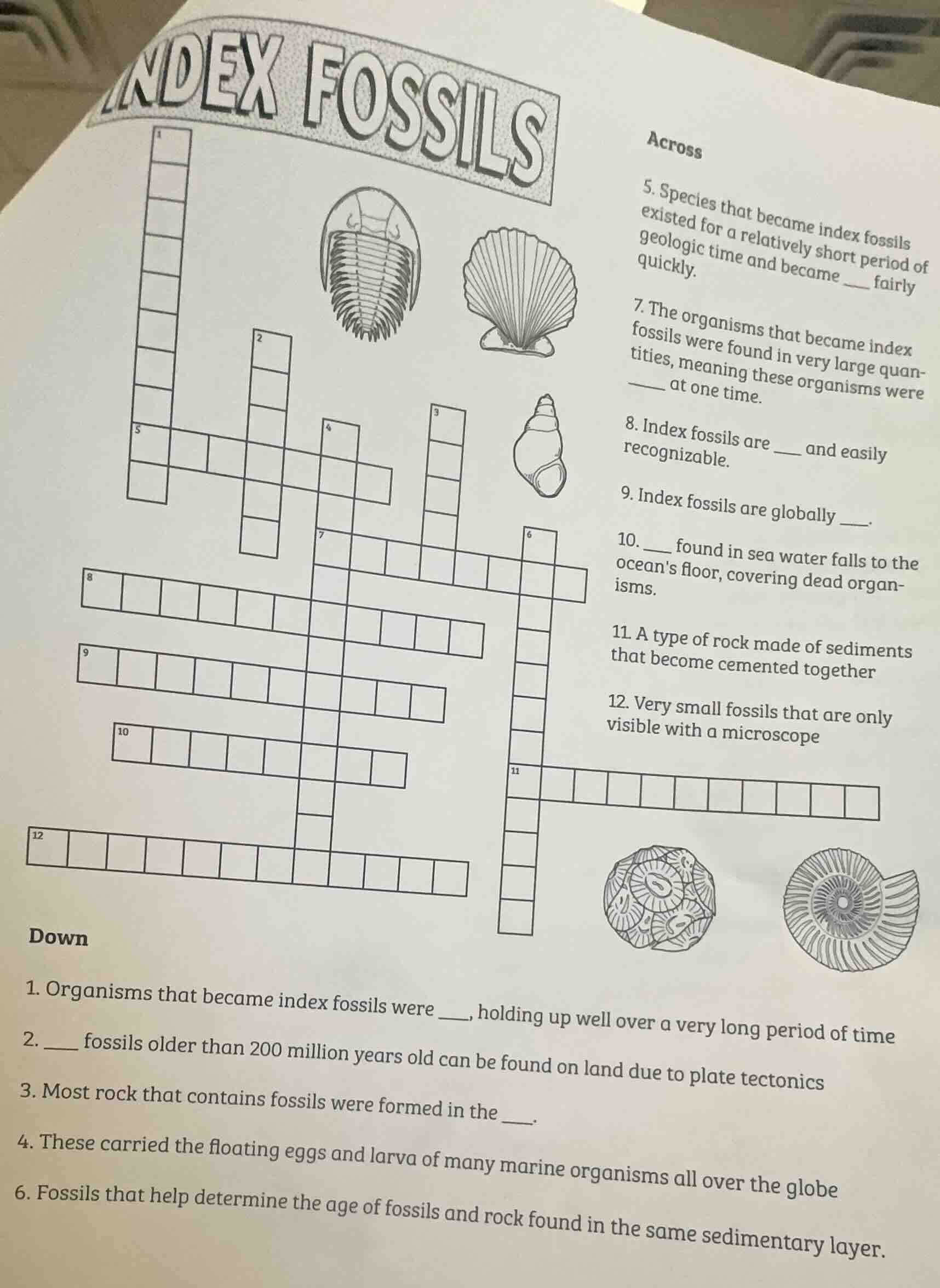
Question
index fossils
across
- species that became index fossils existed for a relatively short period of geologic time and became ___ fairly quickly.
- the organisms that became index fossils were found in very large quantities, meaning these organisms were ___ at one time.
- index fossils are ___ and easily recognizable.
- index fossils are globally ___.
- ___ found in sea water falls to the oceans floor, covering dead organisms.
- a type of rock made of sediments that become cemented together
- very small fossils that are only visible with a microscope
down
- organisms that became index fossils were ___, holding up well over a very long period of time
- ___ fossils older than 200 million years old can be found on land due to plate tectonics
- most rock that contains fossils were formed in the ___.
- these carried the floating eggs and larva of many marine organisms all over the globe
- fossils that help determine the age of fossils and rock found in the same sedimentary layer.
Brief Explanations
Each answer matches the definition provided for the crossword, based on paleontology/geology concepts related to index fossils:
- Down 1: Index fossil organisms need to be durable to fossilize well over time.
- Down 2: Marine fossils can end up on land due to plate tectonics shifting ocean floors upward.
- Down 3: Most fossil-bearing rocks form in oceans, where sediment accumulates to bury organisms.
- Down 4: Ocean currents carry marine larvae/eggs globally, helping index fossils spread widely.
- Down 6: Index fossils are defined by their ability to date associated rocks/fossils.
- Across 5: Index fossil species spread widely (became abundant) quickly over a short geologic time.
- Across 7: Index fossils come from organisms that were widespread (numerous across large areas).
- Across 8: Index fossils must be distinct and easy to identify.
- Across 9: Index fossils are found across the entire globe (widespread geographically).
- Across 10: Sediment in seawater falls to the ocean floor to cover dead organisms.
- Across 11: Sedimentary rock forms from cemented sediments, where fossils are typically found.
- Across 12: Microfossils are tiny fossils only visible with a microscope.

Snap & solve any problem in the app
Get step-by-step solutions on Sovi AI
Photo-based solutions with guided steps
Explore more problems and detailed explanations
Across
- ABUNDANT
- WIDESPREAD
- DISTINCT
- DISTRIBUTED
- SEDIMENT
- SEDIMENTARY
- MICROFOSSILS
Down
- DURABLE
- MARINE
- OCEAN
- CURRENTS
- INDEX