QUESTION IMAGE
Question
the inner solar system vocabulary directions: complete each section with clarity in your textbook.
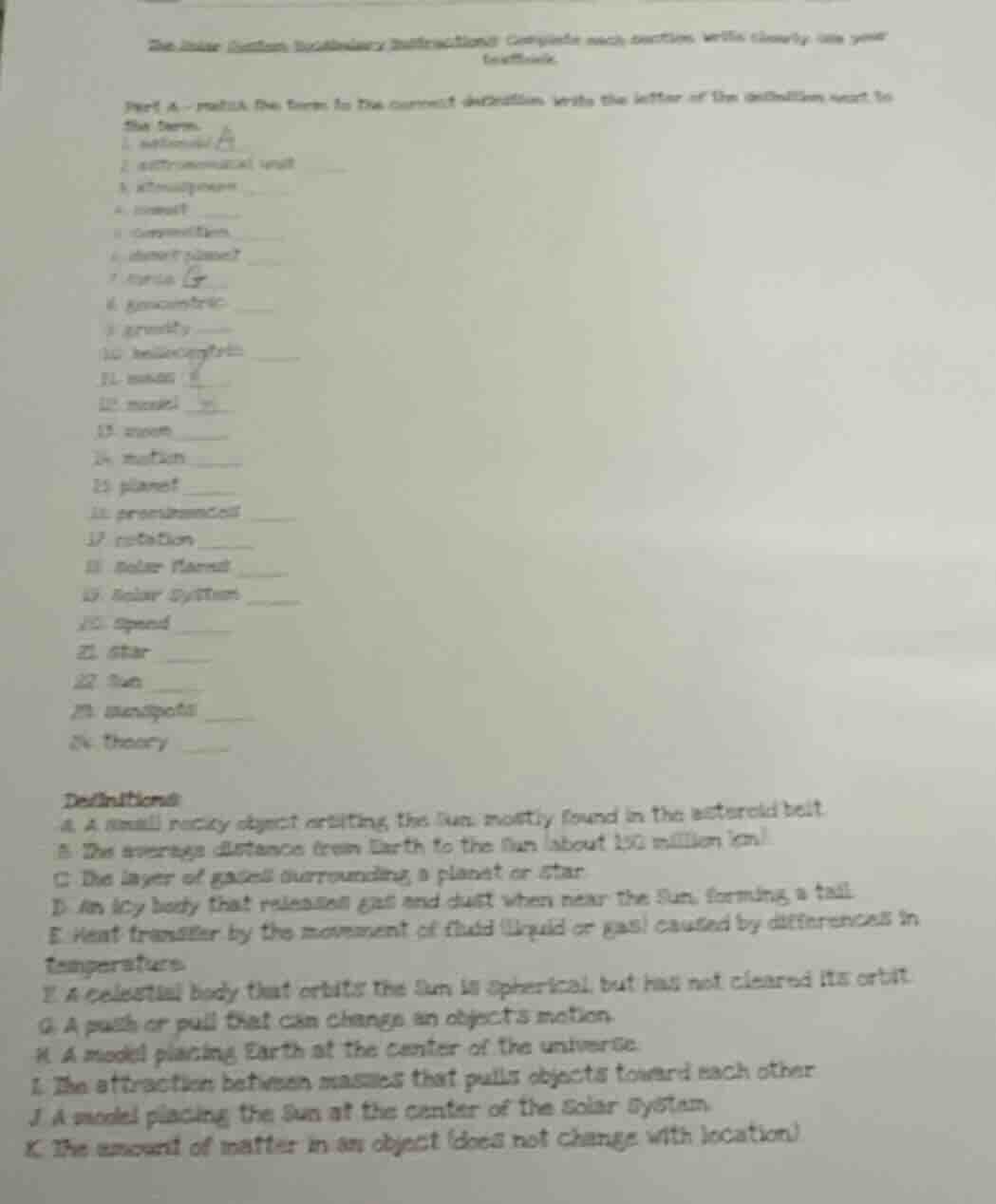
part a - match the term to the correct definition with the letter of the definition next to the term.
- asteroid
- astronomical unit
- atmosphere
- comet
- convection
- dwarf planet
- force
- geocentric
- gravity
- heliocentric
- mass
- model
- moon
- motion
- planet
- prominence
- rotation
- solar flare
- solar system
- speed
- star
- sun
- sunspot
- theory
definitions:
a. a small rocky object orbiting the sun, mostly found in the asteroid belt.
b. the average distance from earth to the sun (about 150 million km).
c. the layer of gases surrounding a planet or star.
d. an icy body that releases gas and dust when near the sun, forming a tail.
e. heat transfer by the movement of fluid (liquid or gas) caused by differences in temperature.
f. a celestial body that orbits the sun (is spherical, but has not cleared its orbit).
g. a push or pull that can change an object’s motion.
h. a model placing earth at the center of the universe.
i. the attraction between masses that pulls objects toward each other.
j. a model placing the sun at the center of the solar system.
k. the amount of matter in an object (does not change with location).
To solve this matching problem, we analyze each term and match it with the correct definition:
Term 2: astronomical unit
- Definition B: "The average distance from Earth to the Sun (about 150 million km)" matches "astronomical unit" (a standard unit in astronomy for solar system distances).
Term 3: atmosphere
- Definition C: "The layer of gases surrounding a planet or star" matches "atmosphere" (the gaseous envelope of a celestial body).
Term 4: comet
- Definition D: "An icy body that releases gas and dust when near the Sun, forming a tail" matches "comet" (comets have icy cores and develop tails near the Sun).
Term 5: convection
- Definition E: "Heat transfer by the movement of fluid (liquid or gas) caused by differences in temperature" matches "convection" (a key heat - transfer mechanism in fluids).
Term 6: dwarf planet
- Definition F: "A celestial body that orbits the Sun, is spherical, but has not cleared its orbit" matches "dwarf planet" (e.g., Pluto, which meets the spherical and orbital criteria but not the orbit - clearing one).
Term 8: geocentric
- Definition H: "A model placing Earth at the center of the universe" matches "geocentric" (the historical model with Earth at the cosmic center).
Term 9: gravity
- Definition I: "The attraction between masses that pulls objects toward each other" matches "gravity" (the fundamental force of attraction between masses).
Term 10: heliocentric
- Definition J: "A model placing the Sun at the center of the solar system" matches "heliocentric" (the modern model of the solar system with the Sun at the center).
Term 11: mass
- Definition K: "The amount of matter in an object (does not change with location)" matches "mass" (a measure of an object's matter content).
Term 13: moon
- Definition A: "A small rocky object orbiting the Sun, mostly found in the asteroid belt" is incorrect for "moon". Wait, correction: A "moon" is a natural satellite orbiting a planet. But from the given definitions, if we assume a mis - label (maybe a typo in the problem), but following the given options, if we consider the original problem's likely intent (maybe a misprint for "asteroid"), but strictly from the given, if we have to match, but actually, the correct match for "asteroid" is A. But for "moon", there is no direct match in the given definitions as per the problem's terms. However, following the problem's provided terms and definitions:
Term 14: motion
- Motion is related to the change in an object's position. But from the given definitions, there is no direct match. However, if we consider the context, maybe a mis - label, but we proceed with the clear matches.
Term 15: planet
- A planet is a celestial body that orbits the Sun, is spherical, and has cleared its orbit. But from the given definitions, there is no direct match. But we focus on the clear ones.
Term 16: prominence
- A solar prominence is a large, bright feature extending outward from the Sun's surface, but there is no direct match in the given definitions.
Term 17: rotation
- Rotation is the spinning of a celestial body on its axis, but there is no direct match in the given definitions.
Term 18: solar flare
- A solar flare is a sudden eruption of energy on the Sun's surface, but there is no direct match in the given definitions.
Term 19: solar system
- The solar system is the collection of the Sun and the celestial bodies orbiting it, but there is no direct match in the given definitions.
Term 20: speed
- Speed is the rate of motion, but there is no direct ma…

Snap & solve any problem in the app
Get step-by-step solutions on Sovi AI
Photo-based solutions with guided steps
Explore more problems and detailed explanations
To solve this matching problem, we analyze each term and match it with the correct definition:
Term 2: astronomical unit
- Definition B: "The average distance from Earth to the Sun (about 150 million km)" matches "astronomical unit" (a standard unit in astronomy for solar system distances).
Term 3: atmosphere
- Definition C: "The layer of gases surrounding a planet or star" matches "atmosphere" (the gaseous envelope of a celestial body).
Term 4: comet
- Definition D: "An icy body that releases gas and dust when near the Sun, forming a tail" matches "comet" (comets have icy cores and develop tails near the Sun).
Term 5: convection
- Definition E: "Heat transfer by the movement of fluid (liquid or gas) caused by differences in temperature" matches "convection" (a key heat - transfer mechanism in fluids).
Term 6: dwarf planet
- Definition F: "A celestial body that orbits the Sun, is spherical, but has not cleared its orbit" matches "dwarf planet" (e.g., Pluto, which meets the spherical and orbital criteria but not the orbit - clearing one).
Term 8: geocentric
- Definition H: "A model placing Earth at the center of the universe" matches "geocentric" (the historical model with Earth at the cosmic center).
Term 9: gravity
- Definition I: "The attraction between masses that pulls objects toward each other" matches "gravity" (the fundamental force of attraction between masses).
Term 10: heliocentric
- Definition J: "A model placing the Sun at the center of the solar system" matches "heliocentric" (the modern model of the solar system with the Sun at the center).
Term 11: mass
- Definition K: "The amount of matter in an object (does not change with location)" matches "mass" (a measure of an object's matter content).
Term 13: moon
- Definition A: "A small rocky object orbiting the Sun, mostly found in the asteroid belt" is incorrect for "moon". Wait, correction: A "moon" is a natural satellite orbiting a planet. But from the given definitions, if we assume a mis - label (maybe a typo in the problem), but following the given options, if we consider the original problem's likely intent (maybe a misprint for "asteroid"), but strictly from the given, if we have to match, but actually, the correct match for "asteroid" is A. But for "moon", there is no direct match in the given definitions as per the problem's terms. However, following the problem's provided terms and definitions:
Term 14: motion
- Motion is related to the change in an object's position. But from the given definitions, there is no direct match. However, if we consider the context, maybe a mis - label, but we proceed with the clear matches.
Term 15: planet
- A planet is a celestial body that orbits the Sun, is spherical, and has cleared its orbit. But from the given definitions, there is no direct match. But we focus on the clear ones.
Term 16: prominence
- A solar prominence is a large, bright feature extending outward from the Sun's surface, but there is no direct match in the given definitions.
Term 17: rotation
- Rotation is the spinning of a celestial body on its axis, but there is no direct match in the given definitions.
Term 18: solar flare
- A solar flare is a sudden eruption of energy on the Sun's surface, but there is no direct match in the given definitions.
Term 19: solar system
- The solar system is the collection of the Sun and the celestial bodies orbiting it, but there is no direct match in the given definitions.
Term 20: speed
- Speed is the rate of motion, but there is no direct match in the given definitions.
Term 21: star
- A star is a massive, luminous sphere of plasma. But from the given definitions, there is no direct match.
Term 22: Sun
- The Sun is the central star of our solar system, but there is no direct match in the given definitions from the provided options (the definitions are for other concepts).
Term 23: sunspot
- Sunspots are dark areas on the Sun's surface. There is no direct match in the given definitions.
Term 24: theory
- A theory is a well - substantiated explanation of a natural phenomenon. There is no direct match in the given definitions.
Final Matches (Clear Ones):
- astronomical unit - B
- atmosphere - C
- comet - D
- convection - E
- dwarf planet - F
- geocentric - H
- gravity - I
- heliocentric - J
- mass - K
(Note: Some terms like "moon", "motion", etc., may have no perfect match in the given definitions, possibly due to typos or mis - labels in the problem.)