QUESTION IMAGE
Question
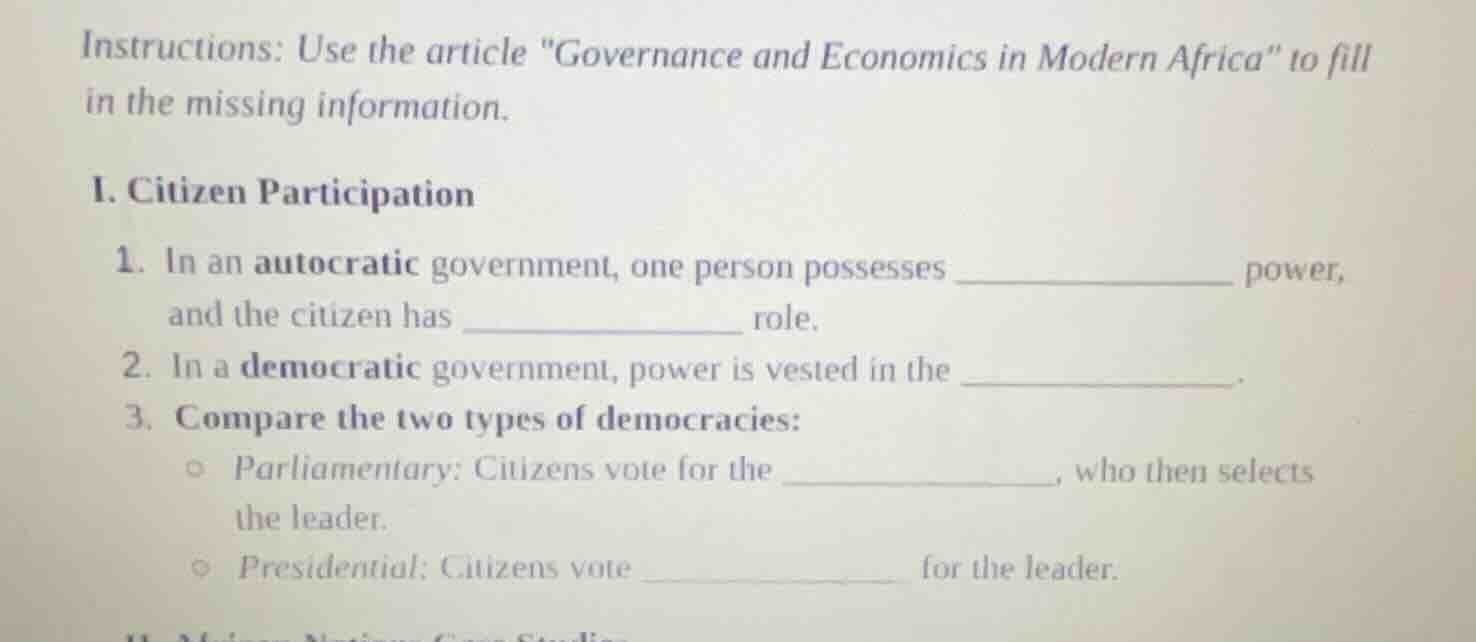
instructions: use the article \governance and economics in modern africa\ to fill in the missing information.
- citizen participation
- in an autocratic government, one person possesses ________ power, and the citizen has ________ role.
- in a democratic government, power is vested in the __________.
- compare the two types of democracies:
- parliamentary: citizens vote for the __________, who then selects the leader.
- presidential: citizens vote __________ for the leader.
To answer these questions, we refer to the concepts of governance and political systems (from the article "Governance and Economics in Modern Africa" or general political science knowledge):
1. In an autocratic government:
- One person possesses unlimited (or absolute) power (autocratic systems concentrate power in a single ruler, e.g., a dictator or monarch with unchecked authority).
- The citizen has no (or minimal) role (autocracies limit or eliminate citizen participation in governance, such as voting or influencing policy).
2. In a democratic government:
Power is vested in the people (or citizens) (democracy is defined by popular sovereignty, where authority originates from the citizens, often exercised through voting, representation, etc.).
3. Compare the two types of democracies:
- Parliamentary: Citizens vote for the legislature (or parliament members), who then selects the leader (e.g., in a parliamentary system, voters elect MPs, and the majority party/coalition chooses the Prime Minister).
- Presidential: Citizens vote directly for the leader (in a presidential system, voters cast ballots for the President, who is elected independently of the legislature, e.g., the U.S. presidential election).
(Note: If the article provides specific terminology, adjust these answers to match the article’s wording. These responses align with standard political science definitions of autocracy, democracy, and democratic subtypes.)

Snap & solve any problem in the app
Get step-by-step solutions on Sovi AI
Photo-based solutions with guided steps
Explore more problems and detailed explanations
To answer these questions, we refer to the concepts of governance and political systems (from the article "Governance and Economics in Modern Africa" or general political science knowledge):
1. In an autocratic government:
- One person possesses unlimited (or absolute) power (autocratic systems concentrate power in a single ruler, e.g., a dictator or monarch with unchecked authority).
- The citizen has no (or minimal) role (autocracies limit or eliminate citizen participation in governance, such as voting or influencing policy).
2. In a democratic government:
Power is vested in the people (or citizens) (democracy is defined by popular sovereignty, where authority originates from the citizens, often exercised through voting, representation, etc.).
3. Compare the two types of democracies:
- Parliamentary: Citizens vote for the legislature (or parliament members), who then selects the leader (e.g., in a parliamentary system, voters elect MPs, and the majority party/coalition chooses the Prime Minister).
- Presidential: Citizens vote directly for the leader (in a presidential system, voters cast ballots for the President, who is elected independently of the legislature, e.g., the U.S. presidential election).
(Note: If the article provides specific terminology, adjust these answers to match the article’s wording. These responses align with standard political science definitions of autocracy, democracy, and democratic subtypes.)