QUESTION IMAGE
Question
international affairs
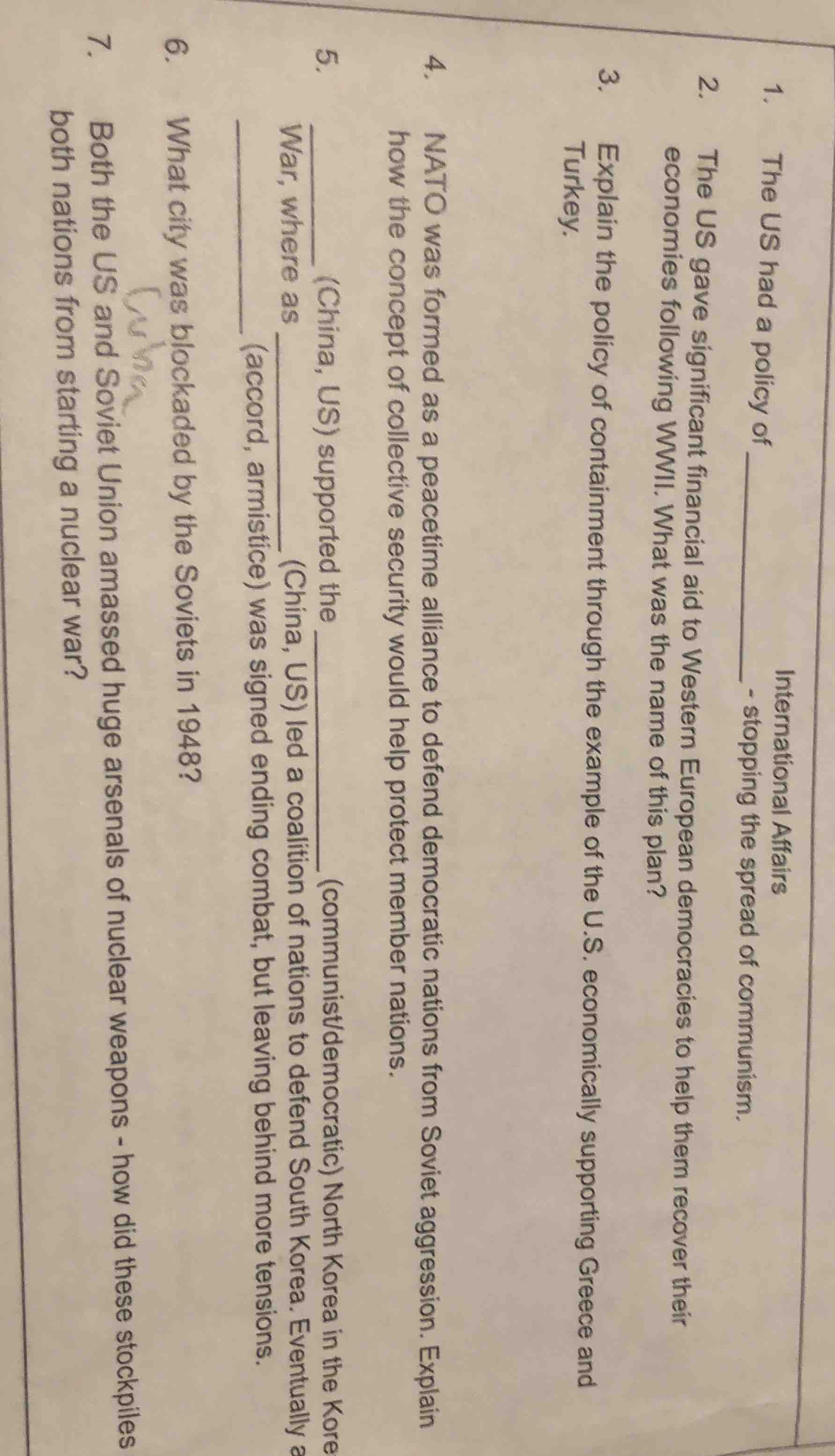
- the us had a policy of ____ - stopping the spread of communism.
- the us gave significant financial aid to western european democracies to help them recover their economies following wwii. what was the name of this plan?
- explain the policy of containment through the example of the u.s. economically supporting greece and turkey.
- nato was formed as a peacetime alliance to defend democratic nations from soviet aggression. explain how the concept of collective security would help protect member nations.
- __ (china, us) supported the (communist/democratic) north korea in the korean war, where as (china, us) led a coalition of nations to defend south korea. eventually a __ (accord, armistice) was signed ending combat, but leaving behind more tensions.
- what city was blockaded by the soviets in 1948?
- both the us and soviet union amassed huge arsenals of nuclear weapons - how did these stockpiles both nations from starting a nuclear war?
Brief Explanations
- This was the core U.S. Cold War foreign policy focused on halting communist expansion.
- This U.S. program provided post-WWII financial aid to Western Europe to rebuild economies and counter communism.
- The U.S. used economic aid (instead of military force) to these two nations to prevent communist takeovers, aligning with containment goals.
- Collective security means an attack on one NATO member is treated as an attack on all; this deters Soviet aggression by uniting democratic nations' military strength.
- North Korea was communist and backed by China; the U.S. led the UN coalition for South Korea, and an armistice paused fighting without a formal peace treaty.
- This was a Western-controlled enclave in East Germany, blockaded by the Soviets to force Western powers out.
- The mutual assured destruction (MAD) doctrine meant a nuclear attack by either nation would result in total annihilation for both, deterring direct nuclear war.

Snap & solve any problem in the app
Get step-by-step solutions on Sovi AI
Photo-based solutions with guided steps
Explore more problems and detailed explanations
- Containment
- The Marshall Plan (European Recovery Program)
- The U.S. provided economic aid to Greece and Turkey to stabilize their governments and economies, preventing communist parties from gaining power through unrest or economic collapse—this fulfilled containment by stopping communism from spreading to these strategically important Mediterranean nations.
- Collective security within NATO means all member states agree to defend any single member that is attacked. This created a unified military deterrent: the Soviet Union avoided attacking any NATO nation because it would face the combined military force of all alliance members, rather than just one country, making aggression too risky.
- China supported the communist North Korea in the Korean War, whereas the US led a coalition of nations to defend democratic South Korea. Eventually an armistice was signed ending combat, but leaving behind more tensions.
- West Berlin
- The massive nuclear arsenals created a situation of mutual assured destruction (MAD): if either nation launched a nuclear attack, the other could retaliate with equal or greater force, resulting in the total destruction of both countries. This mutually guaranteed catastrophic outcome acted as a powerful deterrent, preventing either side from starting a nuclear war.