QUESTION IMAGE
Question
introduction
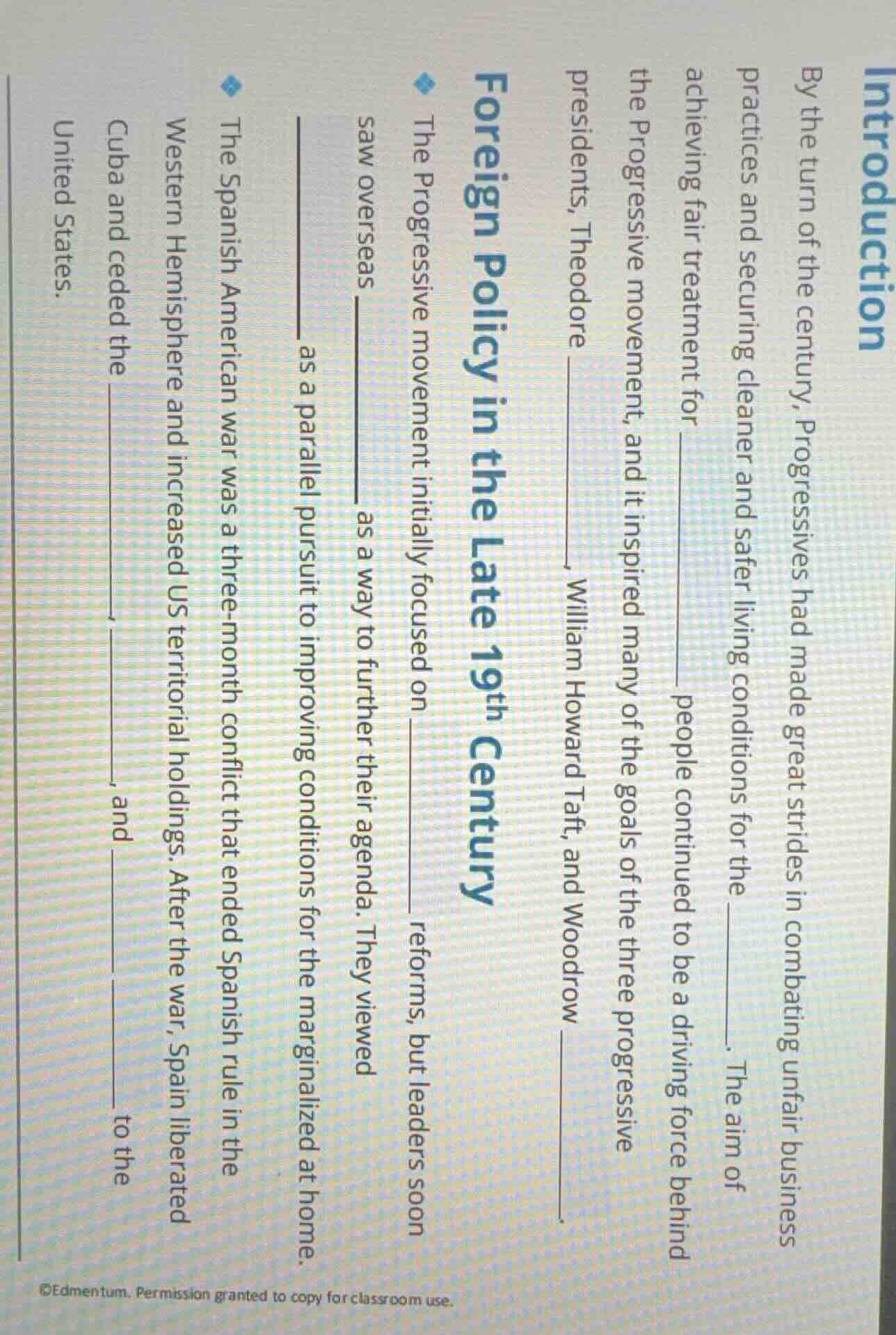
by the turn of the century, progressives had made great strides in combating unfair business
practices and securing cleaner and safer living conditions for the ____. the aim of
achieving fair treatment for ____ people continued to be a driving force behind
the progressive movement, and it inspired many of the goals of the three progressive
presidents, theodore __, william howard taft, and woodrow __.
foreign policy in the late 19th century
the progressive movement initially focused on ____ reforms, but leaders soon
saw overseas ____ as a way to further their agenda. they viewed
____ as a parallel pursuit to improving conditions for the marginalized at home.
the spanish american war was a three - month conflict that ended spanish rule in the
western hemisphere and increased us territorial holdings. after the war, spain liberated
cuba and ceded the __, , and __ to the
united states.
©edmentum. permission granted to copy for classroom use.
To solve this fill - in - the - blank problem about late 19th - century US history (Progressive Era and Spanish - American War), we analyze each blank based on historical knowledge:
1. First part (Progressive movement and presidents)
- The Progressive movement initially focused on domestic reforms (such as labor laws, food safety, etc.).
- The Progressive presidents in the early 20th century (after the turn of the century) were Theodore Roosevelt, William Howard Taft, and Woodrow Wilson.
- The Progressives aimed at fair treatment for the working people (since a large part of their reforms were for laborers, consumers, etc.).
- Their work was about securing better conditions for the public (the general population, including workers, consumers, etc.).
2. Progressive movement and foreign policy
- The Progressive movement initially focused on domestic reforms, but leaders soon saw overseas expansion as a way to further their agenda (the US was expanding its influence abroad, like in the Philippines after the Spanish - American War).
- They viewed imperialism as a parallel pursuit to improving conditions at home (extending US influence and control overseas, similar to how they wanted to reform at home, in a sense of "civilizing" or improving other regions).
3. Spanish - American War and territorial changes
- After the Spanish - American War, Spain liberated Cuba and ceded the Philippines, Puerto Rico, and Guam to the United States.
Filled - in Text:
By the turn of the century, Progressives had made great strides in combating unfair business practices and securing cleaner and safer living conditions for the public. The aim of achieving fair treatment for working people continued to be a driving force behind the Progressive movement, and it inspired many of the goals of the three Progressive presidents, Theodore Roosevelt, William Howard Taft, and Woodrow Wilson.
Foreign Policy in the Late 19th Century
- The Progressive movement initially focused on domestic reforms, but leaders soon saw overseas expansion as a way to further their agenda. They viewed imperialism as a parallel pursuit to improving conditions for the marginalized at home.
- The Spanish - American War was a three - month conflict that ended Spanish rule in the Western Hemisphere and increased US territorial holdings. After the war, Spain liberated Cuba and ceded the Philippines, Puerto Rico, and Guam to the United States.

Snap & solve any problem in the app
Get step-by-step solutions on Sovi AI
Photo-based solutions with guided steps
Explore more problems and detailed explanations
To solve this fill - in - the - blank problem about late 19th - century US history (Progressive Era and Spanish - American War), we analyze each blank based on historical knowledge:
1. First part (Progressive movement and presidents)
- The Progressive movement initially focused on domestic reforms (such as labor laws, food safety, etc.).
- The Progressive presidents in the early 20th century (after the turn of the century) were Theodore Roosevelt, William Howard Taft, and Woodrow Wilson.
- The Progressives aimed at fair treatment for the working people (since a large part of their reforms were for laborers, consumers, etc.).
- Their work was about securing better conditions for the public (the general population, including workers, consumers, etc.).
2. Progressive movement and foreign policy
- The Progressive movement initially focused on domestic reforms, but leaders soon saw overseas expansion as a way to further their agenda (the US was expanding its influence abroad, like in the Philippines after the Spanish - American War).
- They viewed imperialism as a parallel pursuit to improving conditions at home (extending US influence and control overseas, similar to how they wanted to reform at home, in a sense of "civilizing" or improving other regions).
3. Spanish - American War and territorial changes
- After the Spanish - American War, Spain liberated Cuba and ceded the Philippines, Puerto Rico, and Guam to the United States.
Filled - in Text:
By the turn of the century, Progressives had made great strides in combating unfair business practices and securing cleaner and safer living conditions for the public. The aim of achieving fair treatment for working people continued to be a driving force behind the Progressive movement, and it inspired many of the goals of the three Progressive presidents, Theodore Roosevelt, William Howard Taft, and Woodrow Wilson.
Foreign Policy in the Late 19th Century
- The Progressive movement initially focused on domestic reforms, but leaders soon saw overseas expansion as a way to further their agenda. They viewed imperialism as a parallel pursuit to improving conditions for the marginalized at home.
- The Spanish - American War was a three - month conflict that ended Spanish rule in the Western Hemisphere and increased US territorial holdings. After the war, Spain liberated Cuba and ceded the Philippines, Puerto Rico, and Guam to the United States.