QUESTION IMAGE
Question
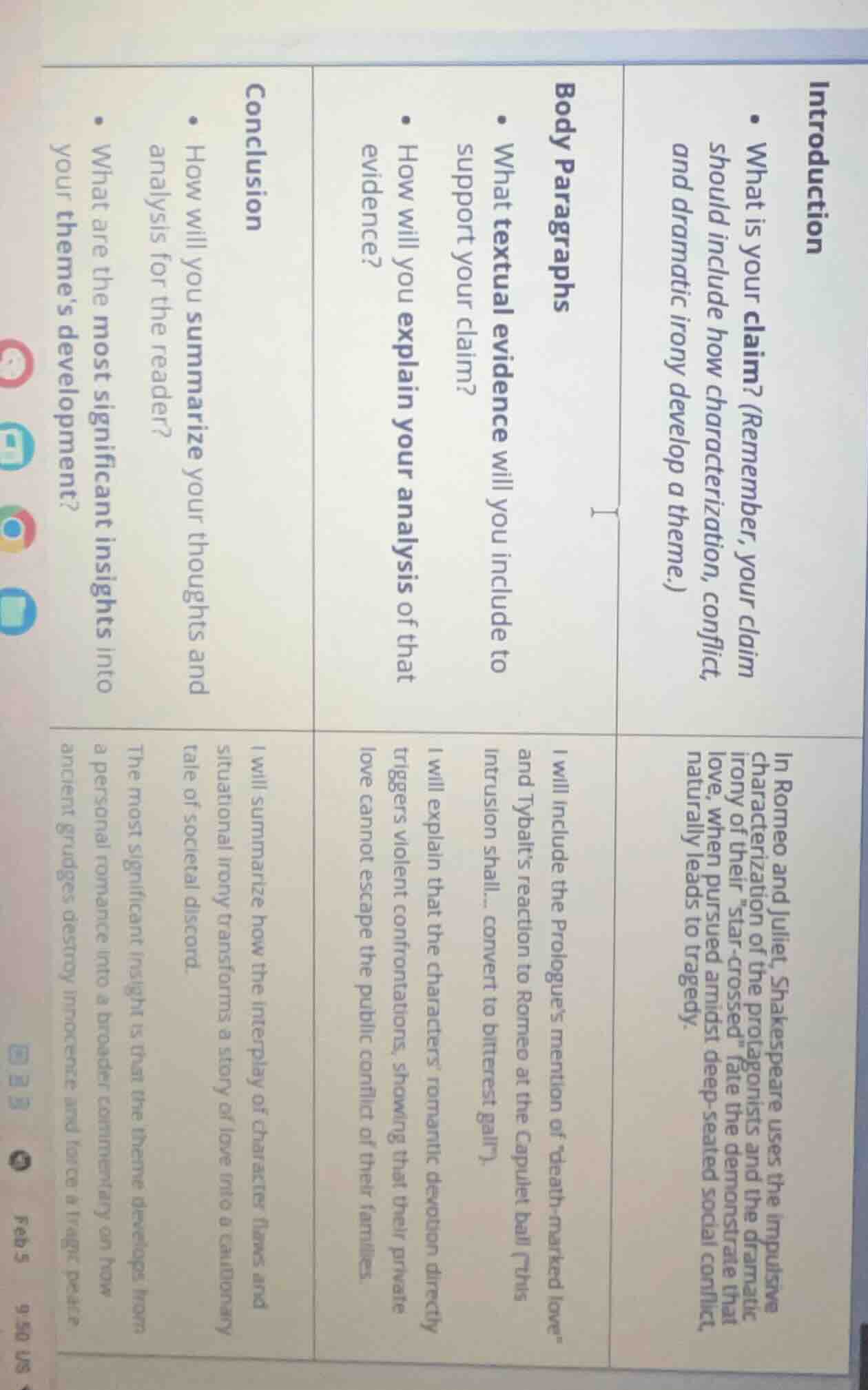
introduction
- what is your claim? (remember, your claim should include how characterization, conflict, and dramatic irony develop a theme.)
body paragraphs
- what textual evidence will you include to support your claim?
- how will you explain your analysis of that evidence?
conclusion
- how will you summarize your thoughts and analysis for the reader?
- what are the most significant insights into your theme’s development?
in romeo and juliet, shakespeare uses the characterization of the protagonists and the dramatic irony of their “star - crossed” fate to demonstrate that love, when pursued amidst deep - seated social conflict, naturally leads to tragedy.
i will include the prologue’s mention of “death - marked love” and tybalt’s reaction to romeo at the capulet ball (”this intrusion shall... convert to bitterest gall”).
i will explain that the characters’ romantic devotion directly triggers violent confrontations, showing that their private love cannot escape the public conflict of their families.
i will summarize how the interplay of character flaws and situational irony transforms a story of love into a cautionary tale of societal discord.
the most significant insight is that the theme develops from a personal romance into a broader commentary on how ancient grudges destroy innocence and force a tragic end.
The table outlines a structure for an essay analysis, likely of a literary work (e.g., Romeo and Juliet). The questions relate to literary analysis, which falls under the Arts discipline, specifically Literature (subfield). The focus is on analyzing themes, characters, and irony in a literary text, typical of Literature studies.

Snap & solve any problem in the app
Get step-by-step solutions on Sovi AI
Photo-based solutions with guided steps
Explore more problems and detailed explanations
The subfield is Literature (under Arts). The table guides literary analysis of a work (e.g., Romeo and Juliet), covering introduction (claim about literary elements), body (textual evidence analysis), and conclusion (summary/insights on theme development), all core to Literature study.