QUESTION IMAGE
Question
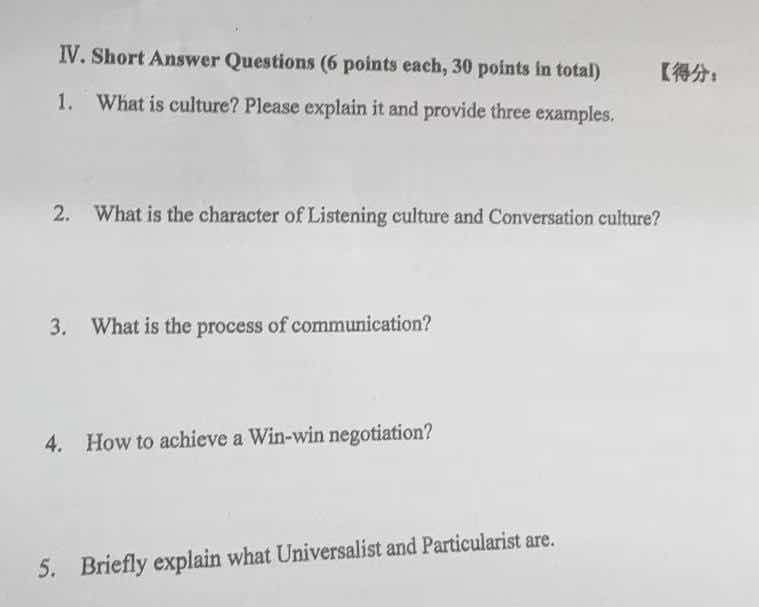
iv. short answer questions (6 points each, 30 points in total) 【得分:
- what is culture? please explain it and provide three examples.
- what is the character of listening culture and conversation culture?
- what is the process of communication?
- how to achieve a win - win negotiation?
- briefly explain what universalist and particularist are.
Sub - question 1
Culture refers to the set of shared beliefs, values, customs, behaviors, and artifacts that characterize a group or society. It is learned and transmitted across generations. Examples: 1. Language: English is a cultural element that enables communication and carries cultural nuances. 2. Festivals: Christmas is a Western cultural festival with religious and social traditions. 3. Art: Chinese calligraphy is a cultural art form that reflects aesthetic and philosophical values.
Listening culture: In such cultures, people value listening more, there is more emphasis on understanding others' viewpoints, and communication may be more reserved, with people taking time to absorb information. For example, in some Asian cultures, listening is seen as a sign of respect. Conversation culture: These cultures emphasize active conversation, sharing one's own ideas, and interaction is more lively and direct. For example, in Western cultures like the US, conversation is often more spontaneous and self - expressive.
The communication process typically includes: 1. Sender: The person who initiates the communication, encoding a message. 2. Message: The content to be communicated, which can be verbal or non - verbal. 3. Channel: The medium through which the message is sent (e.g., face - to - face, email). 4. Receiver: The person who gets the message and decodes it. 5. Feedback: The response from the receiver to the sender, which can be verbal or non - verbal, to complete the communication loop. There may also be noise (interferences) at any stage.

Snap & solve any problem in the app
Get step-by-step solutions on Sovi AI
Photo-based solutions with guided steps
Explore more problems and detailed explanations
Culture is the shared beliefs, values, customs, behaviors, and artifacts of a group/society, learned and transmitted. Examples: Language (e.g., English), Festivals (e.g., Christmas), Art (e.g., Chinese calligraphy).