QUESTION IMAGE
Question
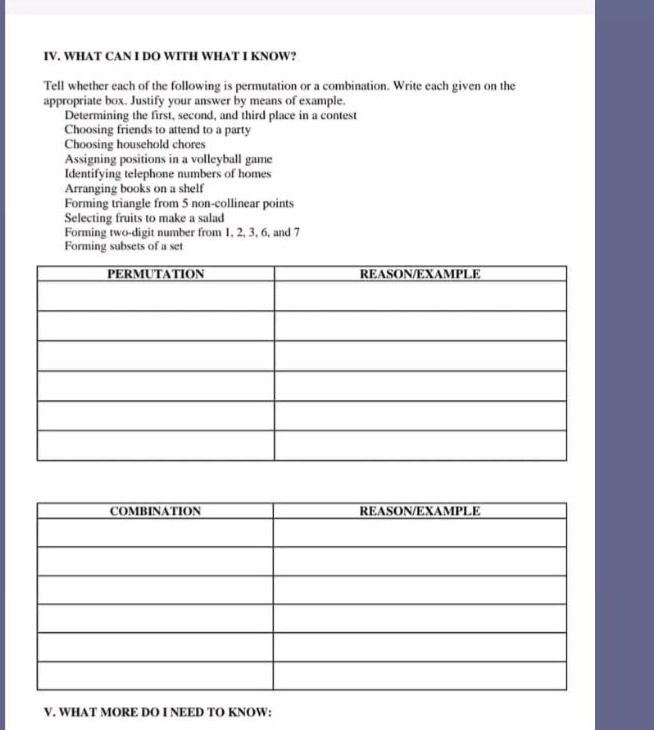
iv. what can i do with what i know?
tell whether each of the following is permutation or a combination. write each given on the
appropriate box. justify your answer by means of example.
determining the first, second, and third place in a contest
choosing friends to attend to a party
choosing household chores
assigning positions in a volleyball game
identifying telephone numbers of homes
arranging books on a shelf
forming triangle from 5 non - collinear points
selecting fruits to make a salad
forming two - digit number from 1, 2, 3, 6, and 7
forming subsets of a set
permutation\treason/example
combination\treason/example
v. what more do i need to know:
To solve this, we recall: A permutation is an arrangement of objects where order matters, while a combination is a selection of objects where order does not matter.
Permutation (Order Matters)
- Determining the first, second, and third place in a contest
- Reason: The order (1st, 2nd, 3rd) is important. E.g., if contestants are A, B, C, “A first, B second, C third” is different from “B first, A second, C third.”
- Assigning positions in a volleyball game
- Reason: Positions (e.g., setter, spiker, libero) are distinct; order/role matters. E.g., assigning Player X to setter vs. spiker changes the arrangement.
- Identifying telephone numbers of homes
- Reason: Telephone numbers are sequences where the order of digits matters (e.g., 1234567 vs. 7654321 are different numbers).
- Arranging books on a shelf
- Reason: The order of books (e.g., Book A first, Book B second) matters. E.g., arranging “Harry Potter” then “Lord of the Rings” is different from the reverse.
- Forming two - digit number from 1, 2, 3, 6, and 7
- Reason: The order of digits matters (e.g., 12 vs. 21 are different two - digit numbers).
Combination (Order Does Not Matter)
- Choosing friends to attend a party
- Reason: The group of friends is what matters, not the order in which we choose them. E.g., choosing Alice and Bob is the same as choosing Bob and Alice.
- Choosing household chores
- Reason: The set of chores is what matters, not the order of selection. E.g., choosing “wash dishes” and “do laundry” is the same as choosing “do laundry” and “wash dishes.”
- Forming triangle from 5 non - collinear points
- Reason: A triangle is defined by a set of 3 points; the order of selecting the points does not change the triangle. E.g., choosing points A, B, C to form a triangle is the same as choosing B, A, C.
- Selecting fruits to make a salad
- Reason: The combination of fruits is what matters, not the order of selection. E.g., selecting apple and banana is the same as selecting banana and apple.
- Forming subsets of a set
- Reason: Subsets are defined by their elements, not the order in which elements are selected. E.g., the subset {1, 2} is the same as {2, 1}.
Filling the Table
Permutation Table
| PERMUTATION | REASON/EXAMPLE |
|---|---|
| Assigning positions in a volleyball game | Positions (roles) are distinct; order of assignment matters (e.g., Player X as setter ≠ Player X as spiker) |
| Identifying telephone numbers of homes | Order of digits in the number matters (e.g., 1234567 ≠ 7654321) |
| Arranging books on a shelf | Order of books matters (e.g., Book A then Book B ≠ Book B then Book A) |
| Forming two - digit number from 1, 2, 3, 6, and 7 | Order of digits matters (e.g., 12 ≠ 21) |
Combination Table
| COMBINATION | REASON/EXAMPLE |
|---|---|
| Choosing household chores | Set of chores matters, not order (e.g., wash dishes & do laundry = do laundry & wash dishes) |
| Forming triangle from 5 non - collinear points | Set of 3 points matters, not order of selection (e.g., Points A, B, C = Points B, A, C) |
| Selecting fruits to make a salad | Set of fruits matters, not order (e.g., apple & banana = banana & apple) |
| Forming subsets of a set | Set of elements matters, not order (…

Snap & solve any problem in the app
Get step-by-step solutions on Sovi AI
Photo-based solutions with guided steps
Explore more problems and detailed explanations
To solve this, we recall: A permutation is an arrangement of objects where order matters, while a combination is a selection of objects where order does not matter.
Permutation (Order Matters)
- Determining the first, second, and third place in a contest
- Reason: The order (1st, 2nd, 3rd) is important. E.g., if contestants are A, B, C, “A first, B second, C third” is different from “B first, A second, C third.”
- Assigning positions in a volleyball game
- Reason: Positions (e.g., setter, spiker, libero) are distinct; order/role matters. E.g., assigning Player X to setter vs. spiker changes the arrangement.
- Identifying telephone numbers of homes
- Reason: Telephone numbers are sequences where the order of digits matters (e.g., 1234567 vs. 7654321 are different numbers).
- Arranging books on a shelf
- Reason: The order of books (e.g., Book A first, Book B second) matters. E.g., arranging “Harry Potter” then “Lord of the Rings” is different from the reverse.
- Forming two - digit number from 1, 2, 3, 6, and 7
- Reason: The order of digits matters (e.g., 12 vs. 21 are different two - digit numbers).
Combination (Order Does Not Matter)
- Choosing friends to attend a party
- Reason: The group of friends is what matters, not the order in which we choose them. E.g., choosing Alice and Bob is the same as choosing Bob and Alice.
- Choosing household chores
- Reason: The set of chores is what matters, not the order of selection. E.g., choosing “wash dishes” and “do laundry” is the same as choosing “do laundry” and “wash dishes.”
- Forming triangle from 5 non - collinear points
- Reason: A triangle is defined by a set of 3 points; the order of selecting the points does not change the triangle. E.g., choosing points A, B, C to form a triangle is the same as choosing B, A, C.
- Selecting fruits to make a salad
- Reason: The combination of fruits is what matters, not the order of selection. E.g., selecting apple and banana is the same as selecting banana and apple.
- Forming subsets of a set
- Reason: Subsets are defined by their elements, not the order in which elements are selected. E.g., the subset {1, 2} is the same as {2, 1}.
Filling the Table
Permutation Table
| PERMUTATION | REASON/EXAMPLE |
|---|---|
| Assigning positions in a volleyball game | Positions (roles) are distinct; order of assignment matters (e.g., Player X as setter ≠ Player X as spiker) |
| Identifying telephone numbers of homes | Order of digits in the number matters (e.g., 1234567 ≠ 7654321) |
| Arranging books on a shelf | Order of books matters (e.g., Book A then Book B ≠ Book B then Book A) |
| Forming two - digit number from 1, 2, 3, 6, and 7 | Order of digits matters (e.g., 12 ≠ 21) |
Combination Table
| COMBINATION | REASON/EXAMPLE |
|---|---|
| Choosing household chores | Set of chores matters, not order (e.g., wash dishes & do laundry = do laundry & wash dishes) |
| Forming triangle from 5 non - collinear points | Set of 3 points matters, not order of selection (e.g., Points A, B, C = Points B, A, C) |
| Selecting fruits to make a salad | Set of fruits matters, not order (e.g., apple & banana = banana & apple) |
| Forming subsets of a set | Set of elements matters, not order (e.g., {1, 2} = {2, 1}) |
If we were to present the answer in a more concise form for the table filling:
Permutation Entries (Row - by - Row)
- Row 1: Determining the first, second, and third place in a contest; Order of placement matters (e.g., A(1st), B(2nd) ≠ B(1st), A(2nd))
- Row 2: Assigning positions in a volleyball game; Order of positions (roles) matters (e.g., Player X as setter ≠ as spiker)
- Row 3: Identifying telephone numbers of homes; Order of digits in number matters (e.g., 1234567 ≠ 7654321)
- Row 4: Arranging books on a shelf; Order of books matters (e.g., Book A then Book B ≠ Book B then Book A)
- Row 5: Forming two - digit number from 1, 2, 3, 6, and 7; Order of digits matters (e.g., 12 ≠ 21)
Combination Entries (Row - by - Row)
- Row 1: Choosing friends to attend a party; Order of selection does not matter (e.g., Alice & Bob = Bob & Alice)
- Row 2: Choosing household chores; Order of selection does not matter (e.g., wash dishes & do laundry = do laundry & wash dishes)
- Row 3: Forming triangle from 5 non - collinear points; Order of point selection does not matter (e.g., Points A, B, C = Points B, A, C)
- Row 4: Selecting fruits to make a salad; Order of selection does not matter (e.g., apple & banana = banana & apple)
- Row 5: Forming subsets of a set; Order of element selection does not matter (e.g., {1, 2} = {2, 1})