QUESTION IMAGE
Question
joe tried to prove that the sum of a triangles interior angle measures is 180°
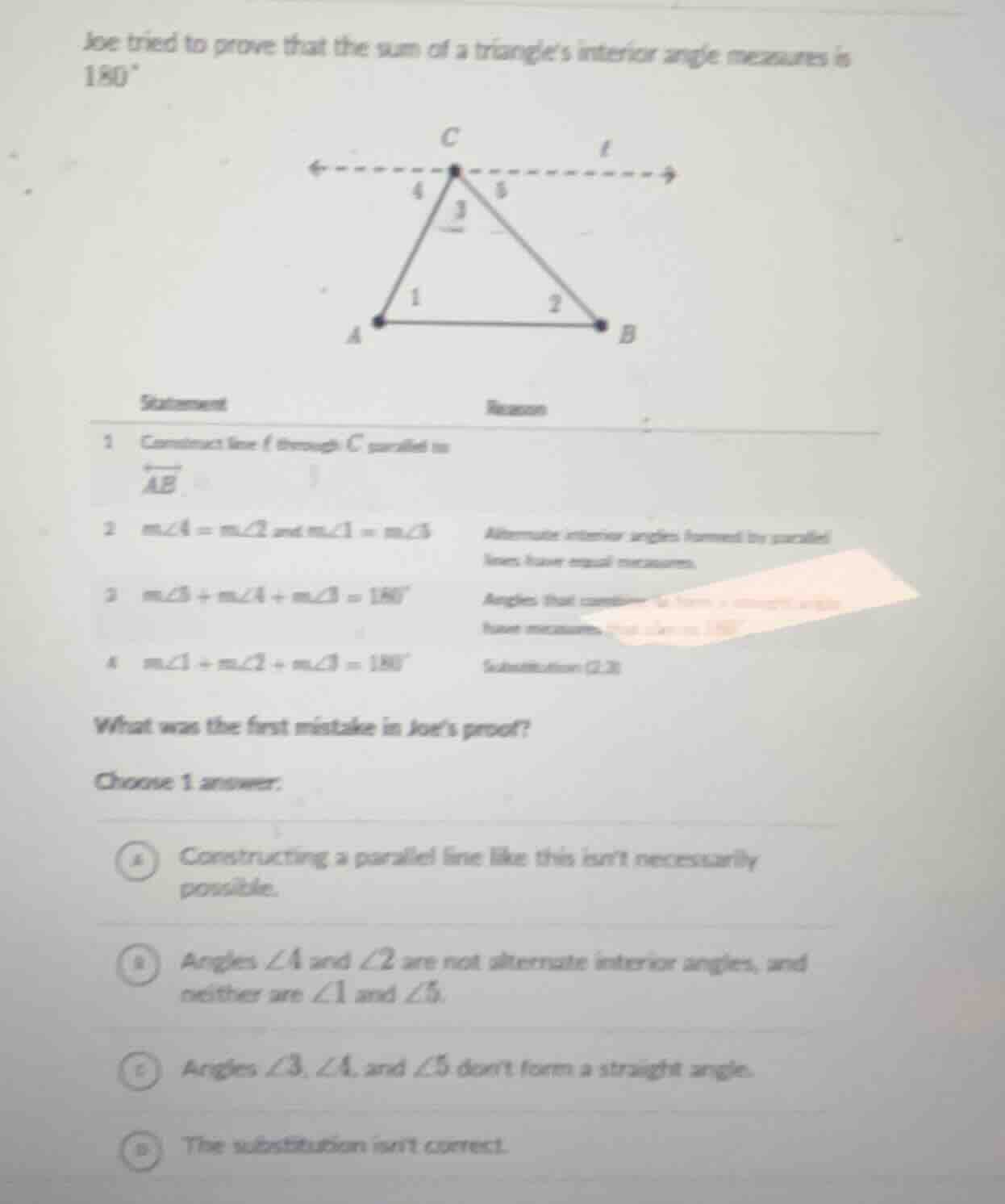
image of triangle and proof steps
statement reason
1 construct line ℓ through c parallel to (overleftrightarrow{ab}).
2 (mangle 4 = mangle 2) and (mangle 1 = mangle 5) alternate interior angles formed by parallel lines have equal measures.
3 (mangle 5 + mangle 4 + mangle 3 = 180^circ) angles that combine to form a straight angle have measures that sum to 180°
4 (mangle 1 + mangle 2 + mangle 3 = 180^circ) substitution (2,3)
what was the first mistake in joe’s proof?
choose 1 answer:
a constructing a parallel line like this isn’t necessarily possible.
b angles (angle 4) and (angle 2) are not alternate interior angles, and neither are (angle 1) and (angle 5).
c angles (angle 3), (angle 4), and (angle 5) don’t form a straight angle.
d the substitution isn’t correct.
- Option A: By the parallel postulate, we can always construct a line through a point parallel to a given line, so this is incorrect.
- Option B: When line \( l \) is parallel to \( AB \), \( \angle 4 \) and \( \angle 2 \) are alternate interior angles (formed by transversal \( BC \)), and \( \angle 1 \) and \( \angle 5 \) are alternate interior angles (formed by transversal \( AC \)). Wait, no—wait, let's re - examine. The transversal for \( \angle 4 \) and \( \angle 2 \): line \( BC \) intersects \( l \) and \( AB \). For alternate interior angles, the angles should be on opposite sides of the transversal and inside the two parallel lines. \( \angle 4 \) is above \( AC \) and \( \angle 2 \) is at \( B \), actually, \( \angle 4 \) and \( \angle 2 \) are not alternate interior angles. Similarly, \( \angle 1 \) and \( \angle 5 \) are not alternate interior angles. Wait, no, maybe I made a mistake. Wait, the correct alternate interior angles: when \( l \parallel AB \), transversal \( AC \): \( \angle 1 \) and \( \angle 5 \) – \( \angle 1 \) is at \( A \), between \( AC \) and \( AB \), \( \angle 5 \) is at \( C \), between \( AC \) and \( l \). So they are alternate interior angles. Transversal \( BC \): \( \angle 2 \) is at \( B \), between \( BC \) and \( AB \), \( \angle 4 \) is at \( C \), between \( BC \) and \( l \). So they are alternate interior angles. Wait, then what's wrong? Wait, no, the mistake is in option B? Wait, no, let's check option C: Angles \( \angle 3 \), \( \angle 4 \), and \( \angle 5 \) are at point \( C \) on line \( l \), so they should form a straight angle (sum to \( 180^\circ \)), so option C is wrong. Option D: Substitution: from step 2, \( m\angle 4 = m\angle 2 \) and \( m\angle 1=m\angle 5 \), so substituting into step 3 (\( m\angle 5 + m\angle 4 + m\angle 3=180^\circ \)) gives \( m\angle 1 + m\angle 2 + m\angle 3 = 180^\circ \), so substitution is correct. Wait, I think I messed up. Wait, the first mistake: let's re - analyze each step. Step 2: The reason says "Alternate interior angles formed by parallel lines have equal measures". But \( \angle 4 \) and \( \angle 2 \): are they alternate interior angles? Let's see the lines: \( l \parallel AB \), transversal \( BC \). \( \angle 4 \) is between \( l \) and \( AC \), \( \angle 2 \) is between \( AB \) and \( BC \). No, they are not alternate interior angles. Similarly, \( \angle 1 \) and \( \angle 5 \): transversal \( AC \), \( \angle 1 \) is between \( AB \) and \( AC \), \( \angle 5 \) is between \( l \) and \( AC \). So they are alternate interior angles. Wait, \( \angle 4 \) and \( \angle 2 \): transversal \( BC \), \( \angle 4 \) is between \( l \) and \( BC \), \( \angle 2 \) is between \( AB \) and \( BC \). So they are alternate interior angles. So step 2's reason is correct? Then what's the mistake? Wait, no, the mistake is in option B: "Angles \( \angle 4 \) and \( \angle 2 \) are not alternate interior angles, and neither are \( \angle 1 \) and \( \angle 5 \)." Wait, but they are alternate interior angles. Wait, maybe I am wrong. Wait, let's check the diagram. Line \( l \) is through \( C \), parallel to \( AB \). So \( l \) is a straight line, so \( \angle 3+\angle 4+\angle 5 = 180^\circ \) (step 3) is correct because they are on a straight line. Step 4: substitution: \( m\angle 1 = m\angle 5 \), \( m\angle 2 = m\angle 4 \), so substituting into \( m\angle 5 + m\angle 4 + m\angle 3 = 180^\circ \) gives \( m\angle 1 + m\angle 2 + m\angle 3 = 180^\circ \), so substitution is correct. Option A: Constructing a parallel line through \( C \) para…

Snap & solve any problem in the app
Get step-by-step solutions on Sovi AI
Photo-based solutions with guided steps
Explore more problems and detailed explanations
B. Angles \( \angle 4 \) and \( \angle 2 \) are not alternate interior angles, and neither are \( \angle 1 \) and \( \angle 5 \).