QUESTION IMAGE
Question
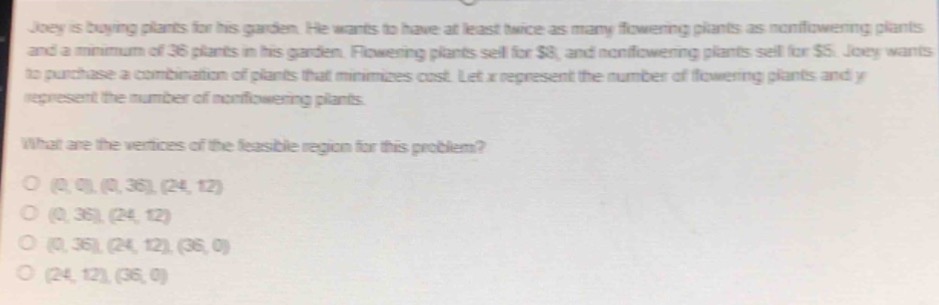
joey is buying plants for his garden. he wants to have at least twice as many flowering plants as nonflowering plants and a minimum of 36 plants in his garden. flowering plants sell for $8, and nonflowering plants sell for $5. joey wants to purchase a combination of plants that minimizes cost. let x represent the number of flowering plants and y represent the number of nonflowering plants. what are the vertices of the feasible region for this problem? \bigcirc (0, 0), (0, 36), (24, 12) \bigcirc (0, 36), (24, 12) \bigcirc (0, 36), (24, 12), (36, 0) \bigcirc (24, 12), (36, 0)
Step1: Define constraints
- Flowering plants ≥ 2×nonflowering: $x \geq 2y$
- Total plants ≥ 36: $x + y \geq 36$
- Non-negative quantities: $x \geq 0, y \geq 0$
Step2: Find intersection of $x=2y$ and $x+y=36$
Substitute $x=2y$ into $x+y=36$:
$2y + y = 36$
$3y = 36$
$y = 12$
Then $x = 2(12) = 24$
Intersection point: $(24, 12)$
Step3: Find intercepts of $x+y=36$
- Set $y=0$: $x=36$, point $(36, 0)$
- Set $x=0$: $y=36$, point $(0, 36)$
Step4: Validate feasible region vertices
The feasible region is bounded by the constraints, so its vertices are the intercepts of the total plant constraint and the intersection of the two main constraints. The point $(0,0)$ does not satisfy $x+y \geq 36$, so it is not in the feasible region.

Snap & solve any problem in the app
Get step-by-step solutions on Sovi AI
Photo-based solutions with guided steps
Explore more problems and detailed explanations
(0, 36), (24, 12), (36, 0)
(Option 3: O (0, 36), (24, 12), (36, 0))