QUESTION IMAGE
Question
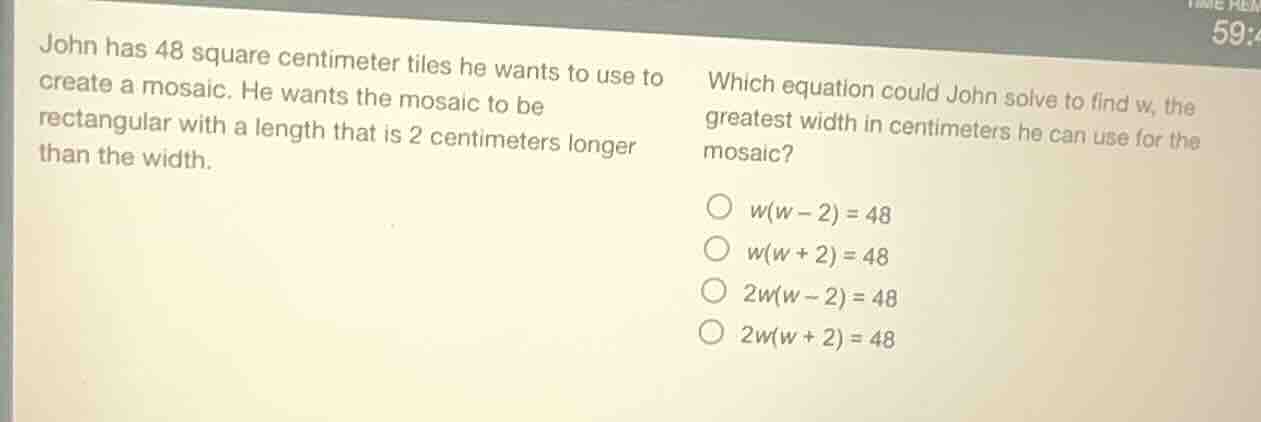
john has 48 square centimeter tiles he wants to use to create a mosaic. he wants the mosaic to be rectangular with a length that is 2 centimeters longer than the width. which equation could john solve to find w, the greatest width in centimeters he can use for the mosaic?\\(\bigcirc\\) \\(w(w - 2) = 48\\)\\(\bigcirc\\) \\(w(w + 2) = 48\\)\\(\bigcirc\\) \\(2w(w - 2) = 48\\)\\(\bigcirc\\) \\(2w(w + 2) = 48\\)
Step1: Define variables for length and width
Let \( w \) be the width of the rectangular mosaic in centimeters. The length is 2 centimeters longer than the width, so the length \( l = w + 2 \) centimeters.
Step2: Recall the area formula for a rectangle
The area \( A \) of a rectangle is given by the formula \( A = l \times w \).
Step3: Substitute the values of length, width, and area into the formula
We know the area \( A = 48 \) square centimeters (since there are 48 square - centimeter tiles), \( l = w + 2 \), and \( w \) is the width. Substituting these into the area formula, we get \( 48=w\times(w + 2) \), or \( w(w + 2)=48 \).

Snap & solve any problem in the app
Get step-by-step solutions on Sovi AI
Photo-based solutions with guided steps
Explore more problems and detailed explanations
\( \boldsymbol{w(w + 2)=48} \) (corresponding to the option " \( w(w + 2)=48 \)")