QUESTION IMAGE
Question
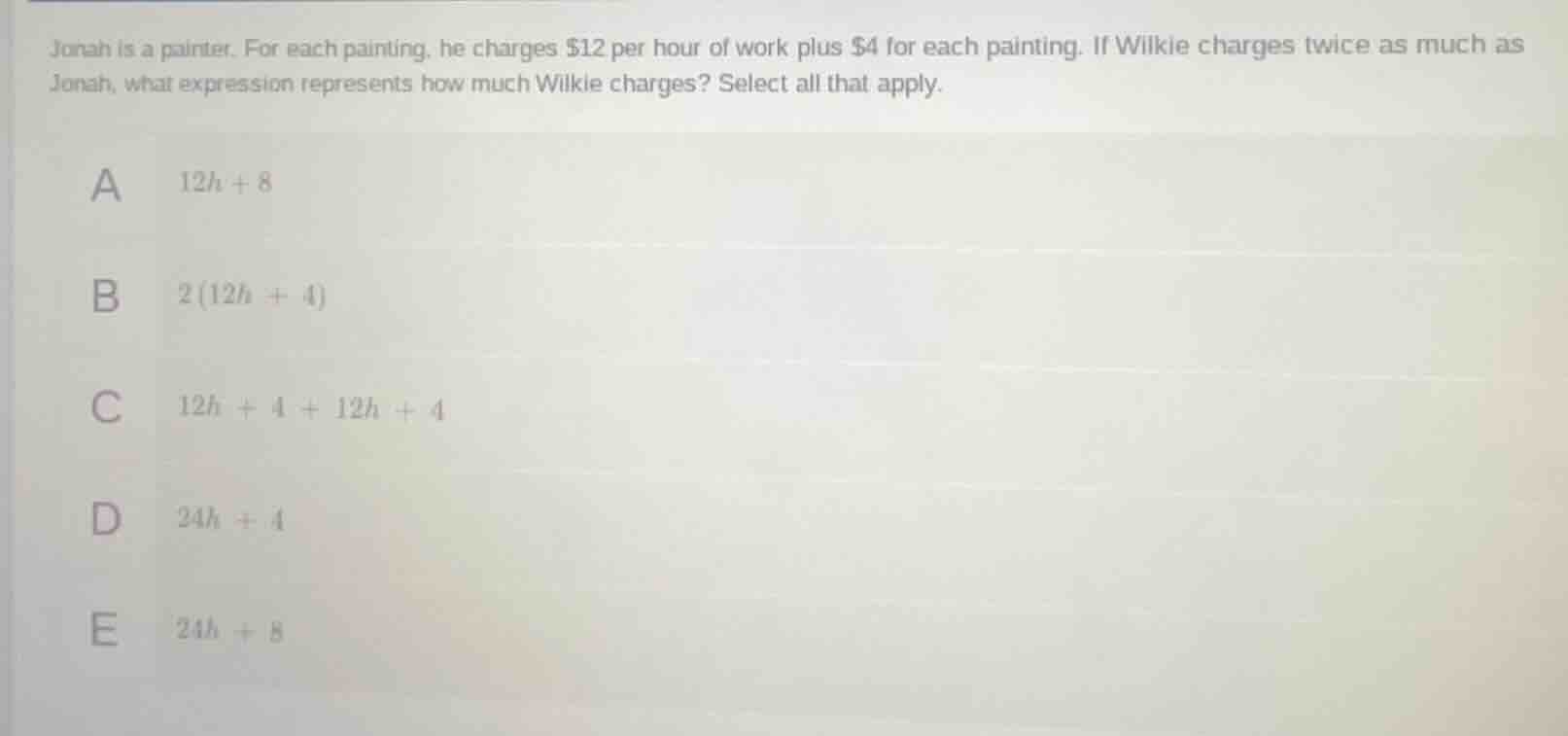
jonah is a painter. for each painting, he charges $12 per hour of work plus $4 for each painting. if wilkie charges twice as much as jonah, what expression represents how much wilkie charges? select all that apply.
a $12h + 8$
b $2(12h + 4)$
c $12h + 4 + 12h + 4$
d $24h + 4$
e $24h + 8$
Step1: Find Jonah's charge expression
Jonah charges $12 per hour (LXI0) plus $4 per painting. So his charge is \(12h + 4\).
Step2: Find Wilkie's charge expression (twice Jonah's)
Wilkie charges twice as much as Jonah, so multiply Jonah's expression by 2: \(2(12h + 4)\).
Step3: Simplify the expression
Expand \(2(12h + 4)\): \(2\times12h + 2\times4 = 24h + 8\). Also, \(2(12h + 4)\) can be written as \((12h + 4)+(12h + 4)=12h + 4 + 12h + 4\). And \(24h + 8\) can be rewritten as \(12h\times2+4\times2\), but also note that \(24h + 8\) is equivalent to \(12h + 8+12h\) (not necessary here). Now check the options:
- Option A: \(12h + 8\) – this is half of \(24h + 8\) if we factor wrong, but actually, if we take \(2(12h + 4)=24h + 8\), and \(12h + 8\) is not equal unless \(h = 0\), wait no, wait: Wait, no, let's re - evaluate. Wait, \(2(12h + 4)=24h + 8\). And \(12h + 8\) is not the same as \(24h + 8\). Wait, I made a mistake. Wait, no: Wait, Jonah's charge is \(12h + 4\) per painting? Wait, the problem says "for each painting, he charges $12 per hour of work plus $4 for each painting". So for one painting, the charge is \(12h+4\). Wilkie charges twice as much, so \(2(12h + 4)=24h + 8\). Also, \(2(12h + 4)=(12h + 4)+(12h + 4)=12h + 4+12h + 4\). Now let's check each option:
- Option A: \(12h + 8\) – is this equal to \(24h + 8\)? No, unless \(h = 0\). Wait, no, wait a second, maybe I misinterpreted the problem. Wait, maybe "for each painting" – maybe the $4 is per painting, and the $12 is per hour per painting. So if we consider that Wilkie's charge is twice Jonah's, so \(2\times(12h + 4)=24h + 8\), and also \(2(12h + 4)=12h + 4+12h + 4\), and \(24h + 8\) can be written as \(12h\times2 + 4\times2\). Now, let's check the options again:
- Option A: \(12h+8\) – if we factor \(24h + 8\) as \(2\times(12h + 4)\), but \(12h + 8\) is not equal. Wait, no, I think I messed up. Wait, let's do the algebra again. \(2(12h + 4)=24h + 8\). Now, \(12h+8\) is not equal to \(24h + 8\). But wait, maybe the problem is that the $4 is a flat fee per painting, and the $12 is per hour. So for example, if \(h = 1\), Jonah charges \(12(1)+4 = 16\), Wilkie charges \(32\). Let's check the options:
- Option A: \(12(1)+8 = 20
eq32\) – no. Wait, I was wrong earlier. Wait, no, wait: Wait, \(2(12h + 4)=24h + 8\). Let's take \(h = 1\): \(24(1)+8 = 32\), which is twice \(16\) (Jonah's charge when \(h = 1\)). Now check option A: \(12(1)+8 = 20
eq32\). Option B: \(2(12(1)+4)=2(16)=32\) – correct. Option C: \(12(1)+4+12(1)+4 = 16 + 16=32\) – correct. Option E: \(24(1)+8 = 32\) – correct. Wait, what about option A? Wait, \(12h + 8\) when \(h = 1\) is \(20\), which is not equal to \(32\). Wait, so where did I go wrong before? Oh! Wait, maybe the problem is that the $4 is a flat fee, and the $12 is per hour, but maybe Wilkie's charge is calculated as twice the hourly rate plus twice the flat fee, but also, if we factor \(24h + 8\) as \(2\times(12h + 4)\), and \(12h + 8\) is not the same. But wait, let's re - express \(24h + 8\) as \(12h+12h + 8\), and \(12h + 8\) is half of that? No. Wait, no, the correct expressions are:
- From \(2(12h + 4)\) (Option B)
- From \((12h + 4)+(12h + 4)\) (Option C)
- From expanding \(2(12h + 4)\) we get \(24h + 8\) (Option E)
- Wait, but earlier I thought Option A was wrong, but let's check again. Wait, \(2(12h + 4)=24h + 8\), and \(12h + 8\) is not equal to \(24h + 8\). But wait, maybe there is a misinterpretation. Suppose that the $4 is a flat fee per hour? No, the problem says "plus $4 for each painting…

Snap & solve any problem in the app
Get step-by-step solutions on Sovi AI
Photo-based solutions with guided steps
Explore more problems and detailed explanations
B. \(2(12h + 4)\), C. \(12h + 4+12h + 4\), E. \(24h + 8\)