QUESTION IMAGE
Question
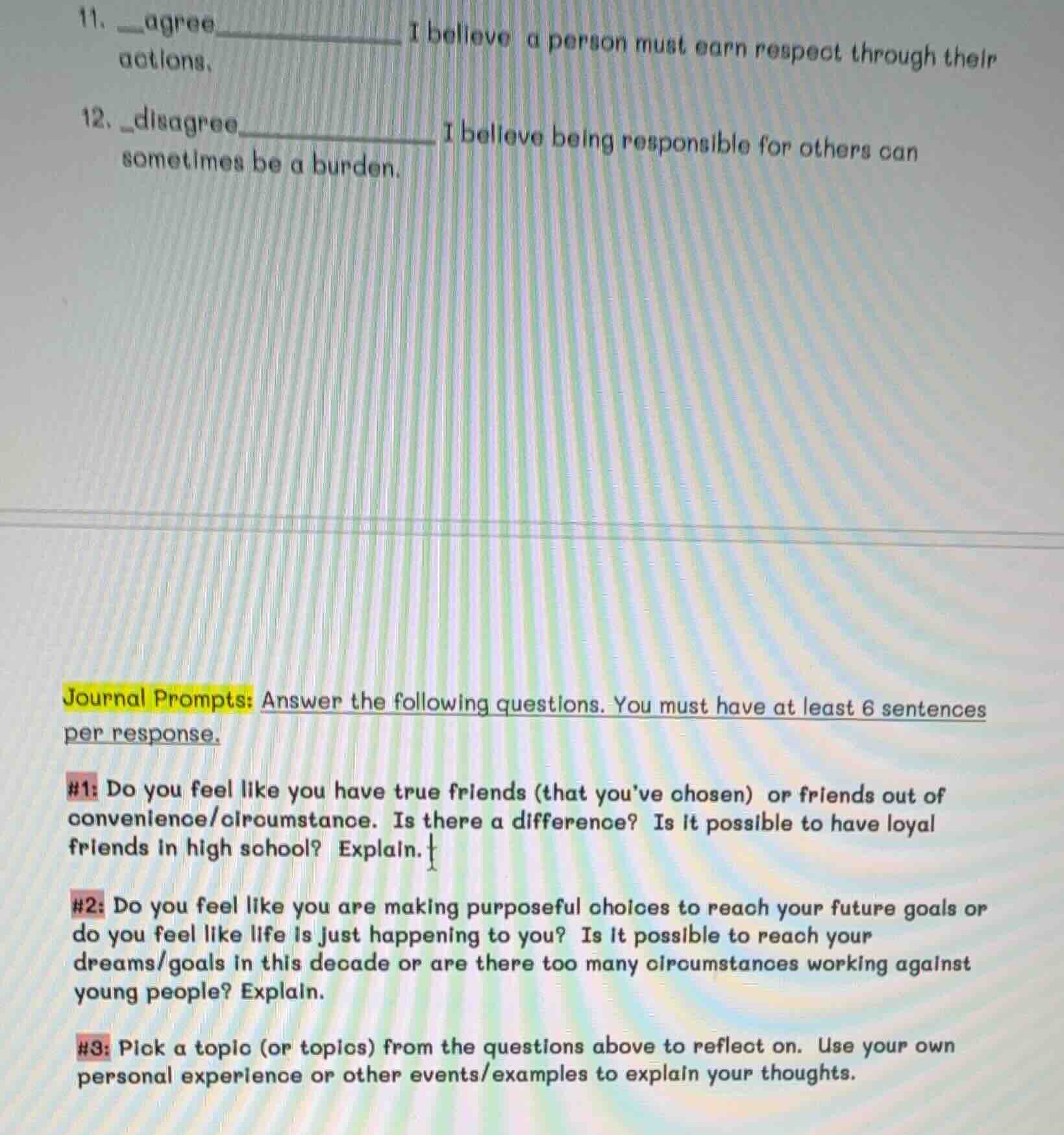
journal prompts: answer the following questions. you must have at least 6 sentences per response.
#1: do you feel like you have true friends (that youve chosen) or friends out of convenience/circumstance. is there a difference? is it possible to have loyal friends in high school? explain.
#2: do you feel like you are making purposeful choices to reach your future goals or do you feel like life is just happening to you? is it possible to reach your dreams/goals in this decade or are there too many circumstances working against young people? explain.
#3: pick a topic (or topics) from the questions above to reflect on. use your own personal experience or other events/examples to explain your thoughts.

Snap & solve any problem in the app
Get step-by-step solutions on Sovi AI
Photo-based solutions with guided steps
Explore more problems and detailed explanations
I feel like I have both true friends I’ve chosen and friends formed out of convenience or circumstance, and there’s a clear difference between the two. True friends are the ones I’ve intentionally grown close to, who know my deepest fears and joys and stick by me even when it’s not easy, while convenience friends are often people I see regularly at school or in a club but don’t open up to fully. It is absolutely possible to have loyal friends in high school; I’ve seen and experienced this firsthand, as my closest group of friends has supported me through tough exam periods, family struggles, and moments of self-doubt. These loyal high school friends are the ones who show up to my games without being asked, who listen when I’m stressed about college applications, and who celebrate my small wins as if they were their own. The difference lies in the level of vulnerability and mutual commitment: true friends choose each other repeatedly, while convenience friends are often tied to a specific situation that may fade over time. High school is a time of intense growth and shared experiences, which can foster incredibly strong, loyal bonds that last long after graduation, proving that age doesn’t determine the depth of a true friendship.
I feel like I am making purposeful choices to reach my future goals, though there are days when it feels like life is just happening to me. I’ve mapped out a plan to study environmental science in college, so I’ve been taking advanced science classes, volunteering at local conservation groups, and researching scholarships related to sustainability—all intentional steps to build my skills and credentials. Some days, though, when I’m overwhelmed by homework, part-time work, and the pressure to make “perfect” choices, it’s easy to feel like I’m just treading water instead of moving forward. It is possible to reach my dreams in this decade, even with the many circumstances working against young people like rising tuition costs, climate change anxiety, and a competitive job market. While these barriers are real, they aren’t insurmountable; I’ve seen peers and mentors who’ve navigated similar challenges by seeking out support networks, adapting their plans when needed, and staying focused on their core values. Young people today have access to more resources and global connections than ever before, which can help us advocate for change and create opportunities for ourselves. By staying persistent, leaning on my support system, and remaining flexible in my approach, I believe I can turn my goals into reality within the next ten years, even when the path feels uncertain.
I want to reflect on the idea of true, loyal friends in high school, as this has been a defining part of my teenage experience. Last year, I struggled with a chronic illness that kept me out of school for months, and I worried I’d lose touch with everyone or that no one would care about my absence. But my closest friends showed up in ways I never expected: they dropped off handwritten notes and homework packets at my door every week, facetimed me during lunch breaks so I wouldn’t feel left out, and even organized a small outdoor gathering when I was well enough to leave the house. These acts of kindness weren’t just convenient—they were intentional, and they showed me that high school friendships can be deeply loyal and meaningful. Before this experience, I’d sometimes dismissed high school friends as temporary, tied only to shared classes or extracurriculars, but this changed my perspective entirely. It taught me that loyalty isn’t about how long you’ve known someone, but about how they show up when you need them most. This group of friends has become like family to me, and I know these bonds will continue to support me long after we graduate, proving that true, loyal friendships are not only possible in high school but can be some of the most impactful relationships of our lives.