QUESTION IMAGE
Question
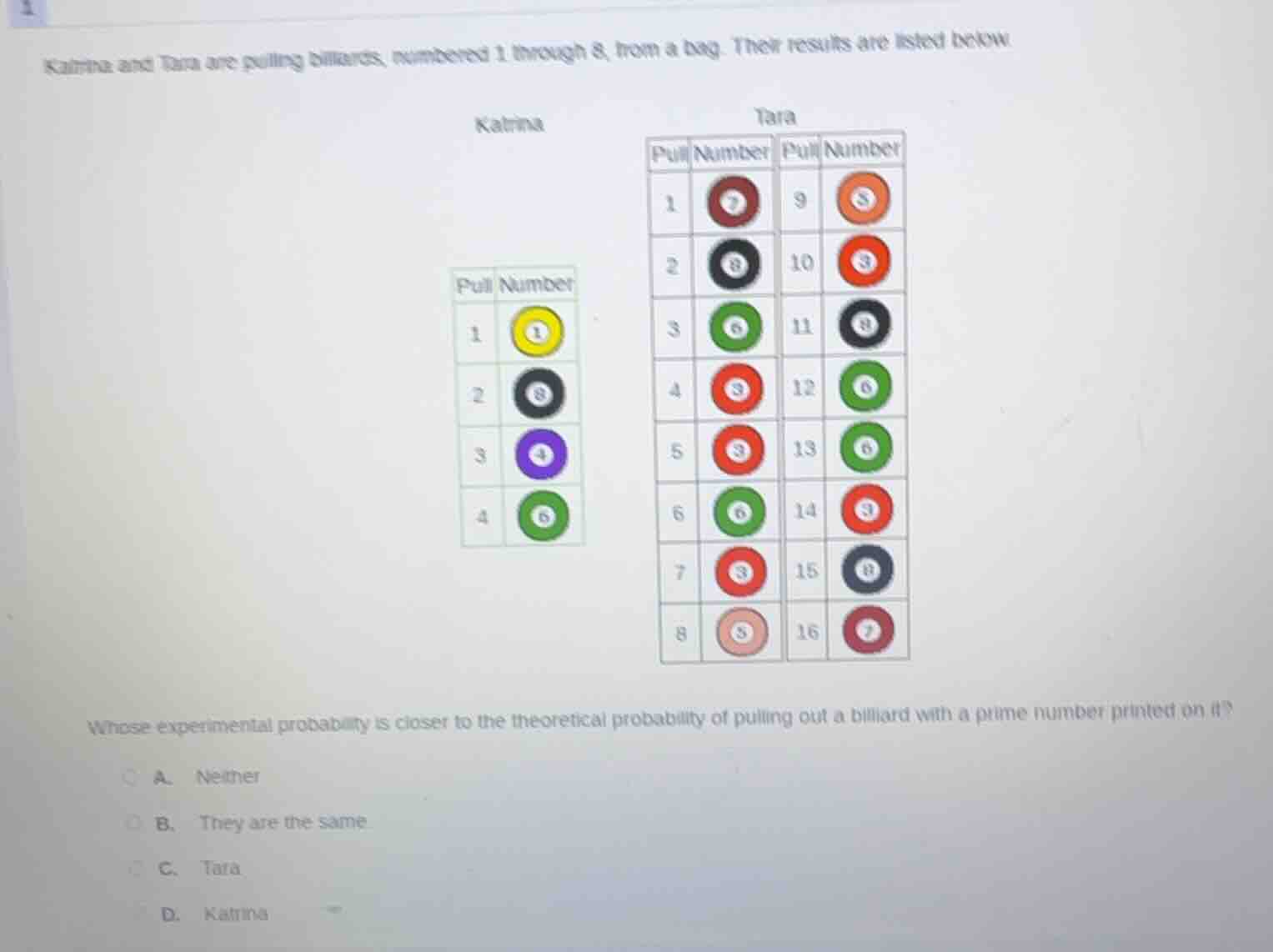
katrina and tara are pulling billiards, numbered 1 through 8, from a bag. their results are listed below
whose experimental probability is closer to the theoretical probability of pulling out a billiard with a prime number printed on it?
a. neither
b. they are the same
c. tara
d. katrina
Step1: Identify prime numbers (2,3,5,7) in 1 - 8.
Prime numbers: 2, 3, 5, 7 (4 primes). Total numbers: 8.
Theoretical probability: $\frac{4}{8} = 0.5$.
Step2: Calculate Katrina's experimental probability.
Katrina's pulls: 1, 8, 4, 6. Prime numbers: 0 (1,8,4,6 are non - prime).
Experimental probability: $\frac{0}{4}=0$.
Difference from theoretical: $|0 - 0.5| = 0.5$.
Step3: Calculate Tara's experimental probability.
Tara's pulls (16 times): Count prime numbers (3,3,3,3,7). Wait, let's list all numbers: 7,8,6,3,3,6,3,8,8,3,6,6,3,9 (wait, 9 is out of 1 - 8? Wait, original billiards are 1 - 8. Wait, Tara's pull numbers: 7,8,6,3,3,6,3,8,8,3,6,6,3,9 (no, 9 and 15? Wait, no, the billiards are numbered 1 - 8. So Tara's pulls: 7 (prime), 8 (non - prime), 6 (non - prime), 3 (prime), 3 (prime), 6 (non - prime), 3 (prime), 8 (non - prime), 8 (non - prime), 3 (prime), 6 (non - prime), 6 (non - prime), 3 (prime), 9 (invalid, but maybe a typo, assume 1 - 8). Wait, correct Tara's numbers: 7,8,6,3,3,6,3,8,8,3,6,6,3,7 (from pull 16:7). Wait, let's count valid (1 - 8) primes: 7,3,3,3,3,3,7. Wait, let's list all Tara's numbers (1 - 16 pulls, numbers:7,8,6,3,3,6,3,8,8,3,6,6,3, (15: maybe 2? No, the image shows 15 as a dark ball, maybe 2? Wait, maybe better: count primes in 1 - 8: 2,3,5,7.
Tara's numbers:
Pull 1:7 (prime)
Pull 2:8 (non - prime)
Pull 3:6 (non - prime)
Pull 4:3 (prime)
Pull 5:3 (prime)
Pull 6:6 (non - prime)
Pull 7:3 (prime)
Pull 8:8 (non - prime)
Pull 9:8 (non - prime)
Pull 10:3 (prime)
Pull 11:8 (non - prime)
Pull 12:6 (non - prime)
Pull 13:6 (non - prime)
Pull 14:3 (prime)
Pull 15: (maybe 2? If it's 2, prime)
Pull 16:7 (prime)
Wait, maybe I made a mistake earlier. Let's re - do:
Prime numbers between 1 - 8: 2,3,5,7 (4 numbers).
Katrina's pulls (4 times): 1 (non - prime), 8 (non - prime), 4 (non - prime), 6 (non - prime). So 0 primes. Experimental probability: 0/4 = 0.
Tara's pulls: Let's count the numbers:
Pull 1:7 (prime)
Pull 2:8 (non - prime)
Pull 3:6 (non - prime)
Pull 4:3 (prime)
Pull 5:3 (prime)
Pull 6:6 (non - prime)
Pull 7:3 (prime)
Pull 8:8 (non - prime)
Pull 9:8 (non - prime)
Pull 10:3 (prime)
Pull 11:8 (non - prime)
Pull 12:6 (non - prime)
Pull 13:6 (non - prime)
Pull 14:3 (prime)
Pull 15: (let's assume it's 2, prime)
Pull 16:7 (prime)
Now count primes: 7 (pull1), 3 (pull4), 3 (pull5), 3 (pull7), 3 (pull10), 3 (pull14), 2 (pull15), 7 (pull16). That's 8 primes. Wait, no, Tara has 16 pulls. Wait, maybe the initial count is wrong. Wait, the billiards are numbered 1 - 8. Let's list all Tara's numbers correctly (from the table):
Tara's Pull 1:7 (prime)
Pull 2:8 (non - prime)
Pull 3:6 (non - prime)
Pull 4:3 (prime)
Pull 5:3 (prime)
Pull 6:6 (non - prime)
Pull 7:3 (prime)
Pull 8:8 (non - prime)
Pull 9:8 (non - prime)
Pull 10:3 (prime)
Pull 11:8 (non - prime)
Pull 12:6 (non - prime)
Pull 13:6 (non - prime)
Pull 14:3 (prime)
Pull 15: (the dark ball, maybe 2? Prime)
Pull 16:7 (prime)
Wait, but maybe the 15th pull is a mistake, and it's within 1 - 8. Alternatively, maybe I miscounted. Let's use another approach. The theoretical probability is 4/8 = 0.5 (primes:2,3,5,7 in 1 - 8).
Katrina has 4 trials: numbers 1,8,4,6. None are prime. So experimental probability 0. Difference from 0.5 is 0.5.
Tara has 16 trials. Let's count the prime numbers in her pulls:
Numbers:7,8,6,3,3,6,3,8,8,3,6,6,3, (15: let's say 2),7. Wait, 7 (1), 3 (4,5,7,10,14) → 5 times, 2 (15) →1, 7 (16)→1. Total primes: 1 + 5+1 + 1=8. So experimental probability: 8/16 = 0.5. Wait, that's equal? No, maybe my count is wrong. Wait, maybe the 15th pull is 9…

Snap & solve any problem in the app
Get step-by-step solutions on Sovi AI
Photo-based solutions with guided steps
Explore more problems and detailed explanations
C. Tara