QUESTION IMAGE
Question
ken burnss civil war
peter tonguette
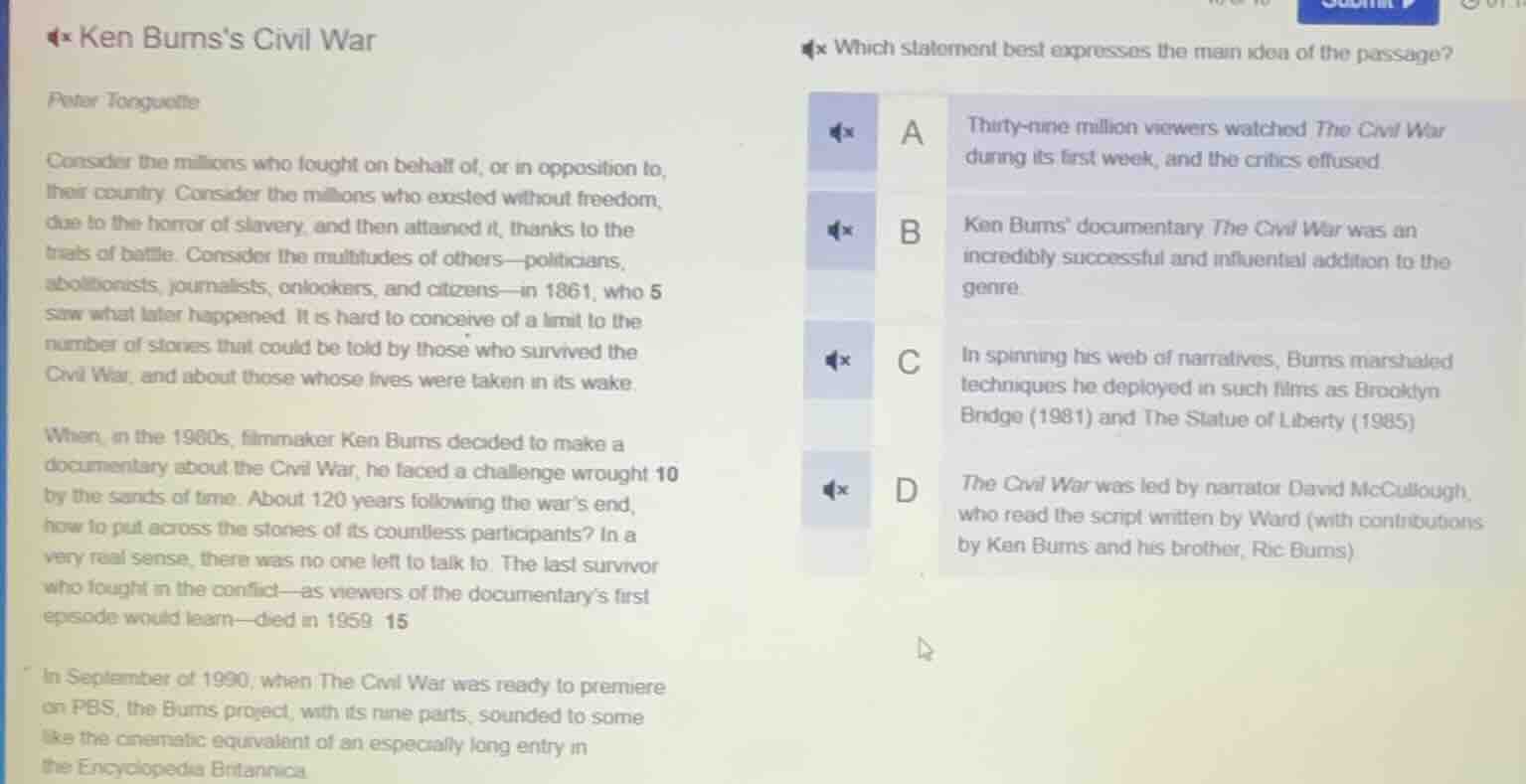
consider the millions who fought on behalf of, or in opposition to, their country. consider the millions who existed without freedom, due to the horror of slavery, and then attained it, thanks to the trials of battle. consider the multitudes of others—politicians, abolitionists, journalists, onlookers, and citizens—in 1861, who saw what later happened. it is hard to conceive of a limit to the number of stories that could be told by those who survived the civil war, and about those whose lives were taken in its wake.
when, in the 1980s, filmmaker ken burns decided to make a documentary about the civil war, he faced a challenge wrought by the sands of time. about 120 years following the war’s end, how to put across the stories of its countless participants? in a very real sense, there was no one left to talk to. the last survivor who fought in the conflict—as viewers of the documentary’s first episode would learn—died in 1959.
in september of 1990, when the civil war was ready to premiere on pbs, the burns project, with its nine parts, sounded to some like the cinematic equivalent of an especially long entry in the encyclopedia britannica.
which statement best expresses the main idea of the passage?
a thirty - nine million viewers watched the civil war during its first week, and the critics effused.
b ken burns’ documentary the civil war was an incredibly successful and influential addition to the genre.
c in spinning his web of narratives, burns marshaled techniques he deployed in such films as brooklyn bridge (1981) and the statue of liberty (1985).
d the civil war was led by narrator david mccullough, who read the script written by ward (with contributions by ken burns and his brother, ric burns).
The passage introduces the vast scope of the Civil War's stories, the challenge Ken Burns faced in creating his documentary about it, and sets up the context of the documentary's premiere. Option A only mentions viewership and critics, which is not covered in the provided excerpt. Option C focuses on filmmaking techniques, which are not discussed here. Option D only talks about the narrator and scriptwriters, a minor detail not the main idea. Option B captures the core: the documentary is a significant, impactful work in its genre, which aligns with the passage's focus on the ambitious project centered on the Civil War.

Snap & solve any problem in the app
Get step-by-step solutions on Sovi AI
Photo-based solutions with guided steps
Explore more problems and detailed explanations
B. Ken Burns' documentary The Civil War was an incredibly successful and influential addition to the genre.