QUESTION IMAGE
Question
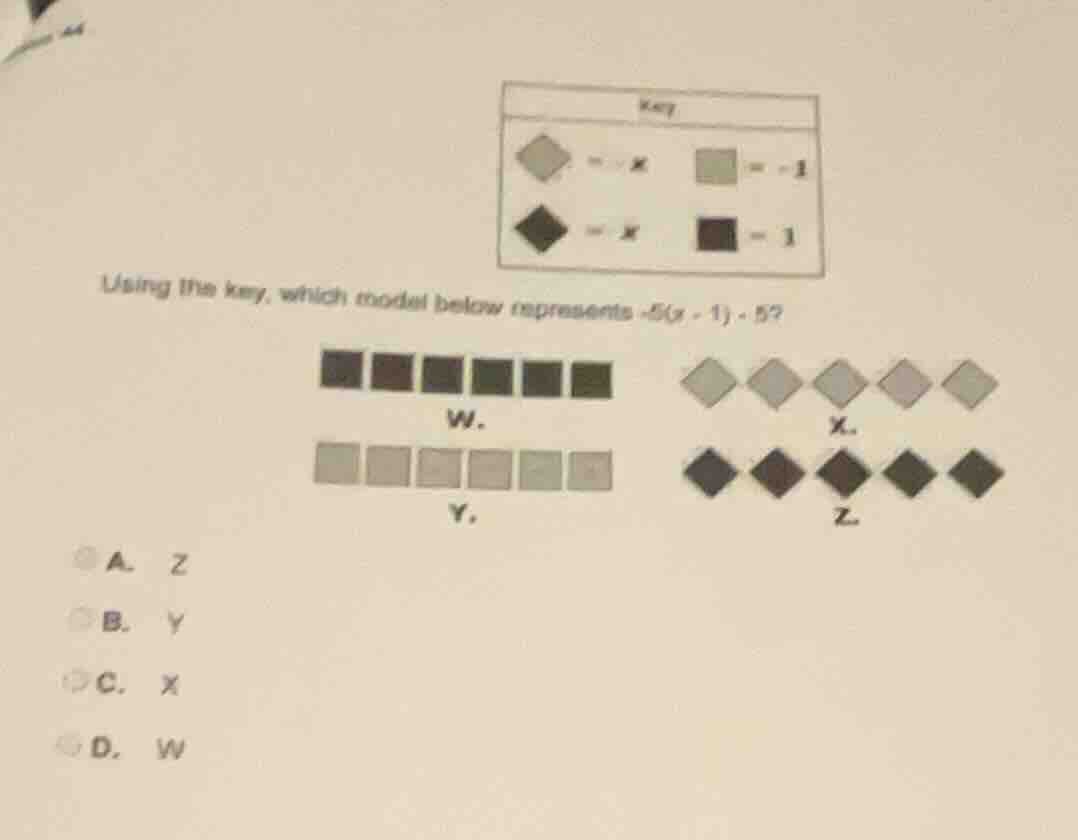
key: (light gray diamond) = -x, (light gray square) = -1; (dark diamond) = x, (dark square) = 1. using the key, which model below represents -5(x - 1) - 5? models: w (dark squares), x (light gray diamonds), y (light gray squares), z (dark diamonds). options: a. z, b. y, c. x, d. w
Step1: Simplify the expression
First, simplify \(-5(x - 1)-5\) using the distributive property. The distributive property states that \(a(b - c)=ab - ac\). So, applying it to \(-5(x - 1)\), we get \(-5x+5\). Then subtract 5: \(-5x + 5-5=-5x\).
Step2: Analyze the key and the models
From the key, the black diamond represents \(x\) and the gray diamond (light - colored diamond) represents \(-x\). We need to represent \(-5x\). Since each gray diamond is \(-x\), to get \(-5x\), we need 5 gray diamonds? Wait, no. Wait, the expression simplifies to \(-5x\). Wait, let's re - do the simplification:
\[
\]
Now, according to the key, the light - colored diamond (let's say the gray - ish one) represents \(-x\) (wait, looking at the key: the light diamond (maybe the first row, first column) is \(-x\), and the dark diamond is \(x\). Wait, the key says: light diamond (maybe the top - left) is \(-x\), dark diamond (bottom - left) is \(x\); light square is \(- 1\), dark square is \(1\).
We have the expression \(-5x\). So we need 5 of the symbols that represent \(-x\). Looking at the options:
- Option W: Dark squares (each is 1), so 6 dark squares would be 6, not related to \(-5x\).
- Option X: Light diamonds (each is \(-x\)), 5 light diamonds. Let's check: if each light diamond is \(-x\), 5 light diamonds would be \(5\times(-x)=-5x\), which matches our simplified expression. Wait, but wait, let's re - check the simplification. Wait, maybe I made a mistake in simplification.
Wait, let's re - expand \(-5(x - 1)-5\):
\[
\]
So we need to represent \(-5x\). The light diamond (from the key: the first row, first diamond) is \(-x\). So 5 light diamonds would represent \(5\times(-x)=-5x\). Wait, but in the options, X is 5 light diamonds. Wait, but let's check the options again. Wait, the options are W, X, Y, Z.
Wait, maybe I misread the key. Let's re - examine the key:
- Light diamond (top row, first diamond): \(-x\)
- Dark diamond (bottom row, first diamond): \(x\)
- Light square (top row, second square): \(-1\)
- Dark square (bottom row, second square): \(1\)
So \(-5x\) means we need 5 of the \(-x\) symbols. The light diamonds (in option X) are 5 in number, and each light diamond is \(-x\), so 5 light diamonds represent \(5\times(-x)=-5x\). Wait, but let's check the other options:
- Option Y: Light squares (each is \(-1\)), 6 light squares would be \(-6\), not \(-5x\).
- Option Z: Dark diamonds (each is \(x\)), 5 dark diamonds would be \(5x\), not \(-5x\).
- Option W: Dark squares (each is 1), 6 dark squares would be 6.
Wait, but according to the simplification, we need \(-5x\), so we need 5 of the \(-x\) symbols. The light diamonds (option X) are 5 in number and each represents \(-x\), so 5 light diamonds give \(-5x\), which is the simplified form of \(-5(x - 1)-5\). Wait, but maybe I made a mistake in the simplification. Wait, let's do the expansion again:
\[
\]
Yes, that's correct. So the model that represents \(-5x\) is the one with 5 of the \(-x\) symbols. The light diamonds (option X) are 5 in number and represent \(-x\) each, so 5 light diamonds (option X) represent \(-5x\). Wait, but the options are labeled as A. Z, B. Y, C. X, D. W? Wait, the original options are:
A. Z
B. Y
C. X
D. W
Wait, maybe I misread the options. Let's check the labels:
- W: 6 dark squares (each is 1)
- X: 5 light diamonds (each is \(-x\))
- Y: 6 light squares (each is \(-1\))
-…

Snap & solve any problem in the app
Get step-by-step solutions on Sovi AI
Photo-based solutions with guided steps
Explore more problems and detailed explanations
C. X