QUESTION IMAGE
Question
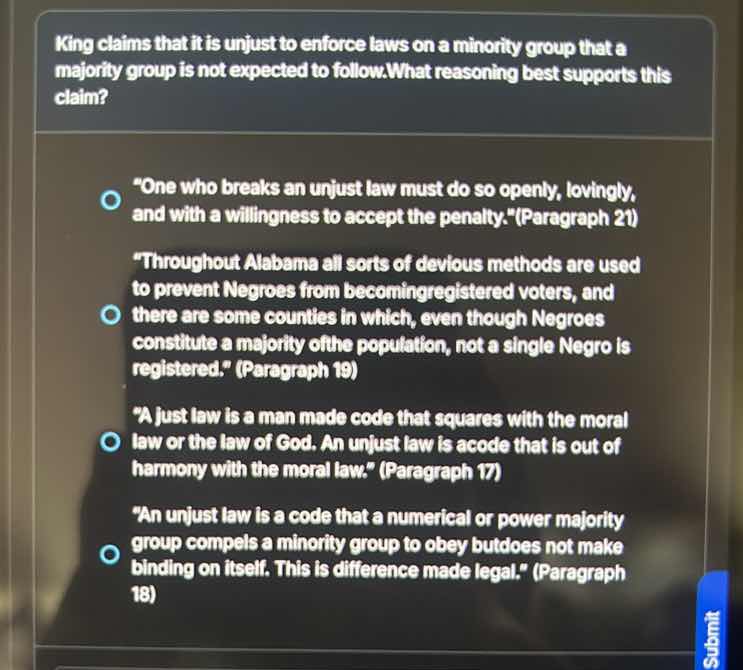
king claims that it is unjust to enforce laws on a minority group that a majority group is not expected to follow. what reasoning best supports this claim?
\one who breaks an unjust law must do so openly, lovingly, and with a willingness to accept the penalty.\(paragraph 21)
\throughout alabama all sorts of devious methods are used to prevent negroes from becoming registered voters, and there are some counties in which, even though negroes constitute a majority of the population, not a single negro is registered.\ (paragraph 19)
\a just law is a man made code that squares with the moral law or the law of god. an unjust law is a code that is out of harmony with the moral law.\ (paragraph 17)
\an unjust law is a code that a numerical or power majority group compels a minority group to obey but does not make binding on itself. this is difference made legal.\ (paragraph 18)
To support the claim that it's unjust to enforce laws on a minority that the majority isn't expected to follow, we analyze each option:
- The first option is about how to break an unjust law, not about what makes a law unjust in terms of majority - minority enforcement.
- The second option is about voter suppression methods in Alabama, not directly related to the concept of unjust laws in terms of majority - minority law enforcement.
- The third option defines just and unjust laws in terms of moral law, not in terms of majority - minority differences in law enforcement.
- The fourth option defines an unjust law as one where a majority compels a minority to obey a law that the majority does not have to follow. This directly supports the given claim.

Snap & solve any problem in the app
Get step-by-step solutions on Sovi AI
Photo-based solutions with guided steps
Explore more problems and detailed explanations
The option: "An unjust law is a code that a numerical or power majority group compels a minority group to obey but does not make binding on itself. This is difference made legal." (Paragraph 18)