QUESTION IMAGE
Question
kuta software - infinite precalculus
graphs of rational functions
name joyla allen
date 12/16/25 period
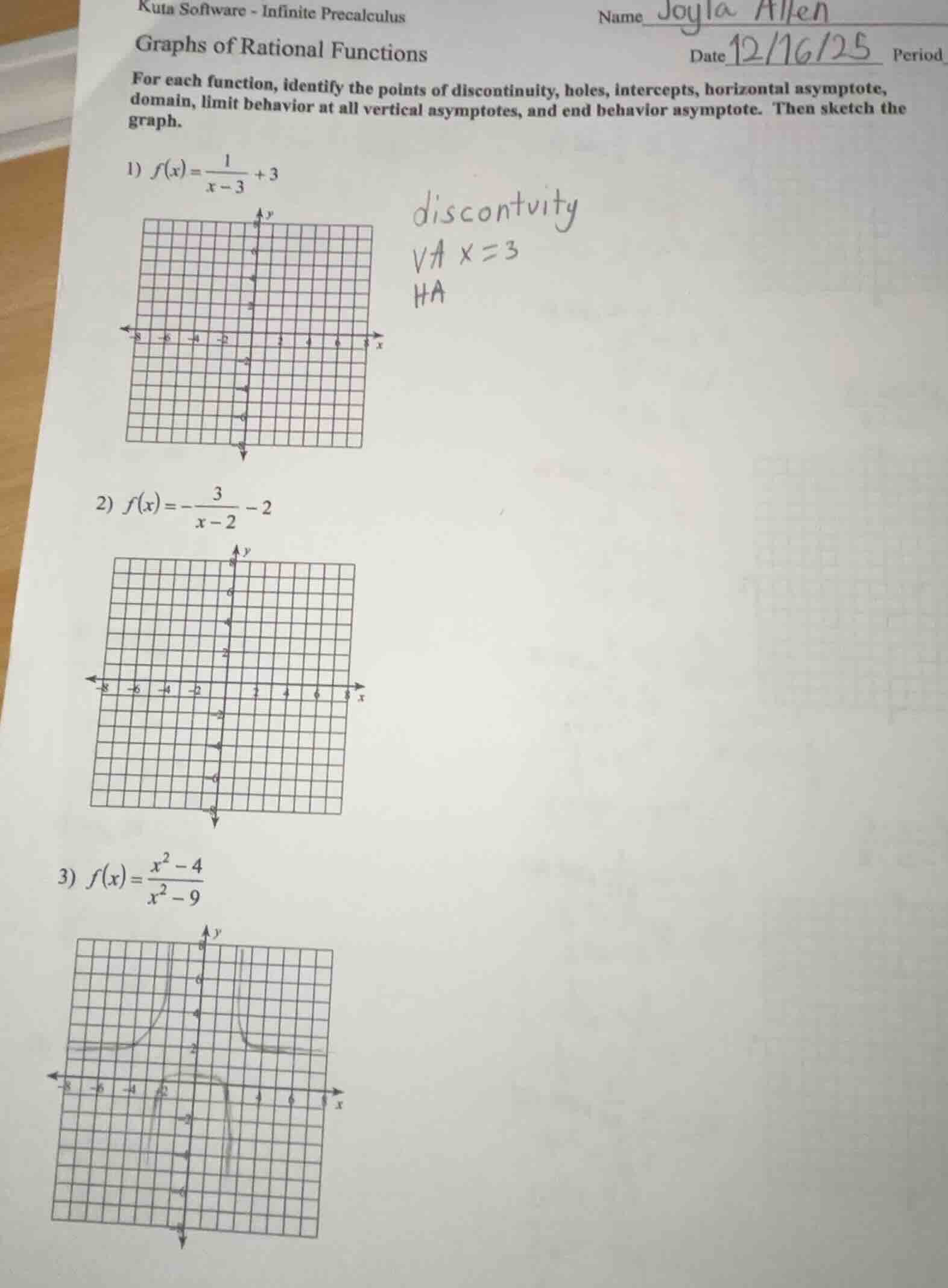
for each function, identify the points of discontinuity, holes, intercepts, horizontal asymptote,
domain, limit behavior at all vertical asymptotes, and end behavior asymptote. then sketch the
graph.
- $f(x)=\frac{1}{x - 3}+3$
- $f(x)=-\frac{3}{x - 2}-2$
- $f(x)=\frac{x^2 - 4}{x^2 - 9}$
Problem 1: \( f(x)=\frac{1}{x - 3}+3 \)
Step 1: Points of Discontinuity
A rational function is discontinuous where the denominator is zero. For \( f(x)=\frac{1}{x - 3}+3 \), the denominator \( x - 3 = 0 \) when \( x = 3 \). So, the point of discontinuity is \( x = 3 \).
Step 2: Holes
There are no common factors in the numerator and denominator (the numerator is \( 1 \), denominator is \( x - 3 \)), so there are no holes.
Step 3: Intercepts
- x - intercept: Set \( y = 0 \), so \( 0=\frac{1}{x - 3}+3 \). Subtract \( 3 \): \( - 3=\frac{1}{x - 3} \), then \( - 3(x - 3)=1 \), \( - 3x + 9 = 1 \), \( - 3x=-8 \), \( x=\frac{8}{3}\approx2.67 \).
- y - intercept: Set \( x = 0 \), \( f(0)=\frac{1}{0 - 3}+3=-\frac{1}{3}+3=\frac{8}{3}\approx2.67 \).
Step 4: Horizontal Asymptote
For a rational function \( y=\frac{a}{x - h}+k \), the horizontal asymptote is \( y = k \). Here, \( k = 3 \), so horizontal asymptote is \( y = 3 \).
Step 5: Domain
The domain is all real numbers except where the denominator is zero. So, domain is \( (-\infty,3)\cup(3,\infty) \).
Step 6: Limit Behavior at Vertical Asymptote (\( x = 3 \))
- As \( x
ightarrow3^{+} \), \( x - 3
ightarrow0^{+} \), so \( \frac{1}{x - 3}
ightarrow+\infty \), then \( f(x)=\frac{1}{x - 3}+3
ightarrow+\infty \).
- As \( x
ightarrow3^{-} \), \( x - 3
ightarrow0^{-} \), so \( \frac{1}{x - 3}
ightarrow-\infty \), then \( f(x)=\frac{1}{x - 3}+3
ightarrow-\infty \).
Step 7: End - Behavior Asymptote
The end - behavior is determined by the horizontal asymptote \( y = 3 \). As \( x
ightarrow\pm\infty \), \( \frac{1}{x - 3}
ightarrow0 \), so \( f(x)
ightarrow3 \).
Problem 2: \( f(x)=-\frac{3}{x - 2}-2 \)
Step 1: Points of Discontinuity
Denominator \( x - 2 = 0 \) when \( x = 2 \), so point of discontinuity is \( x = 2 \).
Step 2: Holes
No common factors in numerator (\( - 3 \)) and denominator (\( x - 2 \)), so no holes.
Step 3: Intercepts
- x - intercept: Set \( y = 0 \), \( 0=-\frac{3}{x - 2}-2 \). Add \( 2 \): \( 2=-\frac{3}{x - 2} \), \( 2(x - 2)=-3 \), \( 2x-4=-3 \), \( 2x = 1 \), \( x=\frac{1}{2}=0.5 \).
- y - intercept: Set \( x = 0 \), \( f(0)=-\frac{3}{0 - 2}-2=\frac{3}{2}-2=-\frac{1}{2}=-0.5 \).
Step 4: Horizontal Asymptote
For \( y =-\frac{3}{x - 2}-2 \), the horizontal asymptote is \( y=-2 \) (since \( k=-2 \) in the form \( y=\frac{a}{x - h}+k \)).
Step 5: Domain
All real numbers except \( x = 2 \), so domain is \( (-\infty,2)\cup(2,\infty) \).
Step 6: Limit Behavior at Vertical Asymptote (\( x = 2 \))
- As \( x
ightarrow2^{+} \), \( x - 2
ightarrow0^{+} \), \( -\frac{3}{x - 2}
ightarrow-\infty \), so \( f(x)=-\frac{3}{x - 2}-2
ightarrow-\infty \).
- As \( x
ightarrow2^{-} \), \( x - 2
ightarrow0^{-} \), \( -\frac{3}{x - 2}
ightarrow+\infty \), so \( f(x)=-\frac{3}{x - 2}-2
ightarrow+\infty \).
Step 7: End - Behavior Asymptote
As \( x
ightarrow\pm\infty \), \( -\frac{3}{x - 2}
ightarrow0 \), so \( f(x)
ightarrow - 2 \).
Problem 3: \( f(x)=\frac{x^{2}-4}{x^{2}-9} \)
Step 1: Points of Discontinuity
Denominator \( x^{2}-9=(x - 3)(x + 3)=0 \) when \( x = 3 \) or \( x=-3 \), so points of discontinuity are \( x = 3 \) and \( x=-3 \).
Step 2: Holes
Factor numerator and denominator: numerator \( x^{2}-4=(x - 2)(x + 2) \), denominator \( x^{2}-9=(x - 3)(x + 3) \). No common factors, so no holes.
Step 3: Intercepts
- x - intercept: Set \( y = 0 \), so \( x^{2}-4 = 0 \), \( (x - 2)(x + 2)=0 \), \( x = 2 \) or \( x=-2 \).
- y - intercept: Set \( x = 0 \), \( f(0)=\frac{0 - 4}{0 - 9}=\frac{4}{9}\approx0.44 \).
Step 4: Horizontal Asymptote
For a rational function \( \frac{ax^{n}+...}{bx^{m}+...} \), if \( n = m \), horizontal asymptote is \( y=\frac{a}{b} \). Here, \( a = 1 \), \( b = 1 \), so horizontal asymptote is \( y = 1 \).
Step 5: Domain
All real numbers except \( x = 3 \) and \( x=-3 \), so domain is \( (-\infty,-3)\cup(-3,3)\cup(3,\infty) \).
Step 6: Limit Behavior at Vertical Asymptotes
- At \( x = 3 \):
- As \( x
ightarrow3^{+} \), \( x^{2}-9
ightarrow0^{+} \), \( x^{2}-4
ightarrow9 - 4 = 5>0 \), so \( f(x)=\frac{x^{2}-4}{x^{2}-9}
ightarrow+\infty \).
- As \( x
ightarrow3^{-} \), \( x^{2}-9
ightarrow0^{-} \), \( x^{2}-4
ightarrow5>0 \), so \( f(x)=\frac{x^{2}-4}{x^{2}-9}
ightarrow-\infty \).
- At \( x=-3 \):
- As \( x
ightarrow - 3^{+} \), \( x^{2}-9
ightarrow0^{+} \), \( x^{2}-4
ightarrow9 - 4 = 5>0 \), so \( f(x)=\frac{x^{2}-4}{x^{2}-9}
ightarrow+\infty \).
- As \( x
ightarrow - 3^{-} \), \( x^{2}-9
ightarrow0^{-} \), \( x^{2}-4
ightarrow5>0 \), so \( f(x)=\frac{x^{2}-4}{x^{2}-9}
ightarrow-\infty \).
Step 7: End - Behavior Asymptote
As \( x
ightarrow\pm\infty \), \( \frac{x^{2}-4}{x^{2}-9}=\frac{1-\frac{4}{x^{2}}}{1-\frac{9}{x^{2}}}
ightarrow\frac{1}{1}=1 \), so end - behavior asymptote is \( y = 1 \).

Snap & solve any problem in the app
Get step-by-step solutions on Sovi AI
Photo-based solutions with guided steps
Explore more problems and detailed explanations
(Summary for each function):
Function 1: \( f(x)=\frac{1}{x - 3}+3 \)
- Discontinuity: \( x = 3 \)
- Holes: None
- x - intercept: \( x=\frac{8}{3} \), y - intercept: \( y=\frac{8}{3} \)
- Horizontal Asymptote: \( y = 3 \)
- Domain: \( (-\infty,3)\cup(3,\infty) \)
- Limit at \( x = 3 \): \( x
ightarrow3^{+},f(x)
ightarrow+\infty \); \( x
ightarrow3^{-},f(x)
ightarrow-\infty \)
- End - behavior: \( y = 3 \)
Function 2: \( f(x)=-\frac{3}{x - 2}-2 \)
- Discontinuity: \( x = 2 \)
- Holes: None
- x - intercept: \( x=\frac{1}{2} \), y - intercept: \( y =-\frac{1}{2} \)
- Horizontal Asymptote: \( y=-2 \)
- Domain: \( (-\infty,2)\cup(2,\infty) \)
- Limit at \( x = 2 \): \( x
ightarrow2^{+},f(x)
ightarrow-\infty \); \( x
ightarrow2^{-},f(x)
ightarrow+\infty \)
- End - behavior: \( y=-2 \)
Function 3: \( f(x)=\frac{x^{2}-4}{x^{2}-9} \)
- Discontinuity: \( x = 3,x=-3 \)
- Holes: None
- x - intercept: \( x = 2,x=-2 \), y - intercept: \( y=\frac{4}{9} \)
- Horizontal Asymptote: \( y = 1 \)
- Domain: \( (-\infty,-3)\cup(-3,3)\cup(3,\infty) \)
- Limit at \( x = 3 \): \( x
ightarrow3^{+},f(x)
ightarrow+\infty \); \( x
ightarrow3^{-},f(x)
ightarrow-\infty \); At \( x=-3 \): \( x
ightarrow - 3^{+},f(x)
ightarrow+\infty \); \( x
ightarrow - 3^{-},f(x)
ightarrow-\infty \)
- End - behavior: \( y = 1 \)