QUESTION IMAGE
Question
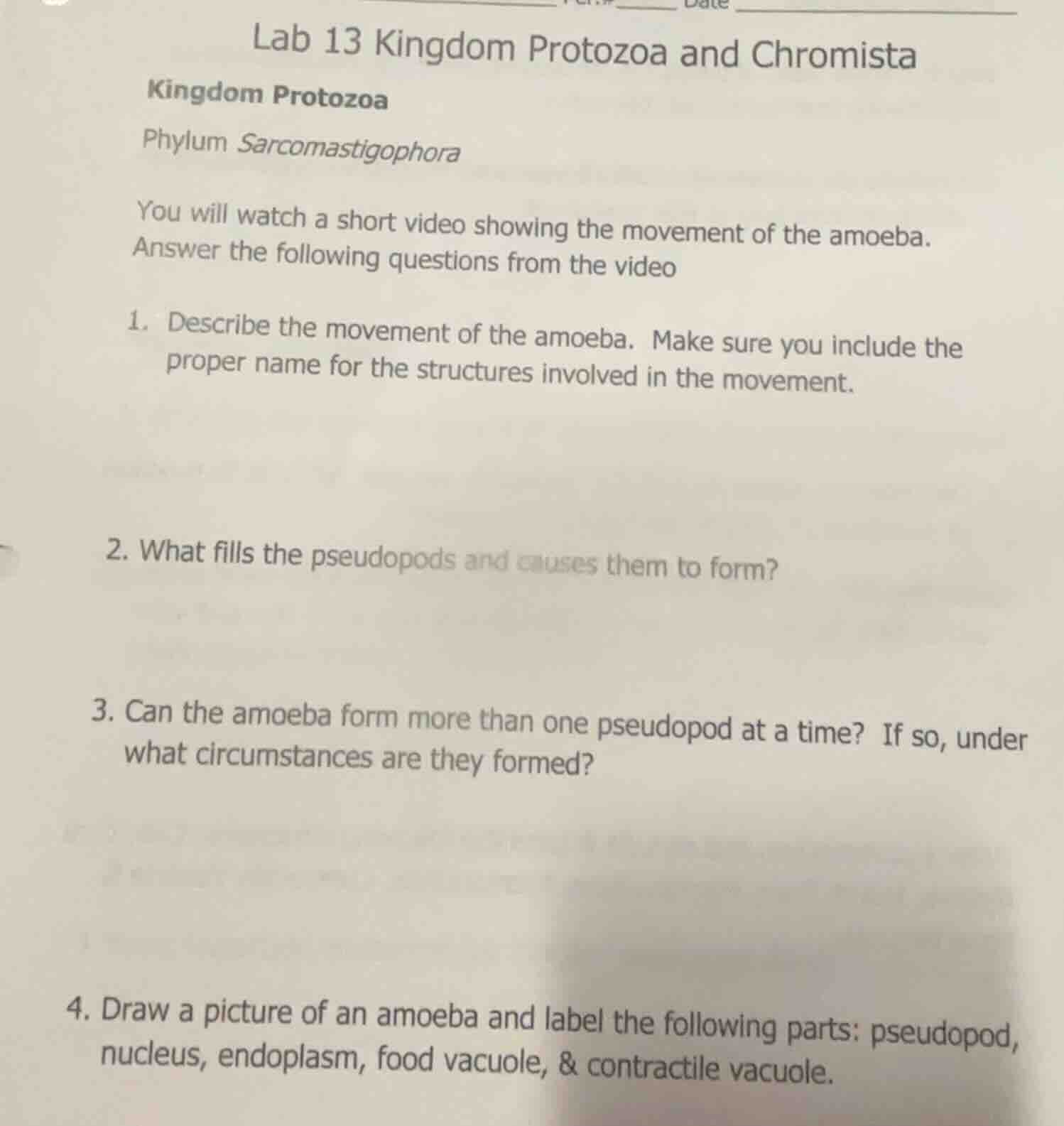
lab 13 kingdom protozoa and chromistakingdom protozoaphylum sarcomastigophorayou will watch a short video showing the movement of the amoeba.answer the following questions from the video1. describe the movement of the amoeba. make sure you include the proper name for the structures involved in the movement.2. what fills the pseudopods and causes them to form?3. can the amoeba form more than one pseudopod at a time? if so, under what circumstances are they formed?4. draw a picture of an amoeba and label the following parts: pseudopod, nucleus, endoplasm, food vacuole, & contractile vacuole.
- Amoeboid movement uses temporary extensions called pseudopods (false feet). The amoeba extends a pseudopod by pushing cytoplasm forward, then the rest of the cell flows into this extension.
- Cytoplasm (specifically the liquid endoplasm) flows into the pseudopod, causing it to extend and form.
- Yes, amoebas can form multiple pseudopods at once. This often occurs when the organism is navigating toward food sources, avoiding harmful stimuli, or exploring its environment.
- A labeled amoeba drawing includes:
- Pseudopod: Bulbous, temporary extension of the cell
- Nucleus: Round, central organelle
- Endoplasm: Inner, fluid cytoplasm
- Food vacuole: Membrane-bound sac containing food
- Contractile vacuole: Sac that expels excess water

Snap & solve any problem in the app
Get step-by-step solutions on Sovi AI
Photo-based solutions with guided steps
Explore more problems and detailed explanations
- The amoeba moves via amoeboid movement, using temporary, finger-like structures called pseudopods. The cell extends a pseudopod by pushing cytoplasm into it, then the rest of the cell body flows into this extension to move forward.
- Cytoplasm (specifically the endoplasm, the inner, more fluid portion of the cell's cytoplasm) fills the pseudopods and causes them to form as it flows into the extended cell membrane.
- Yes, an amoeba can form more than one pseudopod at a time. This typically happens when the amoeba is detecting and moving toward food sources, avoiding unfavorable environmental conditions (like toxins or extreme pH), or exploring a new area to find resources.
- (Description of the labeled drawing):
- Draw an irregular, blob-shaped cell.
- Label one or more bulbous, outward extensions as pseudopod.
- Label a round, dark structure near the center as nucleus.
- Label the inner, fluid-filled region of the cell as endoplasm.
- Label a small, membrane-bound sac within the cytoplasm as food vacuole.
- Label another small sac (often near the cell edge) as contractile vacuole.