QUESTION IMAGE
Question
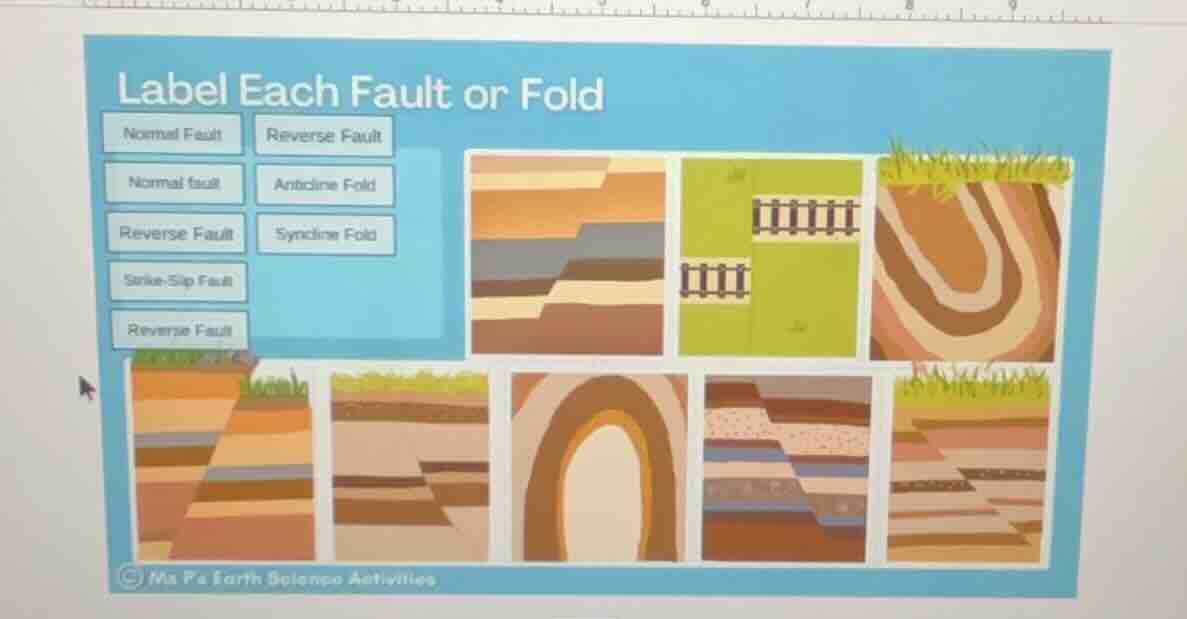
label each fault or fold; normal fault, reverse fault, normal fault, anticline fold, reverse fault, syncline fold, strike - slip fault, reverse fault
Brief Explanations
- Top left (offset horizontal layers, hanging wall drops): This matches a normal fault, where tensional stress pulls crust apart, and the hanging wall moves down relative to the footwall.
- Top middle (offset fence, horizontal slip): This is a strike-slip fault, where blocks slide horizontally past each other, offsetting linear features like fences.
- Top right (U-shaped downward fold): This is a syncline fold, a downward-curving fold where the youngest rock layers are at the center.
- Bottom left (hanging wall rises over footwall): This is a reverse fault, where compressional stress pushes crust together, and the hanging wall moves up relative to the footwall.
- Bottom middle-left (offset layers, hanging wall drops): This is a normal fault, with the hanging wall moving down from the footwall due to tension.
- Bottom middle (arched upward fold): This is an anticline fold, an upward-curving fold where the oldest rock layers are at the center.
- Bottom middle-right (hanging wall rises over footwall): This is a reverse fault, caused by compression pushing the hanging wall upward relative to the footwall.
- Bottom right (offset layers, hanging wall drops): This is a normal fault, with the hanging wall displaced downward from the footwall.

Snap & solve any problem in the app
Get step-by-step solutions on Sovi AI
Photo-based solutions with guided steps
Explore more problems and detailed explanations
- Top left image: Normal Fault
- Top middle image: Strike-Slip Fault
- Top right image: Syncline Fold
- Bottom left image: Reverse Fault
- Bottom middle-left image: Normal fault
- Bottom middle image: Anticline Fold
- Bottom middle-right image: Reverse Fault
- Bottom right image: Normal Fault