QUESTION IMAGE
Question
land and water (absorption of energy)
name: miliyah warren date: 2/2/26
mark the text
instructions:
- circle the name of the star that provides earth with energy.
- underline the definition of heat.
- box the two different materials that make up the earths surface.
- put a star (★) next to the sentence that explains why land gets hotter than wa
reading passage:
the sun is the star at the center of our solar system. it provides the earth with energy and wa heat is a kind of energy that warms things up. this energy travels from the suns core to its surface, th makes a speedy trip to earth in the form of light and heat.
when this energy reaches us, it hits the earths surface, which is made up of different types of land and water. these two surfaces absorb the suns heat at different rates. on a beach, the sunlight is absorbed by the sand, making it hot to the touch. because the land is darker in color, it soaks up more energy.
water is different. instead of soaking up all the warmth, water reflects more of it. reflection is when the suns energy bounces off a surface in a different direction. because lighter - colored things like water reflect more heat, the ocean stays much cooler than the sand during a sunny day.
section 1: true or false: circle the correct answer based on the video.
- true / false: heat is a form of energy that warms things up.
- true / false: 100% of the suns energy reaches the earths surface.
- true / false: darker colored objects generally absorb more heat than lighter colored objects.
- true / false: water reflects more of the suns energy than land does.
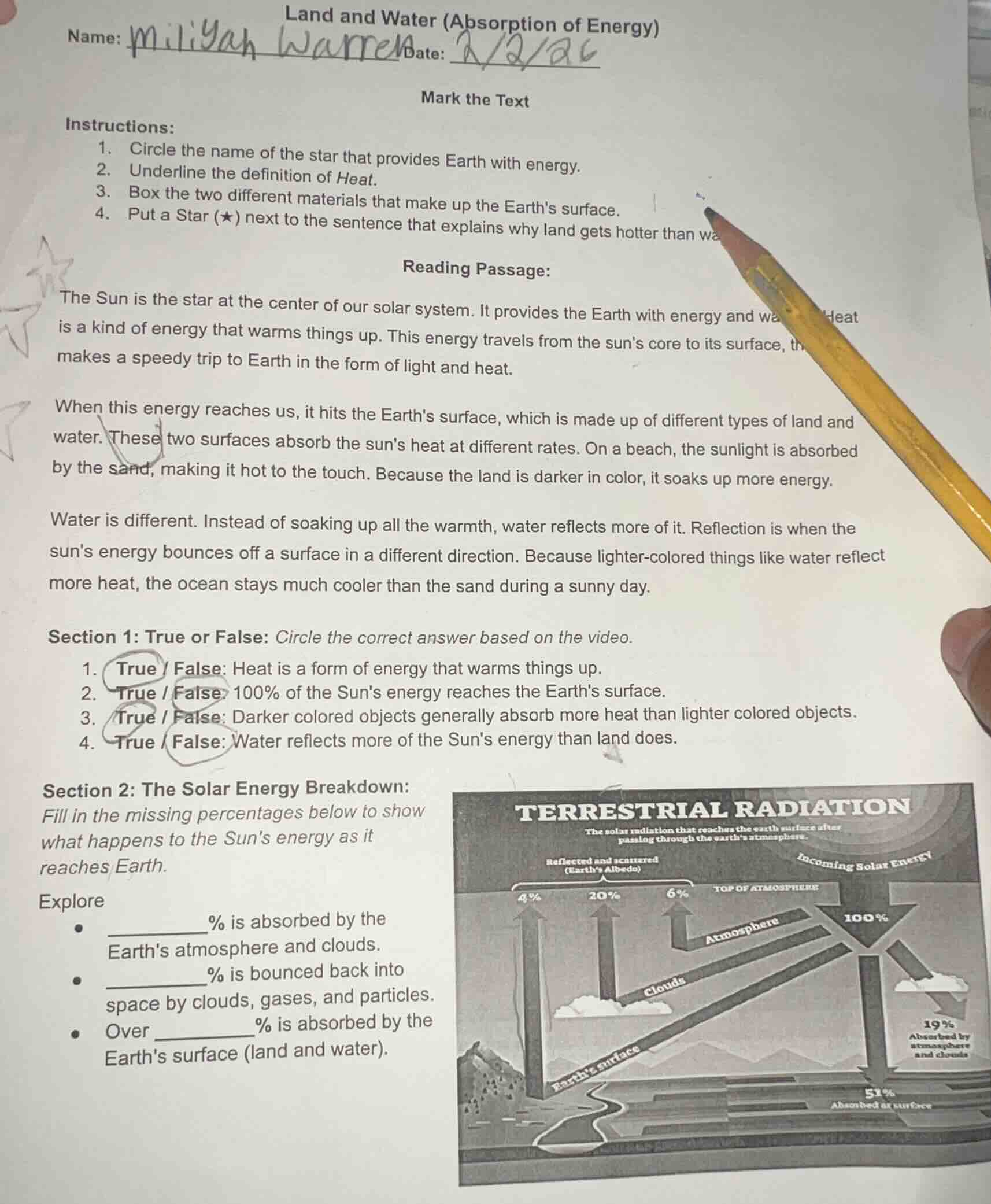
section 2: the solar energy breakdown:
fill in the missing percentages below to show what happens to the suns energy as it reaches earth.
explore
- ______% is absorbed by the earths atmosphere and clouds.
- ______% is bounced back into space by clouds, gases, and particles.
- over ______% is absorbed by the earths surface (land and water).
terrestrial radiation
the solar radiation that reaches the earth surface after passing through the earths atmosphere.
reflected and scattered (earths albedo)
incoming solar energy
4% 20% 6%
top of atmosphere
100%
atmosphere
19%
absorbed by atmosphere and clouds
51%
absorbed at surface
earths surface
clouds
Section 1: True or False
- Answer: True
**: The passage states "Heat is a kind of energy that warms things up."
- Answer: False
**: The diagram (and general knowledge) shows not all solar energy reaches the surface (e.g., some is reflected/scattered).
- Answer: True
**: The passage says "Because the land is darker in color, it soaks up more energy," implying darker objects absorb more heat.
- Answer: True

Snap & solve any problem in the app
Get step-by-step solutions on Sovi AI
Photo-based solutions with guided steps
Explore more problems and detailed explanations
**: The passage states "Water is different. Instead of soaking up all the warmth, water reflects more of it" compared to land.
Section 2: Solar Energy Breakdown
Using the diagram:
- First blank: 19% (labeled "Absorbed by atmosphere and clouds").
- Second blank: 20% (labeled "Reflected and scattered (Earth’s Albedo)" from clouds).
- Third blank: 51% (labeled "Absorbed at surface", so "Over 50%" or directly 51).
Final Answers
Section 1:
- True
- False
- True
- True
Section 2:
- 19% is absorbed by the Earth’s atmosphere and clouds.
- 20% is bounced back into space by clouds, gases, and particles.
- Over 51% is absorbed by the Earth’s surface (land and water).