QUESTION IMAGE
Question
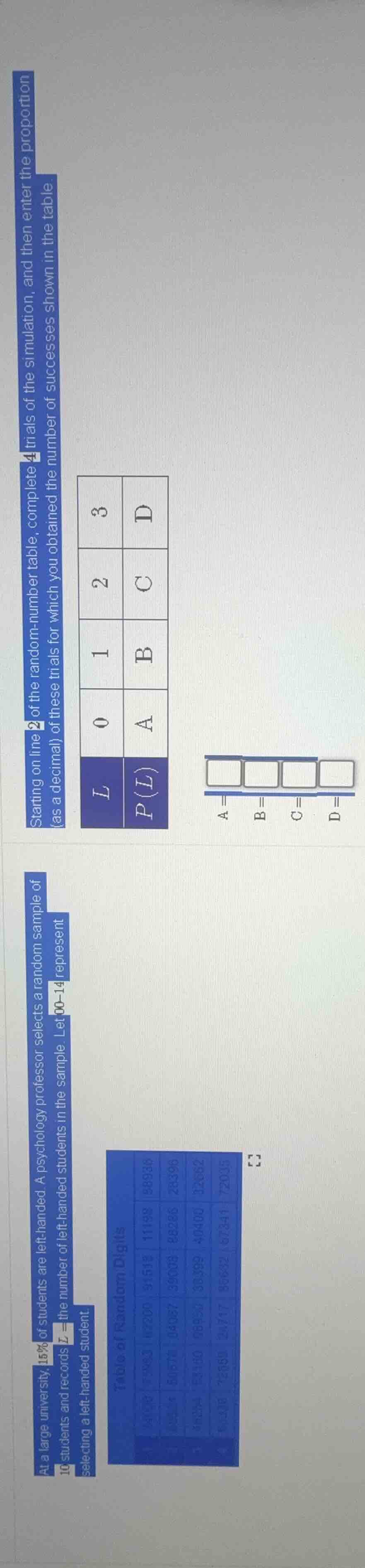
at a large university, 15% of students are left - handed. a psychology professor selects a random sample of 10 students and records ( l=) the number of left - handed students in the sample. let 00 - 14 represent selecting a left - handed student. starting on line 2 of the random - number table, complete 4 trials of the simulation, and then enter the proportion (as a decimal) of these trials for which you obtained the number of successes shown in the table.
the table for ( l) and ( p(l)) is:
| ( l) | 0 | 1 | 2 | 3 |
|---|
there is also a table of random digits and a place to fill in a, b, c, d with boxes labeled a =, b =, c =, d =.
Step1: Understand the problem
We know that 15% of students are left - handed. So the probability of a student being left - handed ($p = 0.15$) and right - handed ($q=1 - 0.15 = 0.85$). We are simulating the number of left - handed students ($L$) in a sample of $n = 10$ students. We will use the binomial probability formula $P(X=k)=C(n,k)\times p^{k}\times q^{n - k}$, where $C(n,k)=\frac{n!}{k!(n - k)!}$ and $n = 10$, $p = 0.15$, $q = 0.85$.
Step2: Calculate $P(L = 0)$ (A)
For $k = 0$:
$C(10,0)=\frac{10!}{0!(10 - 0)!}=1$
$P(L = 0)=C(10,0)\times(0.15)^{0}\times(0.85)^{10}$
$(0.15)^{0}=1$, $(0.85)^{10}\approx0.1969$
So $P(L = 0)\approx1\times1\times0.1969 = 0.1969$
Step3: Calculate $P(L = 1)$ (B)
For $k = 1$:
$C(10,1)=\frac{10!}{1!(10 - 1)!}=\frac{10!}{1!9!}=10$
$P(L = 1)=C(10,1)\times(0.15)^{1}\times(0.85)^{9}$
$(0.15)^{1}=0.15$, $(0.85)^{9}\approx0.2317$
$P(L = 1)=10\times0.15\times0.2317 = 1.5\times0.2317\approx0.3476$
Step4: Calculate $P(L = 2)$ (C)
For $k = 2$:
$C(10,2)=\frac{10!}{2!(10 - 2)!}=\frac{10\times9}{2\times1}=45$
$P(L = 2)=C(10,2)\times(0.15)^{2}\times(0.85)^{8}$
$(0.15)^{2}=0.0225$, $(0.85)^{8}\approx0.2726$
$P(L = 2)=45\times0.0225\times0.2726=1.0125\times0.2726\approx0.2760$
Step5: Calculate $P(L = 3)$ (D)
For $k = 3$:
$C(10,3)=\frac{10!}{3!(10 - 3)!}=\frac{10\times9\times8}{3\times2\times1}=120$
$P(L = 3)=C(10,3)\times(0.15)^{3}\times(0.85)^{7}$
$(0.15)^{3}=0.003375$, $(0.85)^{7}\approx0.3207$
$P(L = 3)=120\times0.003375\times0.3207 = 0.405\times0.3207\approx0.1299$

Snap & solve any problem in the app
Get step-by-step solutions on Sovi AI
Photo-based solutions with guided steps
Explore more problems and detailed explanations
$A\approx0.197$, $B\approx0.348$, $C\approx0.276$, $D\approx0.130$ (If we consider the random digit table simulation, we can also count the number of times 00 - 14 (representing left - handed) appears in groups of 10 digits. Let's assume we have 4 groups of 10 - digit numbers from the table.
Suppose the first group of 10 digits: count the number of two - digit numbers between 00 - 14. Let's say in the first line of random digits, for 10 students, we check each two - digit number.
But if we use the binomial approach as above, the values are approximately:
$A = 0.197$, $B = 0.348$, $C = 0.276$, $D = 0.130$)