QUESTION IMAGE
Question
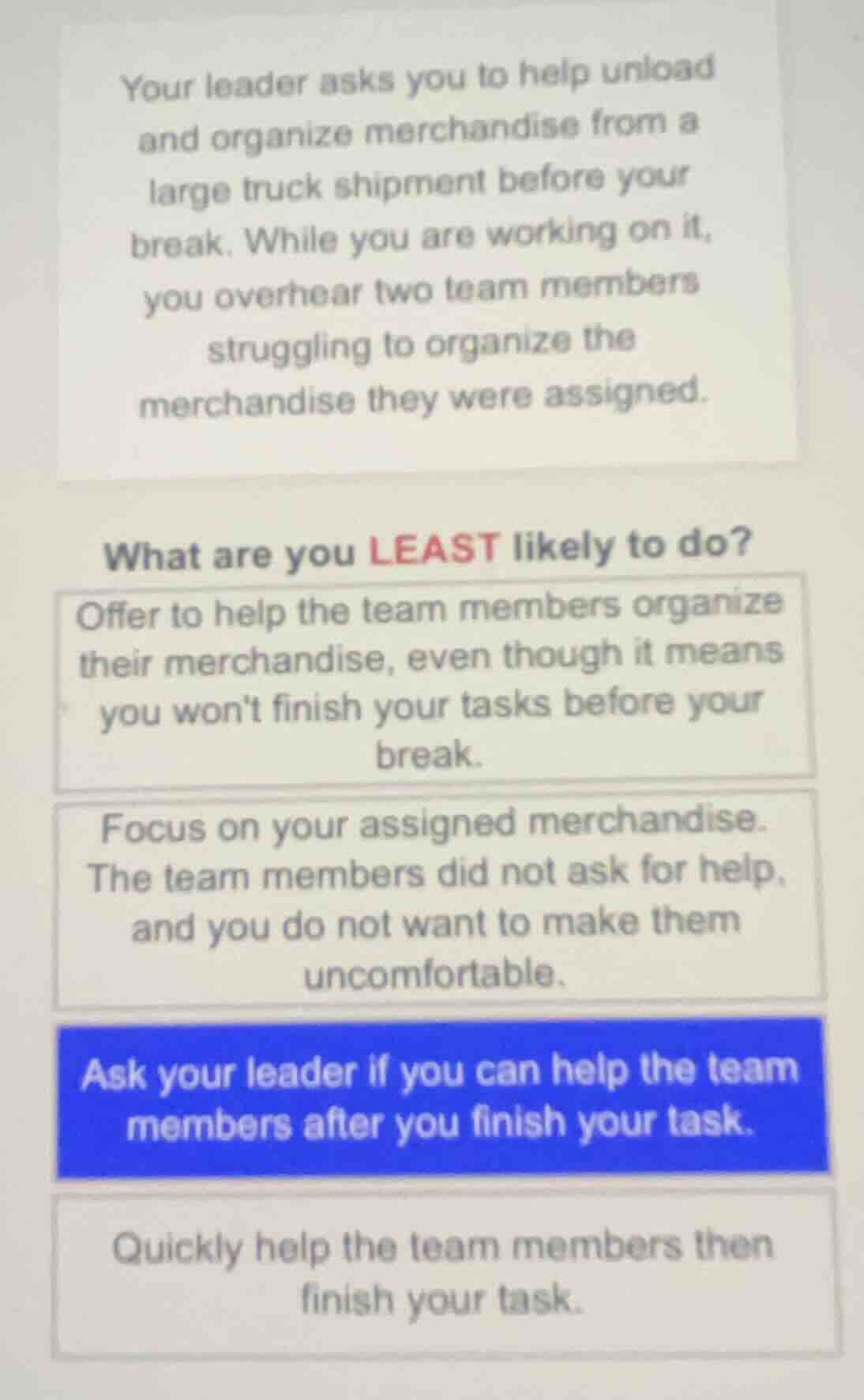
your leader asks you to help unload and organize merchandise from a large truck shipment before your break. while you are working on it, you overhear two team members struggling to organize the merchandise they were assigned. what are you least likely to do? offer to help the team members organize their merchandise, even though it means you wont finish your tasks before your break. focus on your assigned merchandise. the team members did not ask for help, and you do not want to make them uncomfortable. ask your leader if you can help the team members after you finish your task. quickly help the team members then finish your task.
To determine the least likely action, we analyze each option:
- Option 1: Helping others even if it means not finishing your own task before break is a very helpful but less likely in a work context where personal tasks are also important.
- Option 2: Focusing on your own task and not helping (since they didn't ask and you don't want to make them uncomfortable) is a more self - focused approach, but in a team - oriented work environment, this is less collaborative but still a possible action. Wait, no, let's re - evaluate. The question is which is LEAST likely. Let's look at the options again.
- Option 3: Asking the leader if you can help after finishing your task is a balanced approach, considering both your task and helping others.
- Option 4: Quickly helping and then finishing your task is also a proactive and team - oriented approach.
Now, Option 1: Offering to help even if it means you won't finish your tasks before your break. In a work setting, usually, one is expected to complete their assigned tasks on time (before break). So sacrificing your own task completion (before break) to help others, when there are other options like asking the leader after finishing or quickly helping and then finishing, makes this the least likely action. Because it directly impacts your own task completion which is assigned by the leader.
Wait, maybe I got it wrong. Let's re - assess. The options:
- Offer to help, even if you won't finish your tasks before break.
- Focus on your assigned merchandise (don't help as they didn't ask).
- Ask leader if you can help after finishing your task.
- Quickly help then finish your task.
In a typical work scenario, the least likely action would be Option 1. Because in most workplaces, you are responsible for your own tasks first. So offering to help at the cost of not finishing your own task (before break) is less likely than the other options. Option 2: focusing on your own task is a more self - centered but possible action (some people might not want to interfere if not asked). But Option 1: giving up on your own task (before break) to help others, when there are better ways (like Option 3 or 4) to help without sacrificing your own task, is the least likely.

Snap & solve any problem in the app
Get step-by-step solutions on Sovi AI
Photo-based solutions with guided steps
Explore more problems and detailed explanations
A. Offer to help the team members organize their merchandise, even though it means you won't finish your tasks before your break.