QUESTION IMAGE
Question
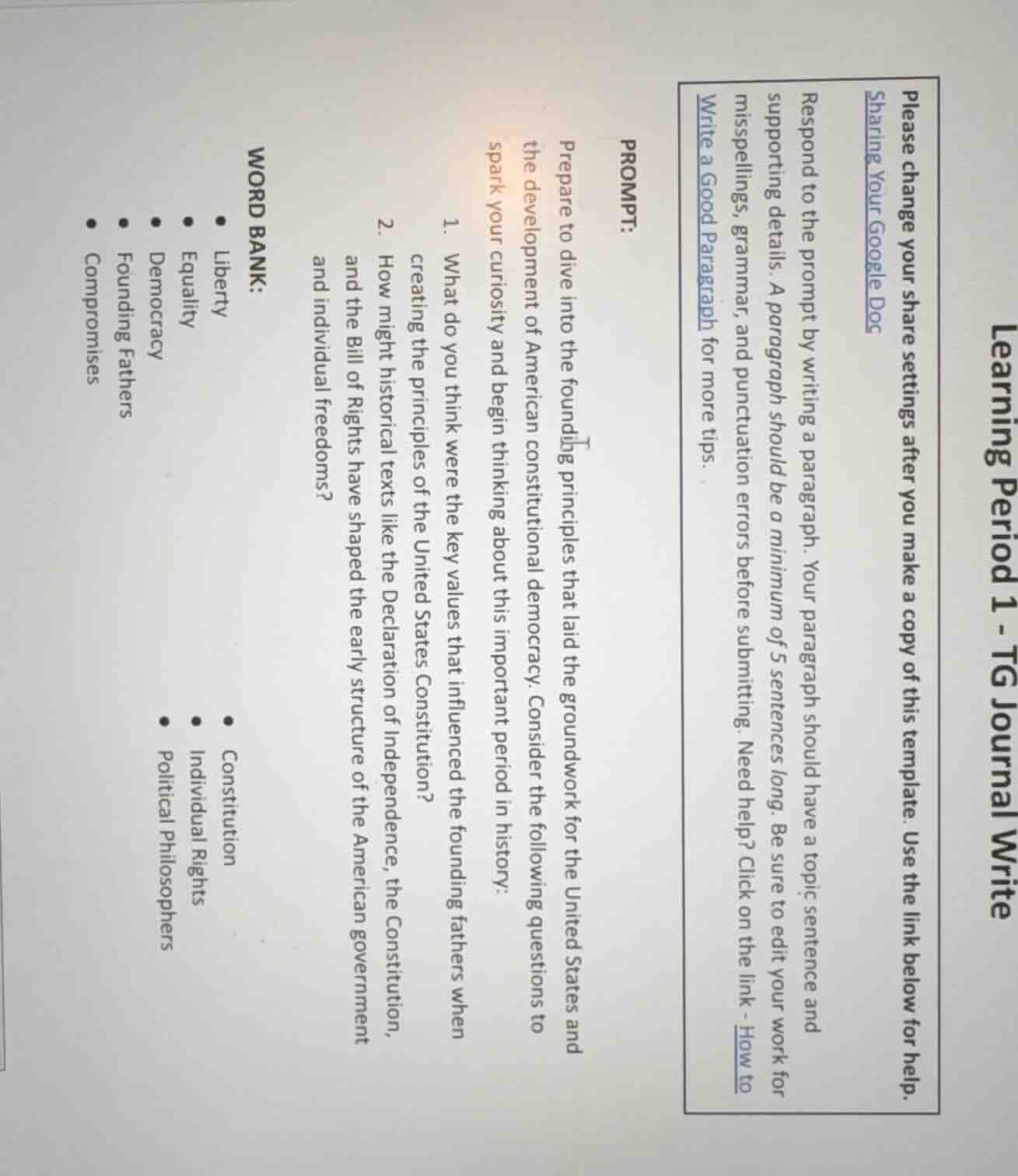
learning period 1 - tg journal write
please change your share settings after you make a copy of this template. use the link below for help.
sharing your google doc
respond to the prompt by writing a paragraph. your paragraph should have a topic sentence and supporting details. a paragraph should be a minimum of 5 sentences long. be sure to edit your work for misspellings, grammar, and punctuation errors before submitting. need help? click on the link - how to write a good paragraph for more tips.
prompt:
prepare to dive into the founding principles that laid the groundwork for the united states and the development of american constitutional democracy. consider the following questions to spark your curiosity and begin thinking about this important period in history:
- what do you think were the key values that influenced the founding fathers when creating the principles of the united states constitution?
- how might historical texts like the declaration of independence, the constitution, and the bill of rights have shaped the early structure of the american government and individual freedoms?
word bank:
- liberty
- equality
- democracy
- founding fathers
- compromises
- constitution
- individual rights
- political philosophers
To address the prompt, first establish a clear topic sentence tying key values to U.S. founding principles. Then, connect Enlightenment-influenced values like liberty, equality, and individual rights to the Founding Fathers' work, reference core texts (Declaration of Independence, Constitution, Bill of Rights) as shapers of early government structure, and wrap up with how these foundations anchored American constitutional democracy.

Snap & solve any problem in the app
Get step-by-step solutions on Sovi AI
Photo-based solutions with guided steps
Explore more problems and detailed explanations
The key values that guided the Founding Fathers in crafting the U.S. Constitution were deeply rooted in Enlightenment ideals from political philosophers, centered on liberty, equality, and the protection of individual rights. These thinkers emphasized that governments derive their legitimacy from the consent of the governed, a principle the Founding Fathers wove into every part of the Constitution to move away from the authoritarian rule they had fled. Historical texts like the Declaration of Independence laid the ideological groundwork by asserting universal rights to life, liberty, and the pursuit of happiness, while the Constitution itself translated these ideas into a structured system of checks and balances to prevent the concentration of power. The Bill of Rights, added shortly after the Constitution’s ratification, further codified individual freedoms such as speech and religious practice, directly responding to fears of overreaching government and solidifying the early framework of American government as one that prioritized both collective democratic governance and the protection of individual liberties. Together, these texts and the values they enshrined created the foundational structure of American constitutional democracy, a system that has evolved but remains tied to the core compromises and ideals of its founding era.