QUESTION IMAGE
Question
legal reasoning quick check
\tinker v. des moines\
by justice abe fortas
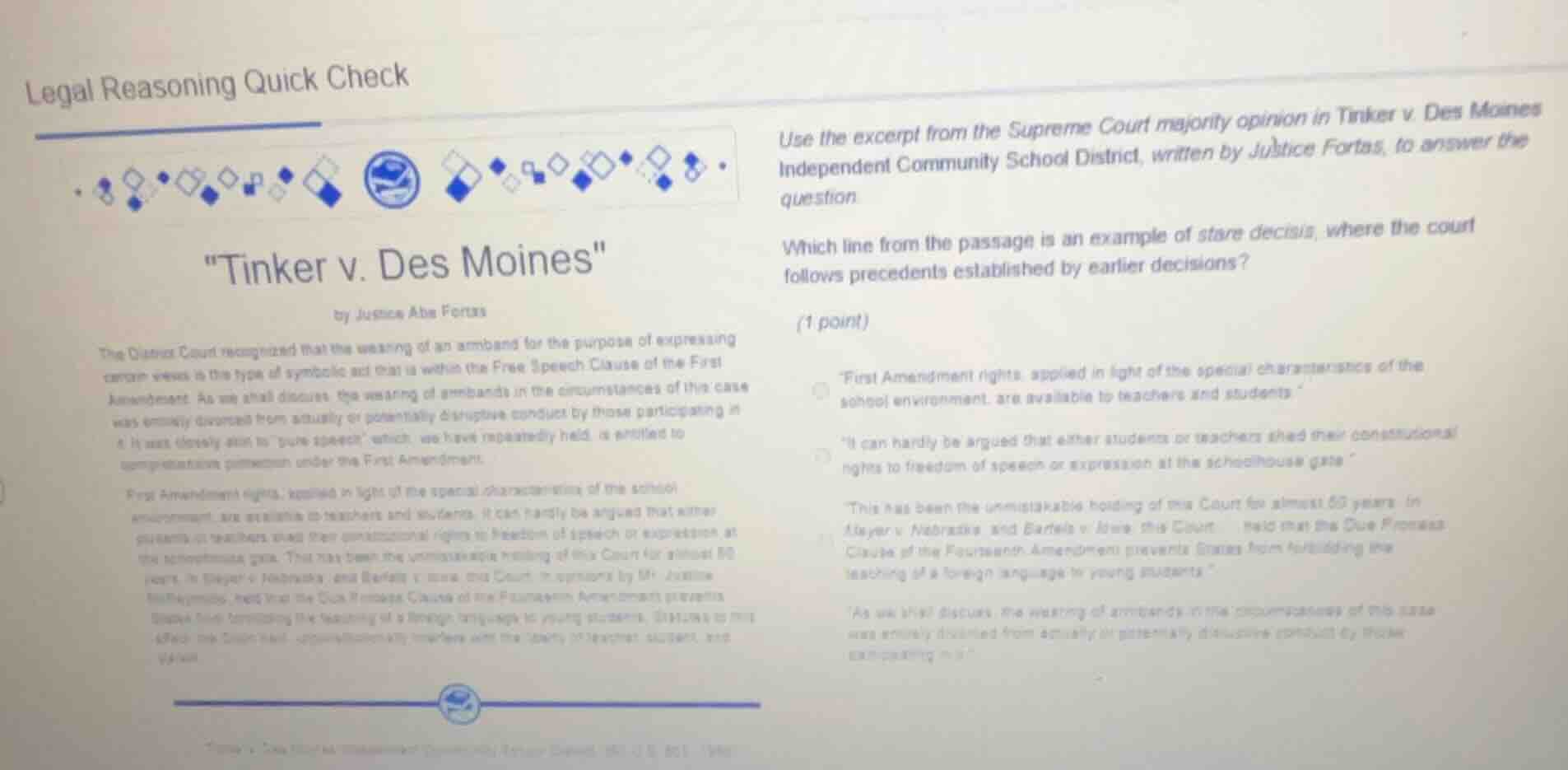
the court recognized that the wearing of an armband for the purpose of expressing certain views is the type of symbolic act that is within the free speech clause of the first amendment. as we shall discuss, the wearing of armbands in the circumstances of this case was entirely divorced from actually or potentially disruptive conduct by those participating in it. it is not closely akin to \pure speech\, which, we have repeatedly held, is entitled to comprehensive protection under the first amendment.
first amendment rights, applied in light of the special characteristics of the school environment, are available to teachers and students. it can hardly be argued that either students or teachers shed their constitutional rights to freedom of speech or expression at the schoolhouse gate. this has been the unmistakable holding of this court for almost 50 years, in meyer v. nebraska, and bartels v. iowa, the court, in opinions by mr. justice mckenna, held that the due process clause of the fourteenth amendment prevents states from forbidding the teaching of a foreign language to young students. (similar to this, in the meyer case, the court held, unanimously, that state may not interfere with the liberty of teacher, student, and parent.)
use the excerpt from the supreme court majority opinion in tinker v. des moines independent community school district, written by justice fortas, to answer the question
which line from the passage is an example of stare decisis, where the court follows precedents established by earlier decisions?
(1 point)
- \first amendment rights, applied in light of the special characteristics of the school environment, are available to teachers and students.\
- \it can hardly be argued that either students or teachers shed their constitutional rights to freedom of speech or expression at the schoolhouse gate.\
- \this has been the unmistakable holding of this court for almost 50 years, in meyer v. nebraska, and bartels v. iowa, the court... held that the due process clause of the fourteenth amendment prevents states from forbidding the teaching of a foreign language to young students.\
- \as we shall discuss, the wearing of armbands in the circumstances of this case was entirely divorced from actually or potentially disruptive conduct by those participating in it.\

Snap & solve any problem in the app
Get step-by-step solutions on Sovi AI
Photo-based solutions with guided steps
Explore more problems and detailed explanations
"This has been the unmistakable holding of this Court for almost 50 years. In Meyer v. Nebraska, and Bartels v. Iowa, this Court... held that the Due Process Clause of the Fourteenth Amendment prevents States from forbidding the teaching of a foreign language to young students."