QUESTION IMAGE
Question
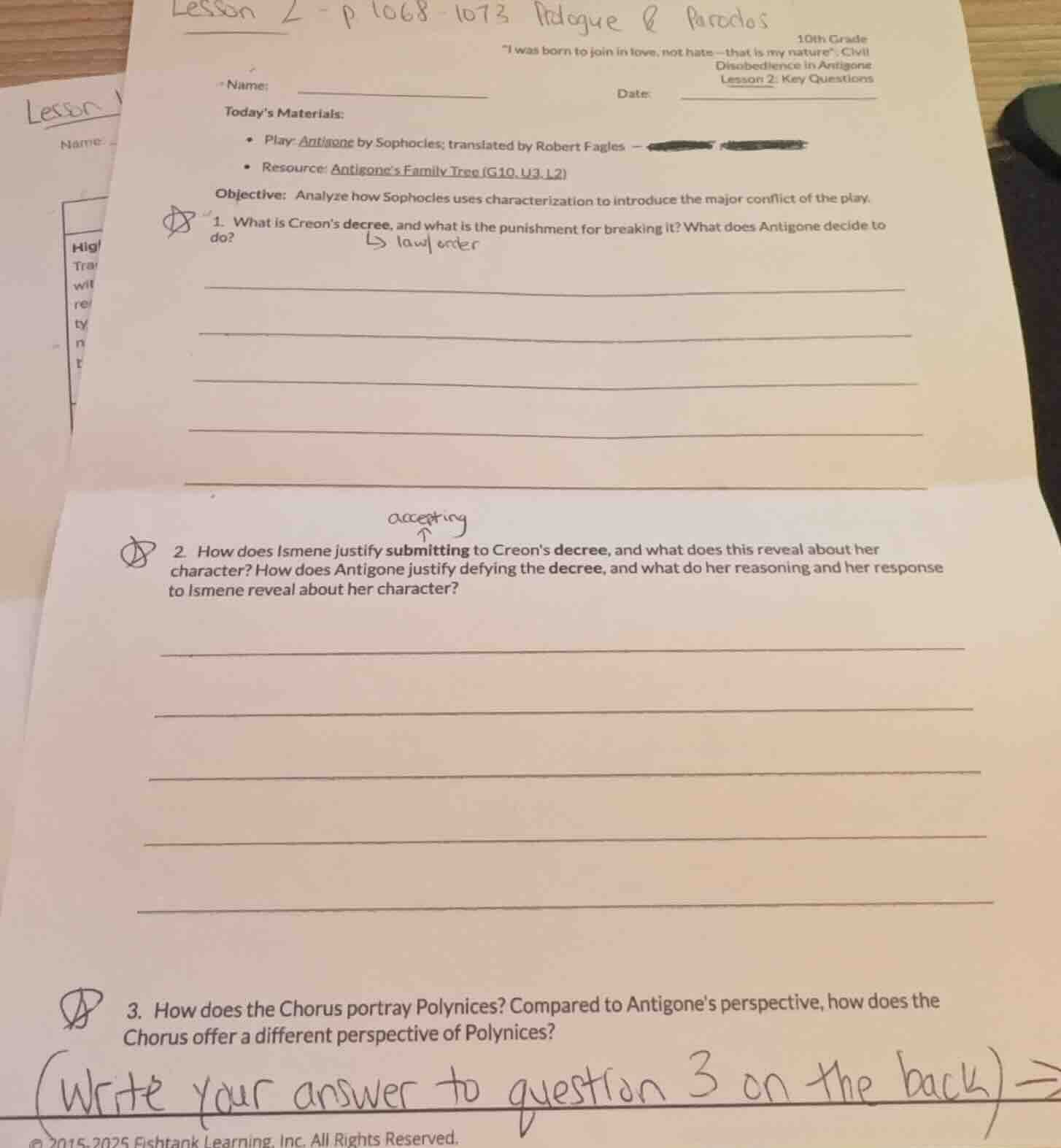
lesson 2 - p 1068 - 1073 prologue & parodos
10th grade
\i was born to join in love, not hate—that is my nature\. civil disobedience in antigone
lesson 2: key questions
name:
date:
today’s materials:
- play: antigone by sophocles; translated by robert fagles
- resource: antigone’s family tree (g10, u3, l2)
objective: analyze how sophocles uses characterization to introduce the major conflict of the play.
- what is creon’s decree, and what is the punishment for breaking it? what does antigone decide to do?
- how does ismene justify submitting to creon’s decree, and what does this reveal about her character? how does antigone justify defying the decree, and what do her reasoning and her response to ismene reveal about her character?
- how does the chorus portray polynices? compared to antigone’s perspective, how does the chorus offer a different perspective of polynices?
(write your answer to question 3 on the back)
© 2015-2025 fishtank learning, inc. all rights reserved.
Question 1
Creon's decree is that Polynices, who fought against Thebes, will not be given a proper burial and will be left to be devoured by animals; the punishment for breaking it is death by stoning. Antigone decides to bury Polynices anyway, as she believes in the divine law of giving proper burial rites over human law.
Ismene justifies submitting to Creon’s decree by saying they are women, weak, and cannot defy the state’s power, showing her timid, law - abiding, and risk - averse nature. Antigone justifies defying the decree by appealing to divine law (the law of the gods that demands burial for the dead) and family loyalty, seeing Creon’s decree as unjust. Her reasoning (prioritizing gods’ law and family) and her firm, even harsh response to Ismene (calling her a traitor to family and gods) reveal her brave, principled, and uncompromising nature, willing to risk death for what she believes is right.
The Chorus portrays Polynices as a traitor who attacked his own city (Thebes) in a civil war, focusing on his act of rebellion against the state. Antigone sees Polynices as her brother, emphasizing family ties and the duty to give him a proper burial, regardless of his political actions. The Chorus’ perspective is more about his violation of civic order, while Antigone’s is about familial and divine duty to the dead.

Snap & solve any problem in the app
Get step-by-step solutions on Sovi AI
Photo-based solutions with guided steps
Explore more problems and detailed explanations
Creon's decree: Polynices (who fought against Thebes) will not be buried (left to rot, devoured by animals). Punishment for breaking it: death (by stoning). Antigone decides to bury Polynices, prioritizing divine law over Creon's human law.