QUESTION IMAGE
Question
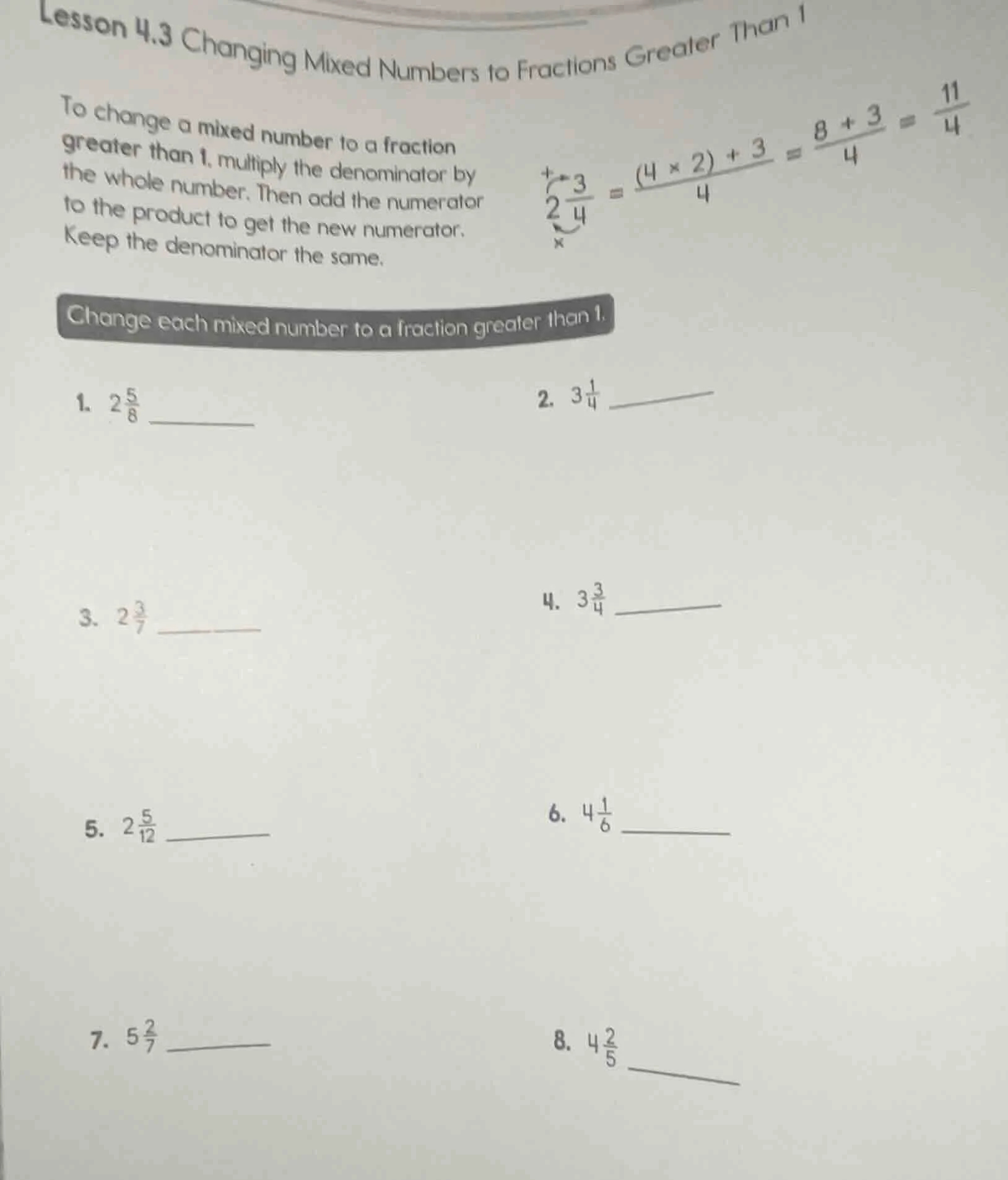
lesson 4.3 changing mixed numbers to fractions greater than 1
to change a mixed number to a fraction greater than 1, multiply the denominator by the whole number. then add the numerator to the product to get the new numerator. keep the denominator the same.
$2\frac{3}{4}=\frac{(4\times2)+3}{4}=\frac{8 + 3}{4}=\frac{11}{4}$
change each mixed number to a fraction greater than 1.
- $2\frac{5}{8}$ ______
- $3\frac{1}{4}$ ______
- $2\frac{3}{7}$ ______
- $3\frac{3}{4}$ ______
- $2\frac{5}{12}$ ______
- $4\frac{1}{6}$ ______
- $5\frac{2}{7}$ ______
- $4\frac{2}{5}$ ______
Response
1. For \(2\frac{5}{8}\)
Step1: Multiply denominator by whole number
\(8\times2 = 16\)
Step2: Add numerator to the product
\(16 + 5=21\)
Step3: Keep denominator same
So, \(2\frac{5}{8}=\frac{21}{8}\)
2. For \(3\frac{1}{4}\)
Step1: Multiply denominator by whole number
\(4\times3 = 12\)
Step2: Add numerator to the product
\(12+ 1 = 13\)
Step3: Keep denominator same
So, \(3\frac{1}{4}=\frac{13}{4}\)
3. For \(2\frac{3}{7}\)
Step1: Multiply denominator by whole number
\(7\times2=14\)
Step2: Add numerator to the product
\(14 + 3=17\)
Step3: Keep denominator same
So, \(2\frac{3}{7}=\frac{17}{7}\)
4. For \(3\frac{3}{4}\)

Snap & solve any problem in the app
Get step-by-step solutions on Sovi AI
Photo-based solutions with guided steps
Explore more problems and detailed explanations
s:
- \(\boldsymbol{\frac{21}{8}}\)
- \(\boldsymbol{\frac{13}{4}}\)
- \(\boldsymbol{\frac{17}{7}}\)
- \(\boldsymbol{\frac{15}{4}}\)
- \(\boldsymbol{\frac{29}{12}}\)
- \(\boldsymbol{\frac{25}{6}}\)
- \(\boldsymbol{\frac{37}{7}}\)
- \(\boldsymbol{\frac{22}{5}}\)