QUESTION IMAGE
Question
lesson 1: the great debates check for understanding - fill in the blank fields in this text.
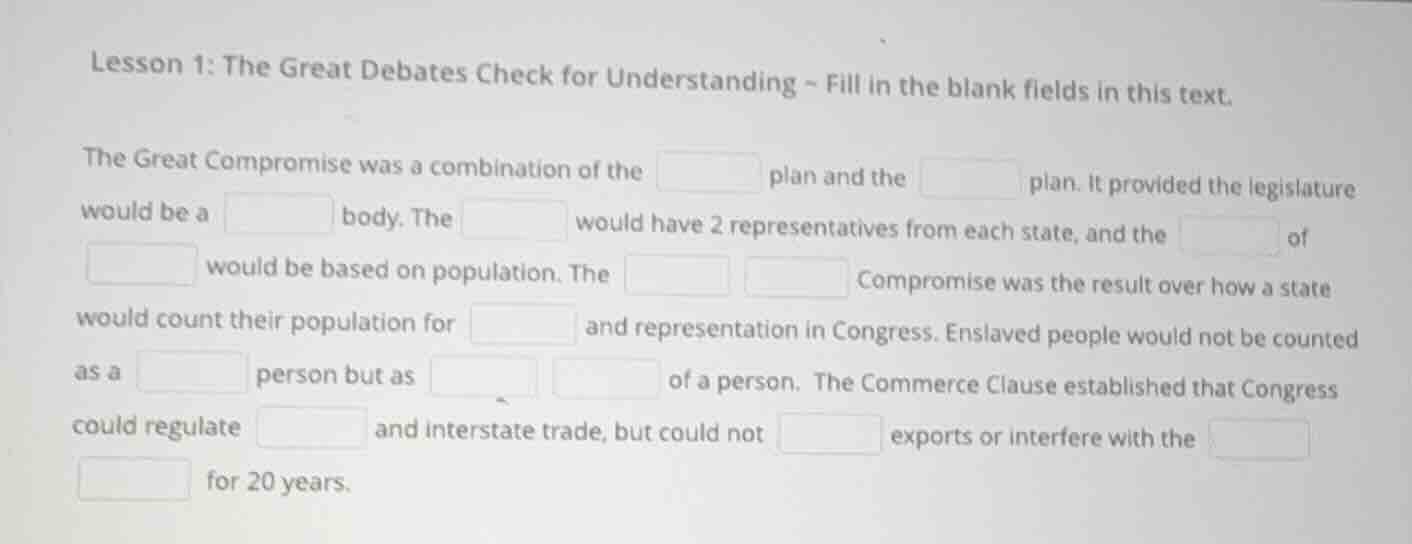
the great compromise was a combination of the plan and the plan. it provided the legislature would be a body. the would have 2 representatives from each state, and the of would be based on population. the compromise was the result over how a state would count their population for and representation in congress. enslaved people would not be counted as a person but as of a person. the commerce clause established that congress could regulate and interstate trade, but could not exports or interfere with the for 20 years.
To solve this fill - in - the - blank problem, we rely on knowledge of American history, specifically the events and compromises during the formation of the United States government.
- The Great Compromise combined the Virginia plan (which favored larger states with representation based on population) and the New Jersey plan (which favored equal representation for each state).
- The legislature established by the Great Compromise was a bicameral (two - chambered) body.
- In the bicameral legislature, the Senate has 2 representatives from each state (equal representation), and the number of representatives in the House of Representatives is based on population.
- The Three - Fifths Compromise dealt with how enslaved people would be counted for taxation and representation. Enslaved people were counted as three - fifths of a person.
- The Commerce Clause gave Congress the power to regulate commerce (trade) and interstate trade. It also stated that Congress could not tax exports or interfere with the slave trade for 20 years.

Snap & solve any problem in the app
Get step-by-step solutions on Sovi AI
Photo-based solutions with guided steps
Explore more problems and detailed explanations
The Great Compromise was a combination of the \boxed{Virginia} plan and the \boxed{New Jersey} plan. It provided the legislature would be a \boxed{bicameral} body. The \boxed{Senate} would have 2 representatives from each state, and the \boxed{number} of \boxed{representatives} would be based on population. The \boxed{Three - Fifths} Compromise was the result over how a state would count their population for \boxed{taxation} and representation in Congress. Enslaved people would not be counted as a \boxed{whole} person but as \boxed{three - fifths} of a person. The Commerce Clause established that Congress could regulate \boxed{commerce} and interstate trade, but could not \boxed{tax} exports or interfere with the \boxed{slave trade} for 20 years.