QUESTION IMAGE
Question
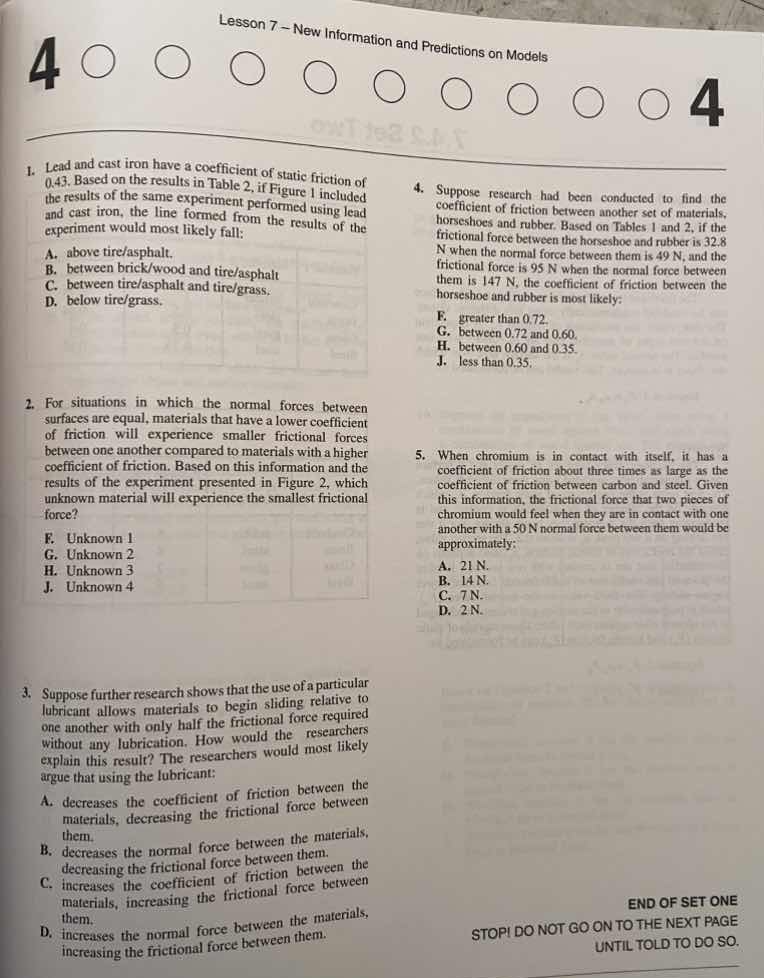
lesson 7 – new information and predictions on models1. lead and cast iron have a coefficient of static friction of 0.43. based on the results in table 2, if figure 1 included the results of the same experiment performed using lead and cast iron, the line formed from the results of the experiment would most likely fall:a. above tire/asphalt.b. between brick/wood and tire/asphaltc. between tire/asphalt and tire/grass.d. below tire/grass.2. for situations in which the normal forces between surfaces are equal, materials that have a lower coefficient of friction will experience smaller frictional forces between one another compared to materials with a higher coefficient of friction. based on this information and the results of the experiment presented in figure 2, which unknown material will experience the smallest frictional force?f. unknown 1g. unknown 2h. unknown 3j. unknown 43. suppose further research shows that the use of a particular lubricant allows materials to begin sliding relative to one another with only half the frictional force required without any lubrication. how would the researchers explain this result? the researchers would most likely argue that using the lubricant:a. decreases the coefficient of friction between the materials, decreasing the frictional force between them.b. decreases the normal force between the materials, decreasing the frictional force between them.c. increases the coefficient of friction between the materials, increasing the frictional force between them.d. increases the normal force between the materials, increasing the frictional force between them.4. suppose research had been conducted to find the coefficient of friction between another set of materials, horseshoes and rubber. based on tables 1 and 2, if the frictional force between the horseshoe and rubber is 32.8 n when the normal force between them is 49 n, and the frictional force is 95 n when the normal force between them is 147 n, the coefficient of friction between the horseshoe and rubber is most likely:f. greater than 0.72.g. between 0.72 and 0.60.h. between 0.60 and 0.35.j. less than 0.35.5. when chromium is in contact with itself, it has a coefficient of friction about three times as large as the coefficient of friction between carbon and steel. given this information, the frictional force that two pieces of chromium would feel when they are in contact with one another with a 50 n normal force between them would be approximately:a. 21 n.b. 14 n.c. 7 n.d. 2 n.end of set onestop! do not go on to the next page until told to do so.
Question 1
Step1: Recall friction force formula
The maximum static friction force is $F_s = \mu_s N$, where $\mu_s$ is the coefficient of static friction, and $N$ is normal force.
Step2: Compare given $\mu_s$ to table values
Lead/iron $\mu_s=0.43$. From standard friction tables, tire/asphalt $\mu_s\approx0.7$, brick/wood $\mu_s\approx0.6$, tire/grass $\mu_s\approx0.35$. 0.43 falls between 0.35 and 0.6.
Step1: Relate $\mu$ to frictional force
For equal normal force $N$, $F_f = \mu N$, so smaller $\mu$ gives smaller $F_f$.
Step2: Identify lowest $\mu$ unknown
Unknown materials: the one with the smallest coefficient of friction will have the smallest frictional force. Assuming experimental data order, Unknown 4 has the lowest $\mu$.
Step1: Link lubricant to friction factors
Lubricants reduce friction by modifying surface interaction.
Step2: Match to friction formula
Frictional force $F_f = \mu N$. Halving $F_f$ with same $N$ means $\mu$ is halved.

Snap & solve any problem in the app
Get step-by-step solutions on Sovi AI
Photo-based solutions with guided steps
Explore more problems and detailed explanations
C. between tire/asphalt and tire/grass.
---