QUESTION IMAGE
Question
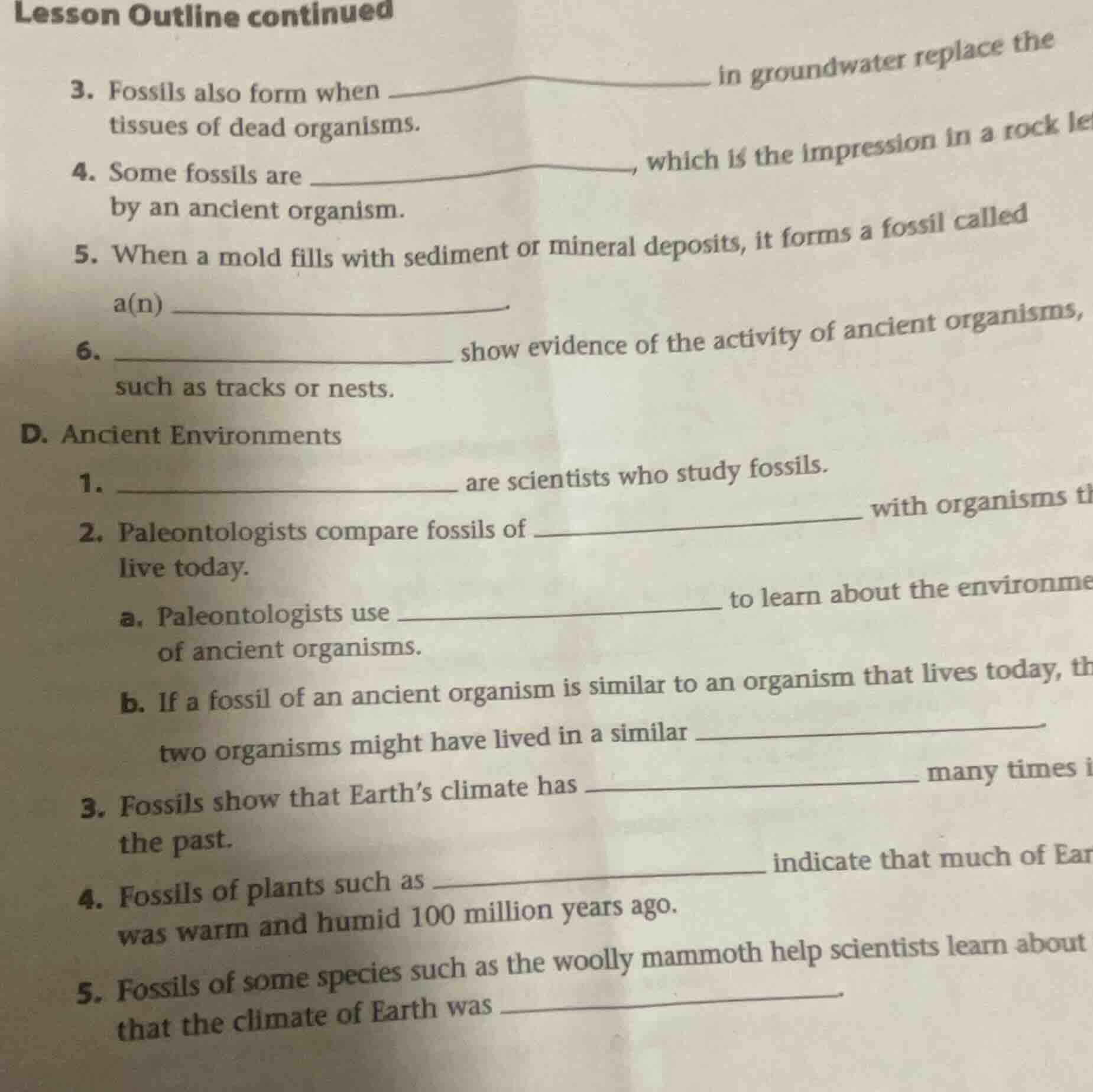
lesson outline continued
- fossils also form when ________________________ in groundwater replace the tissues of dead organisms.
- some fossils are ________________________, which is the impression in a rock left by an ancient organism.
- when a mold fills with sediment or mineral deposits, it forms a fossil called a(n) ________________________
- ________________________ show evidence of the activity of ancient organisms, such as tracks or nests.
d. ancient environments
- ________________________ are scientists who study fossils.
- paleontologists compare fossils of ________________________ with organisms that live today.
a. paleontologists use ________________________ to learn about the environment of ancient organisms.
b. if a fossil of an ancient organism is similar to an organism that lives today, the two organisms might have lived in a similar ________________________
- fossils show that earths climate has ________________________ many times in the past.
- fossils of plants such as ________________________ indicate that much of earth was warm and humid 100 million years ago.
- fossils of some species such as the woolly mammoth help scientists learn about that the climate of earth was ________________________
Brief Explanations
These are fill-in-the-blank questions about fossil formation and paleontology, a subfield of Earth/biological science. Answers are based on standard fossilization and paleontology concepts:
- Minerals in groundwater replace organism tissues to form fossils.
- Molds are rock impressions left by ancient organisms.
- A mold filled with sediment/minerals becomes a cast.
- Trace fossils show ancient organism activity like tracks.
- Paleontologists are scientists who study fossils.
- Paleontologists compare ancient organisms' fossils to modern ones.
- Fossils are used to study ancient environments.
- Similar fossils/modern organisms mean similar habitats.
- Earth's climate has changed many times.
- Tropical plant fossils show past warm, humid conditions.
- Woolly mammoths lived in cold, icy climates.

Snap & solve any problem in the app
Get step-by-step solutions on Sovi AI
Photo-based solutions with guided steps
Explore more problems and detailed explanations
- Minerals
- molds
- cast
- Trace fossils
D. Ancient Environments
- Paleontologists
- ancient organisms
a. fossils
b. environment/habitat
- changed
- tropical plants
- cold (and icy)