QUESTION IMAGE
Question
lesson practice
a1.4.01
name date period
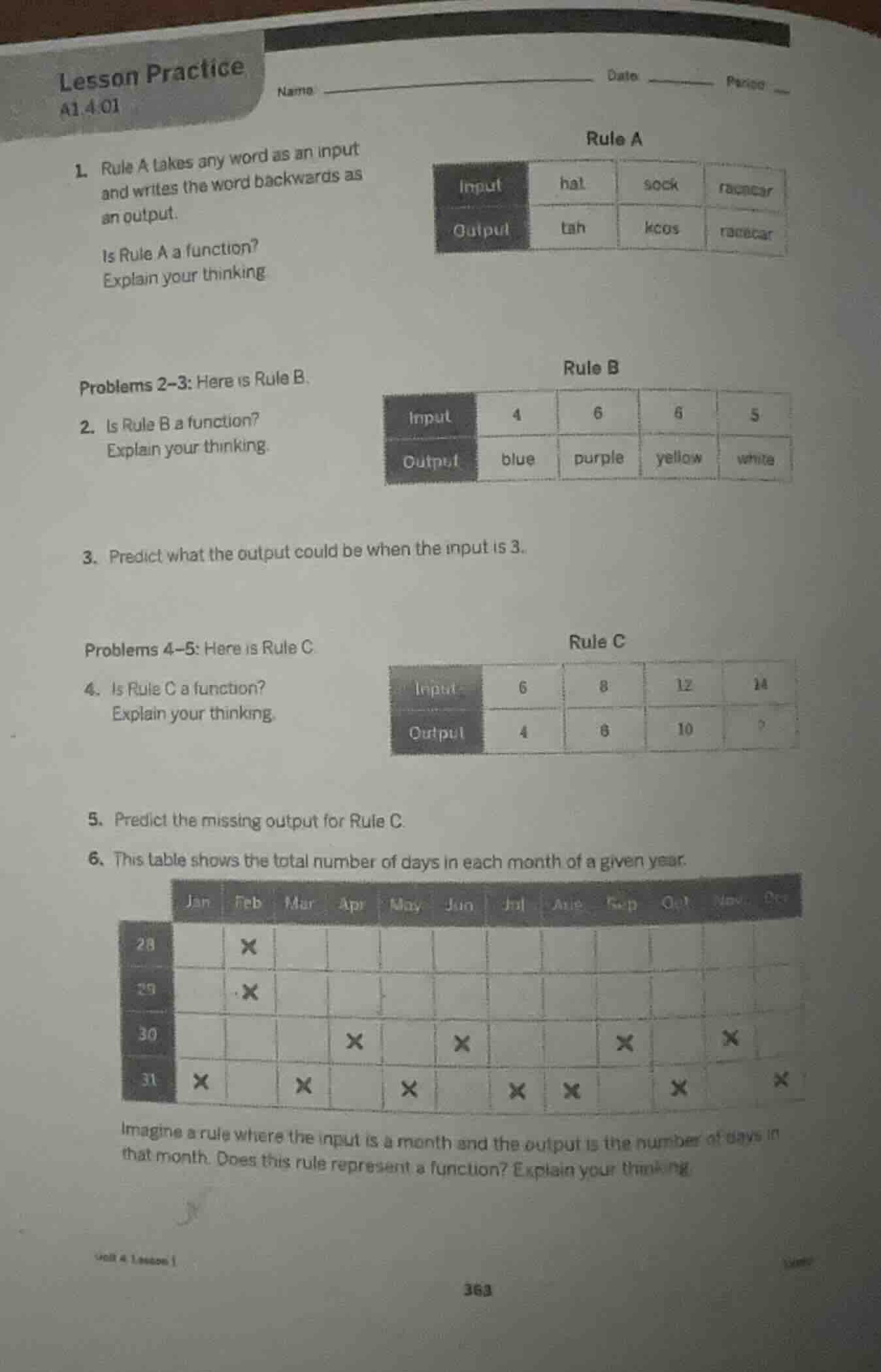
- rule a takes any word as an input
and writes the word backwards as
an output.
is rule a a function?
explain your thinking
rule a
input hat sock racecar
output tah kcos racecar
problems 2–3: here is rule b.
- is rule b a function?
explain your thinking.
rule b
input 4 6 6 5
output blue purple yellow white
- predict what the output could be when the input is 3.
problems 4–5: here is rule c.
- is rule c a function?
explain your thinking.
rule c
input 6 8 12 14
output 4 6 10?
- predict the missing output for rule c.
- this table shows the total number of days in each month of a given year.
jan feb mar apr may jun jul aug sep oct nov dec
28 ×
29 ×
30 × × × ×
31 × × × × × × × ×
imagine a rule where the input is a month and the output is the number of days in
that month. does this rule represent a function? explain your thinking.
unit 4 lesson 1
363
Problem 1
Step1: Recall function definition
A function is a relation where each input has exactly one output.
Step2: Analyze Rule A
For Rule A, each input word (hat, sock, racecar) has exactly one output (the word reversed: tah, kcos, racecar). No input has more than one output.
Step1: Recall function definition
A function requires each input to have exactly one output.
Step2: Analyze Rule B
In Rule B, the input \( 6 \) has two outputs: purple and yellow. Since an input has more than one output, it violates the function definition.
Step1: Note Rule B's nature
Since Rule B is not a function (input \( 6 \) has multiple outputs), for input \( 3 \), there's no fixed rule, but we can pick a color (e.g., red, green, etc.) as output.
Step2: Choose a possible output
We can choose any color, say "red" (or any other color like "green", "orange", etc.).

Snap & solve any problem in the app
Get step-by-step solutions on Sovi AI
Photo-based solutions with guided steps
Explore more problems and detailed explanations
Yes, Rule A is a function. Because every input word has exactly one output (the word written backwards), satisfying the definition of a function (each input has exactly one output).