QUESTION IMAGE
Question
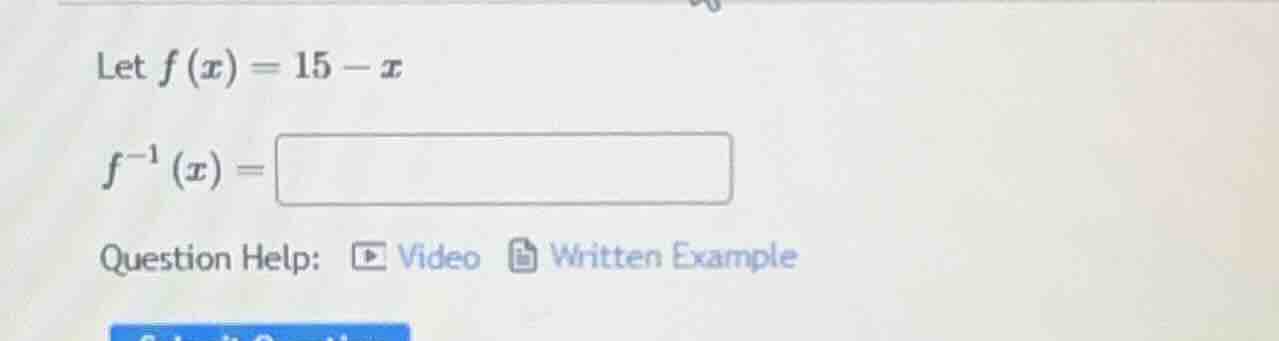
let $f(x)=15 - x$
$f^{-1}(x)=square$
question help: video written example
Step1: Replace \( f(x) \) with \( y \)
We have the function \( f(x) = 15 - x \), so we write it as \( y = 15 - x \).
Step2: Swap \( x \) and \( y \)
To find the inverse function, we swap the roles of \( x \) and \( y \). This gives us \( x = 15 - y \).
Step3: Solve for \( y \)
We need to isolate \( y \) in the equation \( x = 15 - y \). First, we can rewrite the equation as \( y = 15 - x \) (by adding \( y \) to both sides and subtracting \( x \) from both sides, or by rearranging the terms).
Step4: Replace \( y \) with \( f^{-1}(x) \)
After solving for \( y \), we replace \( y \) with the inverse function notation \( f^{-1}(x) \). So we get \( f^{-1}(x)=15 - x \)? Wait, no, wait. Wait, let's do step 3 again. Wait, \( x = 15 - y \), so to solve for \( y \), we can add \( y \) to both sides: \( x + y=15 \), then subtract \( x \) from both sides: \( y = 15 - x \)? Wait, that seems the same as the original function? Wait, no, wait, let's check again. Wait, the original function is \( f(x)=15 - x \), which is a linear function with slope -1. The inverse of a linear function \( y = mx + b \) (when \( m
eq0 \)) is found by swapping \( x \) and \( y \) and solving for \( y \). So for \( y = 15 - x \), swapping \( x \) and \( y \) gives \( x = 15 - y \), then solving for \( y \): \( y = 15 - x \). Wait, so the inverse of \( f(x)=15 - x \) is itself? Let's verify. Let's take a value, say \( x = 5 \). Then \( f(5)=15 - 5 = 10 \). Now, \( f^{-1}(10) \) should be 5. Using \( f^{-1}(x)=15 - x \), \( f^{-1}(10)=15 - 10 = 5 \), which matches. Another example, \( x = 10 \), \( f(10)=15 - 10 = 5 \), \( f^{-1}(5)=15 - 5 = 10 \), which is correct. So the inverse function is indeed \( f^{-1}(x)=15 - x \)? Wait, no, wait, that can't be right? Wait, no, let's check the steps again. Wait, maybe I made a mistake. Wait, let's do it again. Original function: \( y = 15 - x \). Swap \( x \) and \( y \): \( x = 15 - y \). Solve for \( y \): \( y = 15 - x \). So yes, the inverse function is the same as the original function here because the function is an involution (a function that is its own inverse). So that's correct.

Snap & solve any problem in the app
Get step-by-step solutions on Sovi AI
Photo-based solutions with guided steps
Explore more problems and detailed explanations
\( f^{-1}(x)=15 - x \)