QUESTION IMAGE
Question
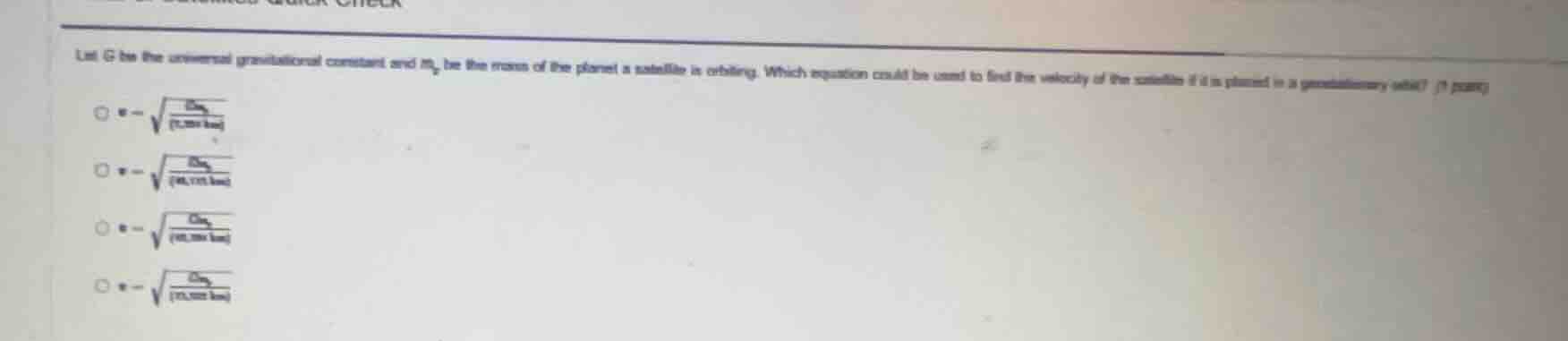
let g be the universal gravitational constant and ( m_p ) be the mass of the planet a satellite is orbiting. which equation could be used to find the velocity of the satellite if it is placed in a geostationary orbit? (1 point)
( circ v = sqrt{\frac{gm_p}{(7,300 \text{km})}} )
( circ v = sqrt{\frac{gm_p}{(6,700 \text{km})}} )
( circ v = sqrt{\frac{gm_p}{(63,700 \text{km})}} )
( circ v = sqrt{\frac{gm_p}{(35,700 \text{km})}} )
Step1: Recall geostationary orbit radius
The radius of a geostationary orbit around Earth is approximately 42,164 km (or ~42,000 km when rounded). For a satellite in circular orbit, the orbital velocity formula is derived from equating gravitational force and centripetal force:
$$v = \sqrt{\frac{GM_p}{r}}$$
where $r$ is the orbital radius.
Step2: Match to correct option
We need the option where the denominator under the square root is the geostationary orbit radius. The value closest to 42,164 km is 42,000 km.

Snap & solve any problem in the app
Get step-by-step solutions on Sovi AI
Photo-based solutions with guided steps
Explore more problems and detailed explanations
$\boldsymbol{v = \sqrt{\frac{GM_p}{(42,000\ \text{km})}}}$ (the first option)