QUESTION IMAGE
Question
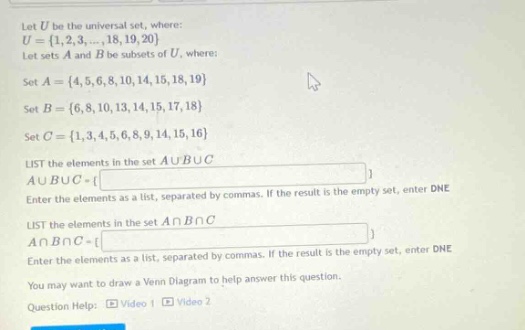
let ( u ) be the universal set, where: ( u = {1,2,3,dots,18,19,20} ). let sets ( a ) and ( b ) be subsets of ( u ), where: set ( a = {4,5,6,8,10,14,15,18,19} ) set ( b = {6,8,10,13,14,15,17,18} ) set ( c = {1,3,4,5,6,8,9,14,15,16} ) list the elements in the set ( a cup b cup c ) ( a cup b cup c = { } ) enter the elements as a list, separated by commas. if the result is the empty set, enter dne list the elements in the set ( a cap b cap c ) ( a cap b cap c = { } ) enter the elements as a list, separated by commas. if the result is the empty set, enter dne you may want to draw a venn diagram to help answer this question. question help: ( square ) video 1 ( square ) video 2
For \( A \cup B \cup C \):
Step 1: Recall the definition of union
The union of sets \( A \), \( B \), and \( C \) (\( A \cup B \cup C \)) is the set of all elements that are in \( A \), or in \( B \), or in \( C \). So we need to collect all unique elements from \( A \), \( B \), and \( C \).
Set \( A = \{4, 5, 6, 8, 10, 14, 15, 18, 19\} \)
Set \( B = \{6, 8, 10, 13, 14, 15, 17, 18\} \)
Set \( C = \{1, 3, 4, 5, 6, 8, 9, 14, 15, 16\} \)
Let's list all elements from each set and remove duplicates:
From \( A \): 4, 5, 6, 8, 10, 14, 15, 18, 19
From \( B \): 6, 8, 10, 13, 14, 15, 17, 18 (add 13, 17)
From \( C \): 1, 3, 4, 5, 6, 8, 9, 14, 15, 16 (add 1, 3, 9, 16)
Combining all and removing duplicates: 1, 3, 4, 5, 6, 8, 9, 10, 13, 14, 15, 16, 17, 18, 19
Step 2: Verify
Check each element is in at least one of \( A \), \( B \), \( C \).
1: in \( C \); 3: in \( C \); 4: in \( A \) and \( C \); 5: in \( A \) and \( C \); 6: in \( A \), \( B \), \( C \); 8: in \( A \), \( B \), \( C \); 9: in \( C \); 10: in \( A \), \( B \); 13: in \( B \); 14: in \( A \), \( B \), \( C \); 15: in \( A \), \( B \), \( C \); 16: in \( C \); 17: in \( B \); 18: in \( A \), \( B \); 19: in \( A \). All are accounted for.
Step 1: Recall the definition of intersection
The intersection of sets \( A \), \( B \), and \( C \) (\( A \cap B \cap C \)) is the set of all elements that are in \( A \), and in \( B \), and in \( C \). So we need to find elements common to all three sets.
First, find \( A \cap B \), then find the intersection of that result with \( C \).
Find \( A \cap B \): elements common to \( A \) and \( B \).
\( A = \{4, 5, 6, 8, 10, 14, 15, 18, 19\} \)
\( B = \{6, 8, 10, 13, 14, 15, 17, 18\} \)
Common elements: 6, 8, 10, 14, 15, 18
Now find intersection of \( \{6, 8, 10, 14, 15, 18\} \) with \( C \).
\( C = \{1, 3, 4, 5, 6, 8, 9, 14, 15, 16\} \)
Common elements: 6, 8, 14, 15
Check each:
6: in \( A \), \( B \), \( C \); 8: in \( A \), \( B \), \( C \); 14: in \( A \), \( B \), \( C \); 15: in \( A \), \( B \), \( C \).
Step 2: Verify
Check each element is in all three sets.
6: \( A \) (yes), \( B \) (yes), \( C \) (yes)
8: \( A \) (yes), \( B \) (yes), \( C \) (yes)
14: \( A \) (yes), \( B \) (yes), \( C \) (yes)
15: \( A \) (yes), \( B \) (yes), \( C \) (yes)

Snap & solve any problem in the app
Get step-by-step solutions on Sovi AI
Photo-based solutions with guided steps
Explore more problems and detailed explanations
(for \( A \cup B \cup C \)):
1, 3, 4, 5, 6, 8, 9, 10, 13, 14, 15, 16, 17, 18, 19