QUESTION IMAGE
Question
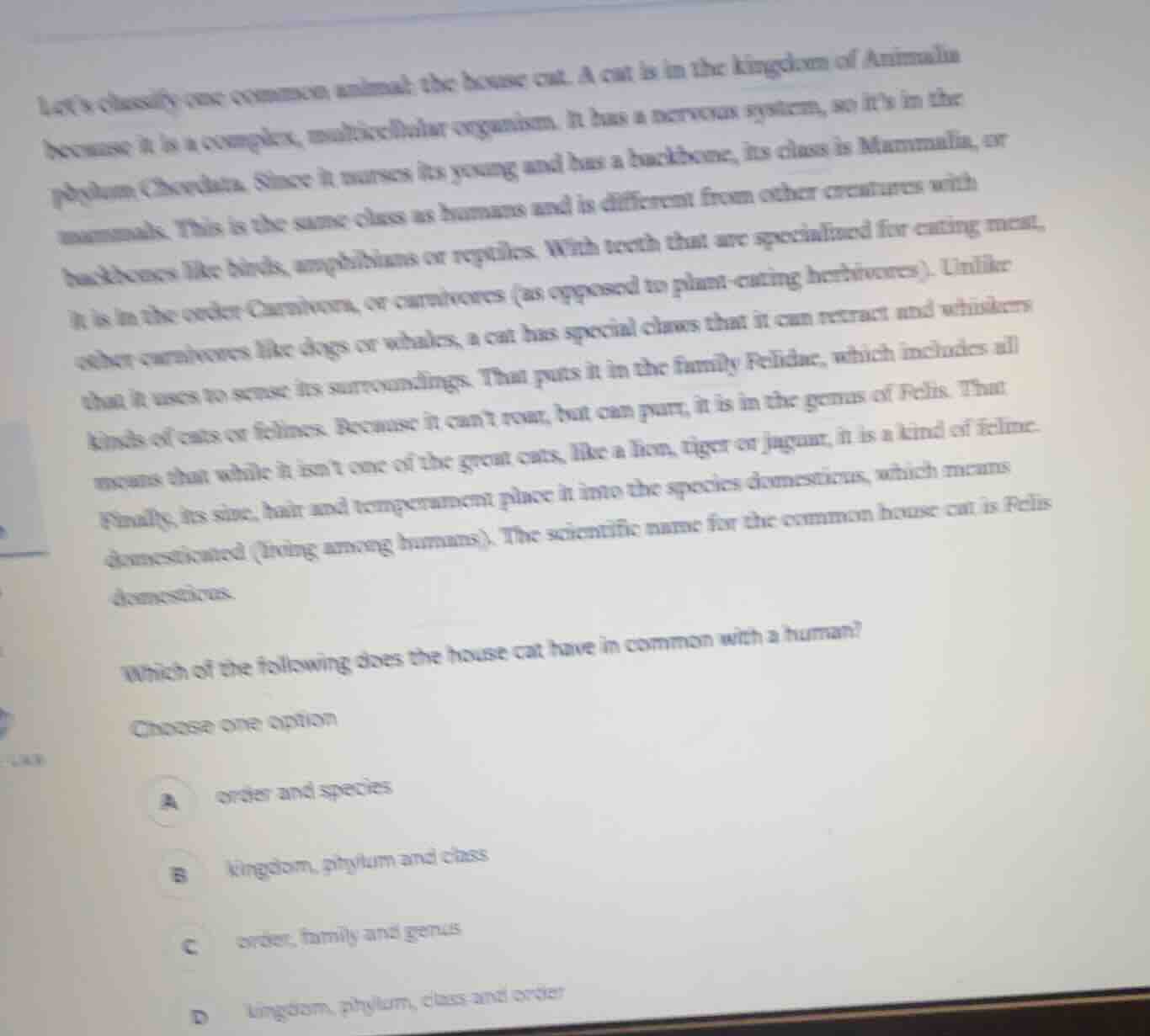
lets classify one common animal: the house cat. a cat is in the kingdom of animalia because it is a complex, multicellular organism. it has a nervous system, so its in the phylum chordata. since it nurses its young and has a backbone, its class is mammalia, or mammals. this is the same class as humans and is different from other creatures with backbones like birds, amphibians or reptiles. with teeth that are specialized for eating meat, it is in the order carnivora, or carnivores (as opposed to plant - eating herbivores). unlike other carnivores like dogs or whales, a cat has special claws that it can retract and whiskers that it uses to sense its surroundings. that puts it in the family felidae, which includes all kinds of cats or felines. because it cant roar, but can purr, it is in the genus of felis. that means that while it isnt one of the great cats, like a lion, tiger or jaguar, it is a kind of feline. finally, its size, hair and temperament place it into the species domesticus, which means domesticated (living among humans). the scientific name for the common house cat is felis domesticus. which of the following does the house cat have in common with a human? choose one option a order and species b kingdom, phylum and class c order, family and genus d kingdom, phylum, class and order
- From the text: The cat is in kingdom Animalia, phylum Chordata, class Mammalia. Humans are also in kingdom Animalia (complex multicellular), phylum Chordata (have a nervous system and backbone), and class Mammalia (nurse young, have backbone).
- For order: The cat is in order Carnivora (meat - eating), while humans are in order Primates (not Carnivora). So order is different.
- For family, genus, species: The cat is in family Felidae, genus Felis, species domesticus. Humans are in family Hominidae, genus Homo, species sapiens. So these are different.
- So the common levels are kingdom, phylum, and class.

Snap & solve any problem in the app
Get step-by-step solutions on Sovi AI
Photo-based solutions with guided steps
Explore more problems and detailed explanations
B. kingdom, phylum and class