QUESTION IMAGE
Question
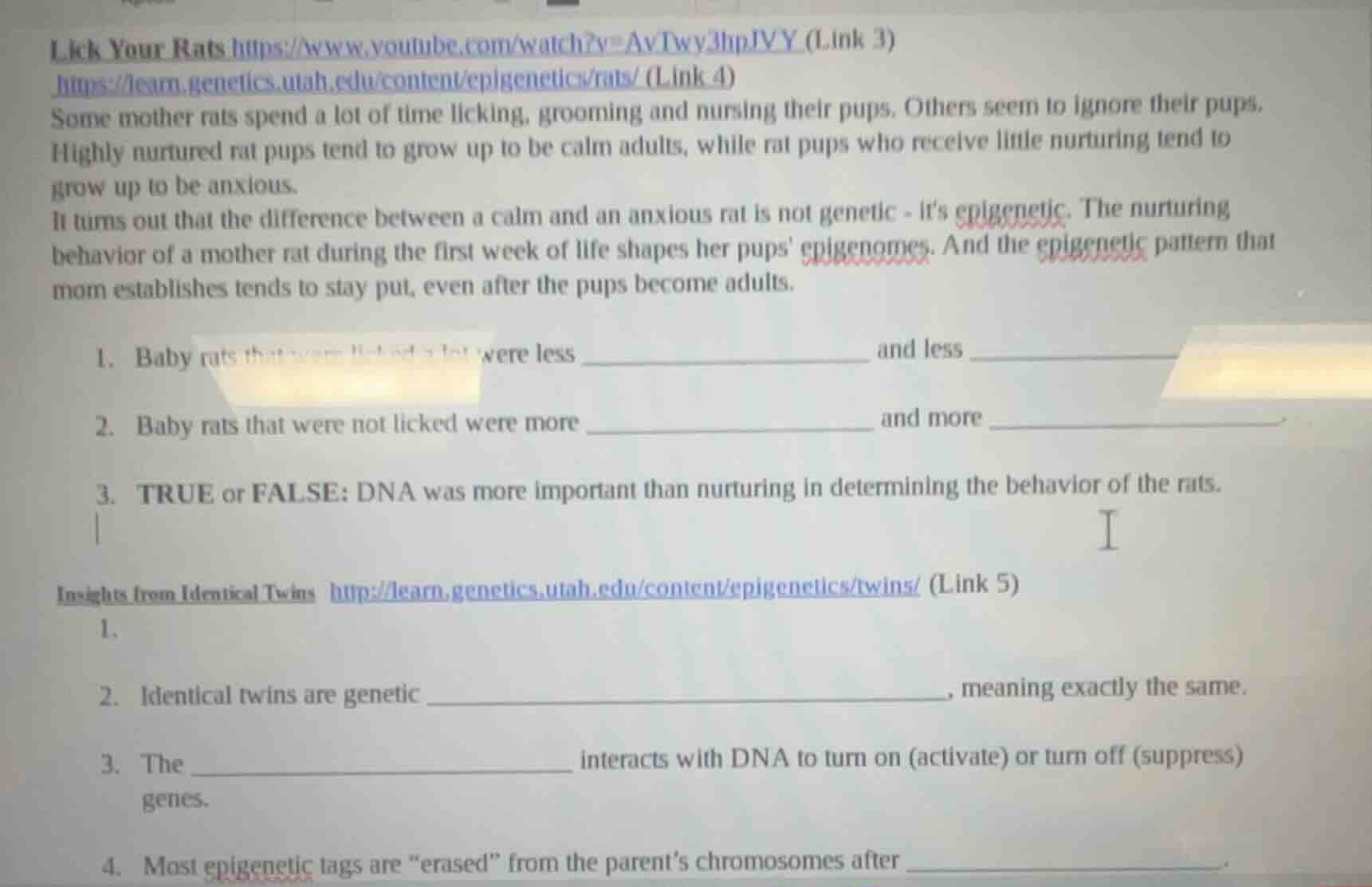
lick your rats https://www.youtube.com/watch?v=avtwy3hpivy (link 3)https://learn.genetics.utah.edu/content/epigenetics/rats/ (link 4)some mother rats spend a lot of time licking, grooming and nursing their pups. others seem to ignore their pups.highly nurtured rat pups tend to grow up to be calm adults, while rat pups who receive little nurturing tend togrow up to be anxious.it turns out that the difference between a calm and an anxious rat is not genetic - its epigenetic. the nurturingbehavior of a mother rat during the first week of life shapes her pups epigenomes. and the epigenetic pattern thatmom establishes tends to stay put, even after the pups become adults.1. baby rats that were licked a lot were less _____________ and less ___________2. baby rats that were not licked were more ___________ and more ___________3. true or false: dna was more important than nurturing in determining the behavior of the rats.insights from identical twins http://learn.genetics.utah.edu/content/epigenetics/twins/ (link 5)1.2. identical twins are genetic ___________, meaning exactly the same.3. the ___________ interacts with dna to turn on (activate) or turn off (suppress) genes.4. most epigenetic tags are “erased” from the parent’s chromosomes after _____________.
- For the rat questions, the text states highly nurtured (licked) pups grow calm, while neglected ones are anxious. It also clarifies behavior is epigenetic, not DNA-driven.
- For twin questions, identical twins share exact genetic material. Epigenetics involves factors that regulate gene activity, and epigenetic tags are reset after fertilization.

Snap & solve any problem in the app
Get step-by-step solutions on Sovi AI
Photo-based solutions with guided steps
Explore more problems and detailed explanations
- Baby rats that were licked a lot were less anxious and less stressed
- Baby rats that were not licked were more anxious and more stressed
- FALSE
---
- Identical twins are genetic clones, meaning exactly the same.
- The epigenome interacts with DNA to turn on (activate) or turn off (suppress) genes.
- Most epigenetic tags are "erased" from the parent's chromosomes after fertilization