QUESTION IMAGE
Question
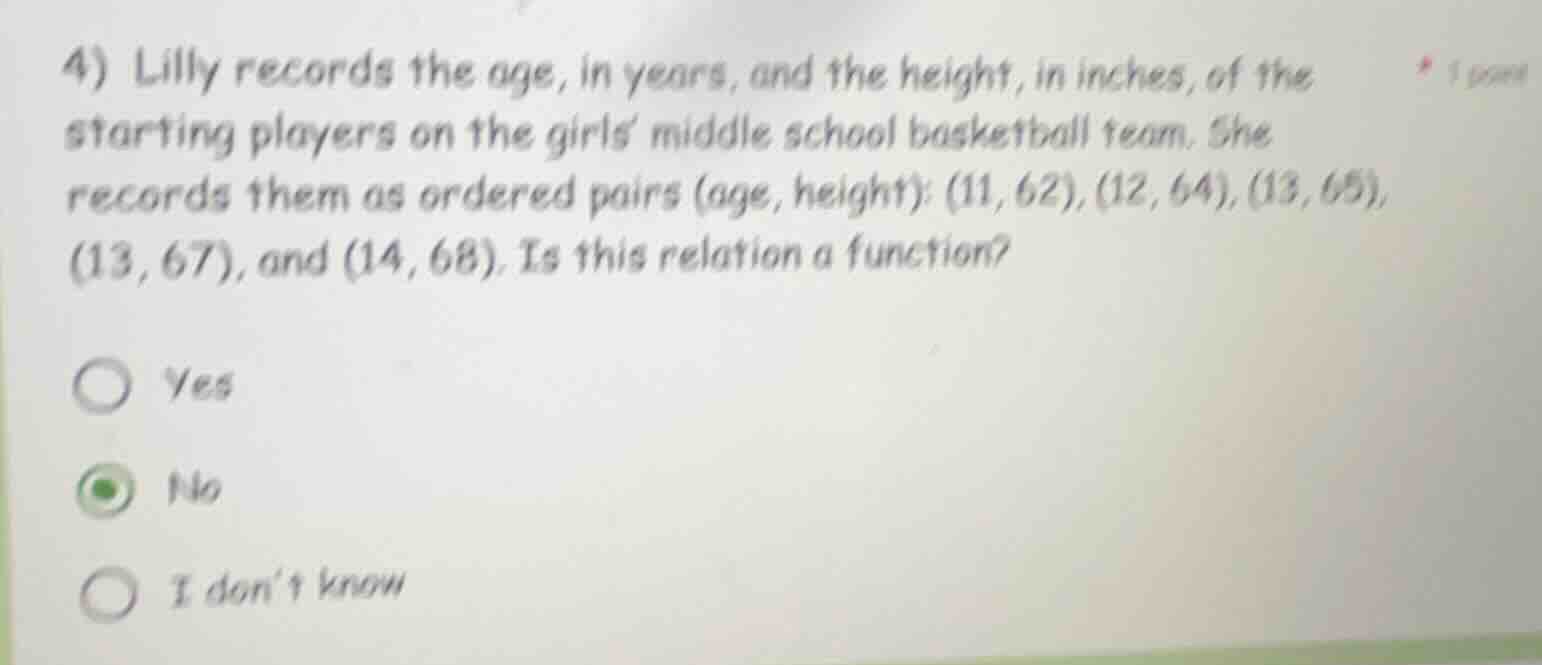
- lilly records the age, in years, and the height, in inches, of the starting players on the girls’ middle school basketball team. she records them as ordered pairs (age, height): (11, 62), (12, 64), (13, 65), (13, 67), and (14, 68). is this relation a function?
○ yes
○ no
○ i dont know
Step1: Recall the definition of a function
A relation is a function if each input (in this case, age) has exactly one output (height). So we need to check if any age (input) is repeated with different heights (outputs).
Step2: Analyze the given ordered pairs
The ordered pairs are (11, 62), (12, 64), (13, 65), (13, 67), (14, 68). Here, the age 13 (input) is paired with two different heights: 65 and 67. Wait, no—wait, a function allows multiple inputs to have the same output, but each input must have only one output? Wait, no, actually, the definition is: for a relation to be a function, each input (x - value) must correspond to exactly one output (y - value). Wait, but in this case, the age is the x - value (input) and height is the y - value (output). Wait, but let's check again. Wait, the ordered pairs are (age, height), so age is the domain (input) and height is the range (output). Now, let's list the ages (inputs): 11, 12, 13, 13, 14. Now, the age 13 is used twice, with different heights (65 and 67). Wait, but according to the definition of a function, a function is a relation where each element in the domain is paired with exactly one element in the range. So if an input (age) is used more than once, but with different outputs (heights), then it's not a function? Wait, no—wait, no. Wait, the definition is: for every x in the domain, there is exactly one y in the range such that (x, y) is in the relation. So if x = 13, there are two y - values: 65 and 67. Therefore, this relation is not a function? Wait, but wait, maybe I made a mistake. Wait, let's check the standard definition. A function is a set of ordered pairs where no two ordered pairs have the same first element (input) with different second elements (outputs). So in other words, if you have two ordered pairs (x, y1) and (x, y2) where y1 ≠ y2, then it's not a function. In our case, we have (13, 65) and (13, 67), so x = 13 has two different y - values. Therefore, this relation is not a function? Wait, but the original answer in the image has "No" selected. Wait, but let's confirm again. Wait, the definition of a function: a function is a relation where each input (x) has exactly one output (y). So if an input is used more than once, but with the same output, that's okay (like (2, 3) and (2, 3) is fine, or (1, 5) and (2, 5) is fine). But if an input is used with different outputs, then it's not a function. So in our case, age 13 is paired with 65 and 67, so different outputs. Therefore, this relation is not a function. Wait, but wait, maybe the question is considering age as the input, and height as the output. So since 13 is an input that maps to two different outputs, it's not a function. So the answer should be No. But wait, let's check again. Wait, the ordered pairs are (age, height). So the domain is {11, 12, 13, 14}? Wait, no, the domain is the set of all first elements, so 11, 12, 13, 13, 14—but when we list the domain, we list unique elements: {11, 12, 13, 14}. Now, for x = 13, how many y - values are there? Two: 65 and 67. Therefore, since x = 13 is in the domain and is paired with two different y - values, the relation is not a function. So the correct answer is No. Wait, but the original image has "No" selected. So the answer is No.

Snap & solve any problem in the app
Get step-by-step solutions on Sovi AI
Photo-based solutions with guided steps
Explore more problems and detailed explanations
No (the relation is not a function because the input age = 13 is paired with two different output heights: 65 and 67, violating the definition of a function where each input must have exactly one output).