QUESTION IMAGE
Question
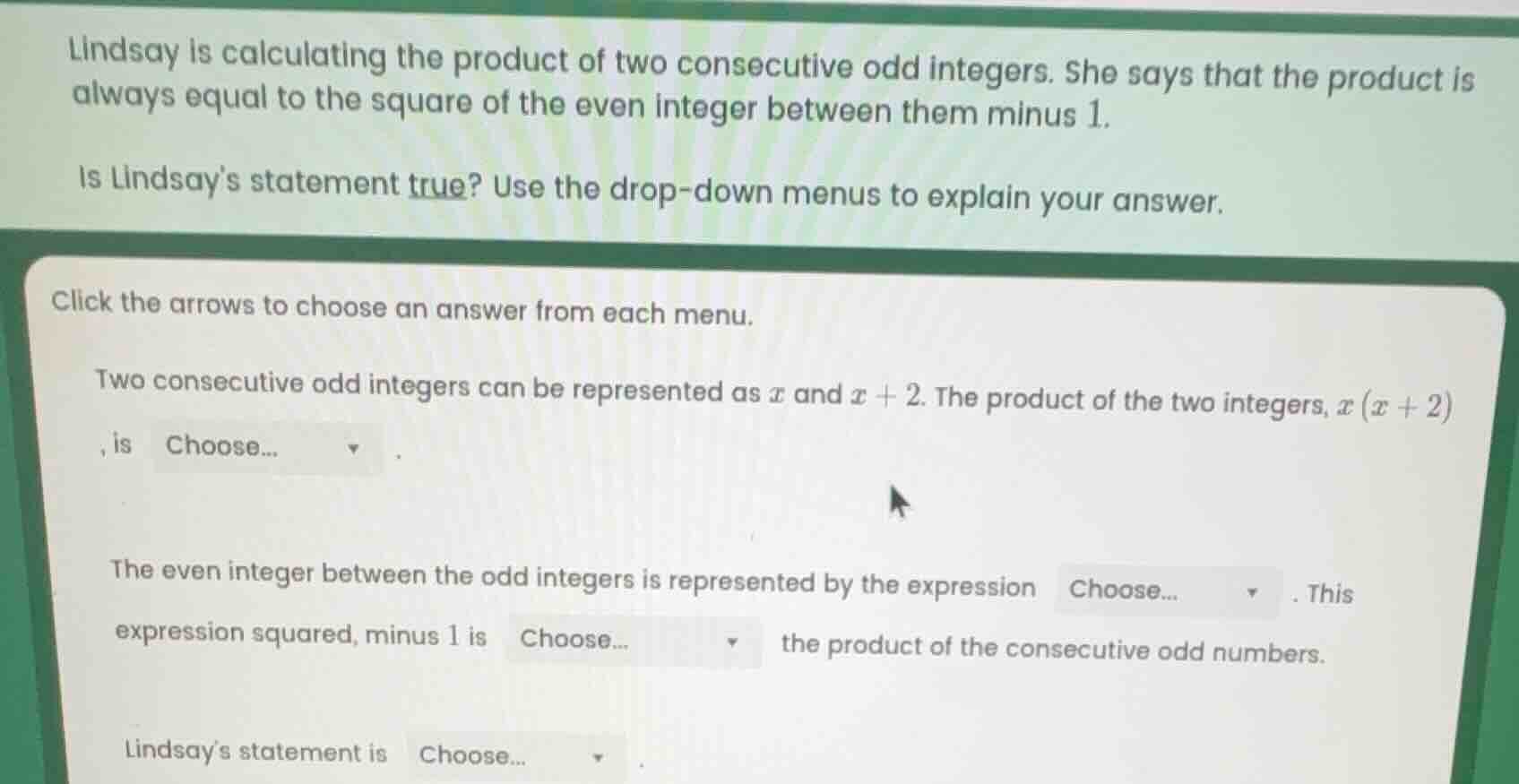
lindsay is calculating the product of two consecutive odd integers. she says that the product is always equal to the square of the even integer between them minus 1.
is lindsays statement true? use the drop - down menus to explain your answer.
click the arrows to choose an answer from each menu.
two consecutive odd integers can be represented as $x$ and $x + 2$. the product of the two integers, $x(x + 2)$, is choose...
the even integer between the odd integers is represented by the expression choose.... this expression squared, minus 1 is choose... the product of the consecutive odd numbers.
lindsays statement is choose...
Step1: Expand the product
$x(x+2) = x^2 + 2x$
Step2: Define middle even integer
The even integer between $x$ and $x+2$ is $x+1$.
Step3: Compute square minus 1
$(x+1)^2 - 1 = x^2 + 2x + 1 - 1 = x^2 + 2x$
Step4: Compare the two expressions
Both simplify to $x^2 + 2x$, so they are equal.

Snap & solve any problem in the app
Get step-by-step solutions on Sovi AI
Photo-based solutions with guided steps
Explore more problems and detailed explanations
- The product of the two integers, $x(x+2)$, is $\boldsymbol{x^2 + 2x}$
- The even integer between the odd integers is represented by the expression $\boldsymbol{x+1}$
- This expression squared, minus 1 is $\boldsymbol{equal\ to}$ the product of the consecutive odd numbers.
- Lindsay's statement is $\boldsymbol{true}$