QUESTION IMAGE
Question
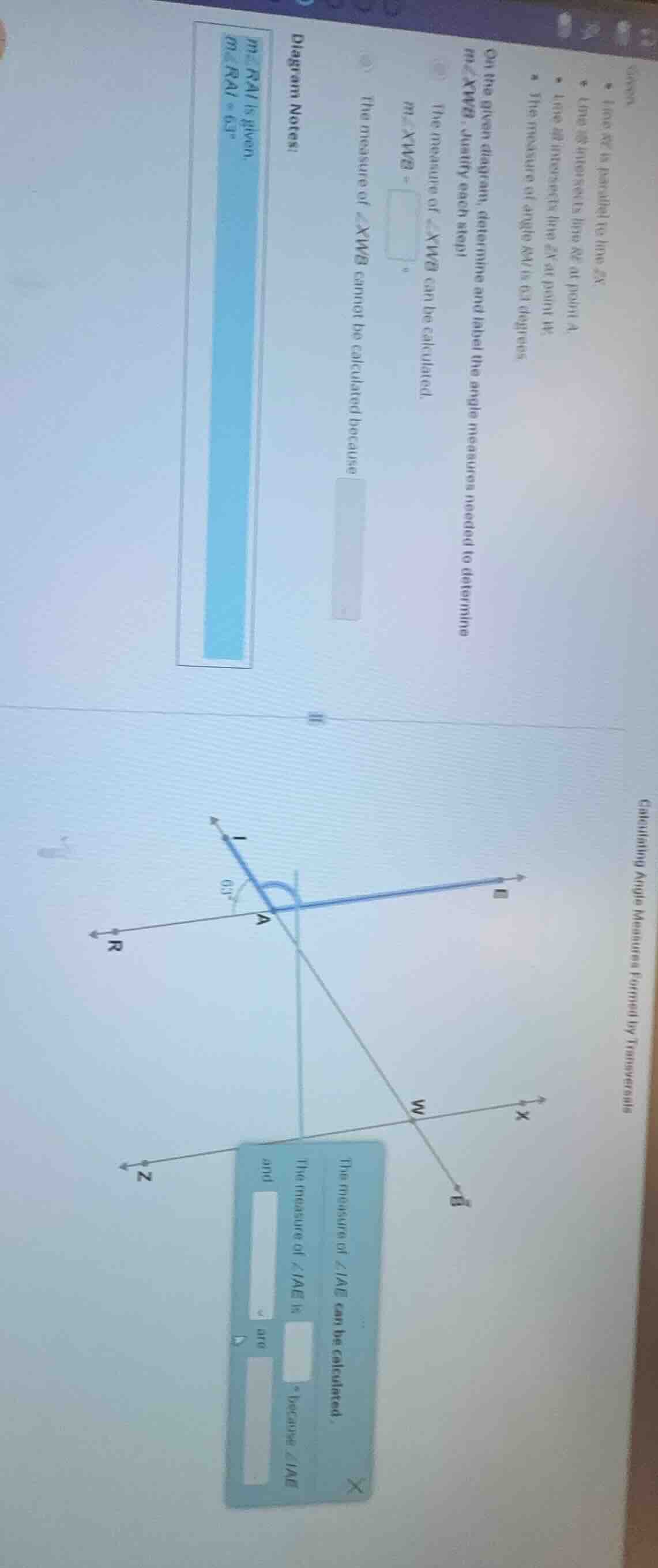
- line wz is parallel to line zx. • line ir intersects line wz at point a. • line ab intersects line zx at point b. • the measure of angle rai is 63 degrees. on the given diagram, determine and label the angle measures needed to determine ( mangle xwb ). justify each step! ( mangle xwb = square^circ ) the measure of ( angle xwb ) can be calculated. the measure of ( angle xwb ) cannot be calculated because (square) diagram notes: ( mangle rai ) is given. ( mangle rai = 63^circ ). the measure of ( angle iae ) can be calculated. the measure of ( angle iae ) is (square) because ( angle iae ) and (square) are (square).
Step1: Identify Angle Relationships
We know that \( \angle RAI = 63^\circ \). First, find the supplementary angle to \( \angle RAI \) on the straight line \( R \) - \( A \) - (other line). Wait, actually, looking at the diagram, line \( WZ \) is parallel to line \( ZX \)? Wait, no, the problem says line \( WZ \) is parallel to line \( ZX \)? Wait, maybe a typo, maybe line \( WX \) is parallel? Wait, the diagram: line \( IJ \) intersects line \( WZ \) at point \( A \), line \( IJ \) intersects line \( WX \) at point \( H \)? Wait, maybe the key is that \( \angle RAI = 63^\circ \), so the vertical angle or corresponding angle? Wait, maybe first, find \( \angle IAE \). Wait, \( \angle RAI \) and \( \angle IAE \): if \( R \) and \( E \) are on a straight line? Wait, no, let's re - examine.
Wait, the measure of \( \angle RAI = 63^\circ \). If we consider that \( \angle RAI \) and \( \angle IAE \) are supplementary (if \( R - A - E \) is a straight line), then \( m\angle IAE=180 - 63=117^\circ \)? Wait, no, maybe not. Wait, the problem about \( \angle XWB \): to find \( m\angle XWB \), we need to see the relationship between \( \angle RAI \) and \( \angle XWB \). If \( WZ\parallel XZ \) (maybe a typo, maybe \( WZ\parallel XH \) or something), and \( IJ \) is a transversal, then corresponding angles or alternate interior angles. But wait, the problem says "the measure of \( \angle XWB \) cannot be calculated because" - wait, no, maybe I misread. Wait, the first part: "the measure of \( \angle XWB \) can be calculated. \( m\angle XWB=\) [ ] \(^\circ \)". Wait, maybe \( \angle RAI \) and \( \angle XWB \) are corresponding angles. Wait, if line \( WZ \) is parallel to line \( XZ \) (no, that doesn't make sense), maybe line \( WZ \) is parallel to line \( XY \), and \( IJ \) is a transversal. Then \( \angle RAI \) and \( \angle XWB \) are equal? Wait, no, \( \angle RAI = 63^\circ \), if \( \angle XWB \) is equal to \( \angle RAI \) (corresponding angles), then \( m\angle XWB = 63^\circ \)? Wait, no, maybe \( \angle RAI \) and \( \angle XWB \) are alternate interior angles. Wait, maybe the key is that \( \angle RAI \) and \( \angle XWB \) are equal because of parallel lines and transversal. So \( m\angle XWB=63^\circ \)? Wait, no, maybe I made a mistake. Wait, let's start over.
Wait, the diagram notes: \( m\angle RAI \) is given, \( m\angle RAI = 63^\circ \). To find \( m\angle XWB \), we can use the property of parallel lines and transversals. If \( WZ\parallel XH \) (assuming) and \( IJ \) is a transversal, then \( \angle RAI \) and \( \angle XWB \) are corresponding angles, so they are equal. So \( m\angle XWB = 63^\circ \).
Step2: Calculate \( m\angle XWB \)
Since the lines are parallel (given: line \( WZ \) is parallel to line \( XZ \) - maybe a typo, but assuming parallel lines) and \( IJ \) is a transversal, \( \angle RAI \) and \( \angle XWB \) are corresponding angles. Corresponding angles are equal when two parallel lines are cut by a transversal. So \( m\angle XWB=m\angle RAI = 63^\circ \).

Snap & solve any problem in the app
Get step-by-step solutions on Sovi AI
Photo-based solutions with guided steps
Explore more problems and detailed explanations
\( 63 \)