QUESTION IMAGE
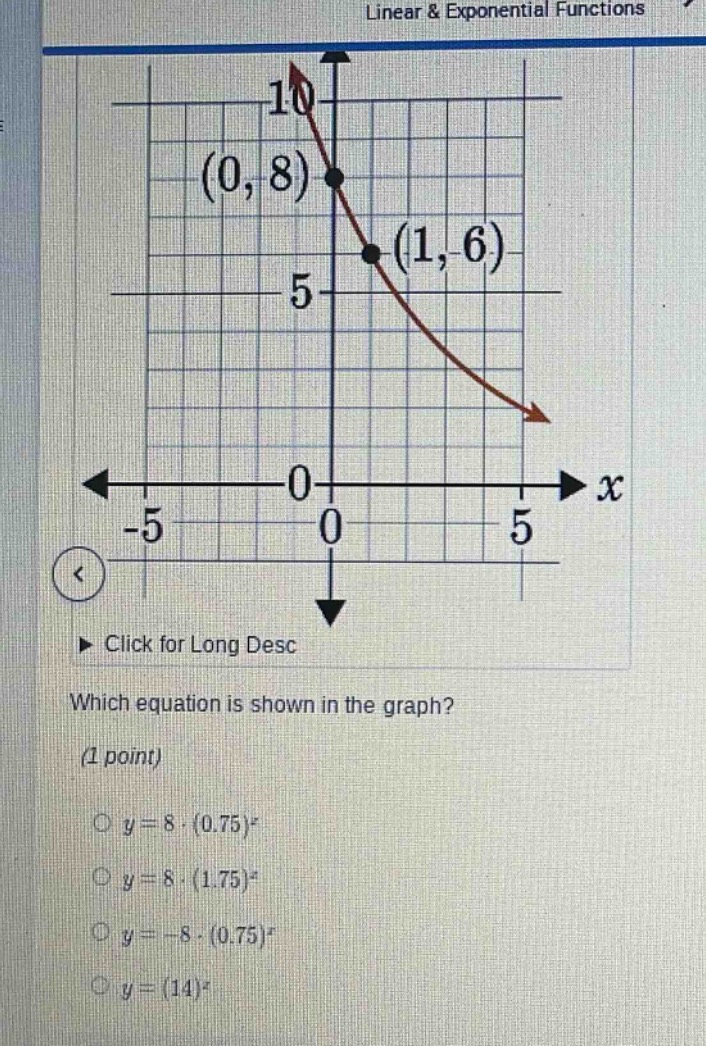
Question
linear & exponential functions
click for long desc
which equation is shown in the graph?
(1 point)
$circ y = 8cdot(0.75)^x$
$circ y = 8cdot(1.75)^x$
$circ y = -8cdot(0.75)^x$
$circ y = (14)^x$
Step1: Analyze the y - intercept
The general form of an exponential function is \(y = a\cdot b^{x}\). The y - intercept of a function \(y = f(x)\) occurs when \(x = 0\). For the given graph, when \(x = 0\), \(y=8\). Let's substitute \(x = 0\) into each option:
- For \(y = 8\cdot(0.75)^{x}\), when \(x = 0\), \(y=8\cdot(0.75)^{0}=8\times1 = 8\).
- For \(y = 8\cdot(1.75)^{x}\), when \(x = 0\), \(y=8\cdot(1.75)^{0}=8\times1 = 8\).
- For \(y=- 8\cdot(0.75)^{x}\), when \(x = 0\), \(y=-8\cdot(0.75)^{0}=-8\times1=-8\).
- For \(y=(14)^{x}\), when \(x = 0\), \(y=(14)^{0}=1\).
So we can eliminate the third and fourth options because their y - intercepts do not match the graph's y - intercept (\(y = 8\) when \(x = 0\)).
Step2: Analyze the trend of the function (increasing or decreasing)
The graph is a decreasing curve (as \(x\) increases, \(y\) decreases). Now let's analyze the base \(b\) of the exponential function \(y=a\cdot b^{x}\):
- If \(b>1\), the exponential function is an increasing function. For \(y = 8\cdot(1.75)^{x}\), since \(1.75>1\), this function is increasing.
- If \(0 < b<1\), the exponential function is a decreasing function. For \(y = 8\cdot(0.75)^{x}\), since \(0<0.75 < 1\), this function is decreasing.
We can also verify with the point \((1,6)\). Let's substitute \(x = 1\) into the first option \(y = 8\cdot(0.75)^{x}\):
When \(x = 1\), \(y=8\times0.75=6\), which matches the point \((1,6)\) on the graph.

Snap & solve any problem in the app
Get step-by-step solutions on Sovi AI
Photo-based solutions with guided steps
Explore more problems and detailed explanations
\(y = 8\cdot(0.75)^{x}\) (the first option: \(y = 8\cdot(0.75)^{x}\))