QUESTION IMAGE
Question
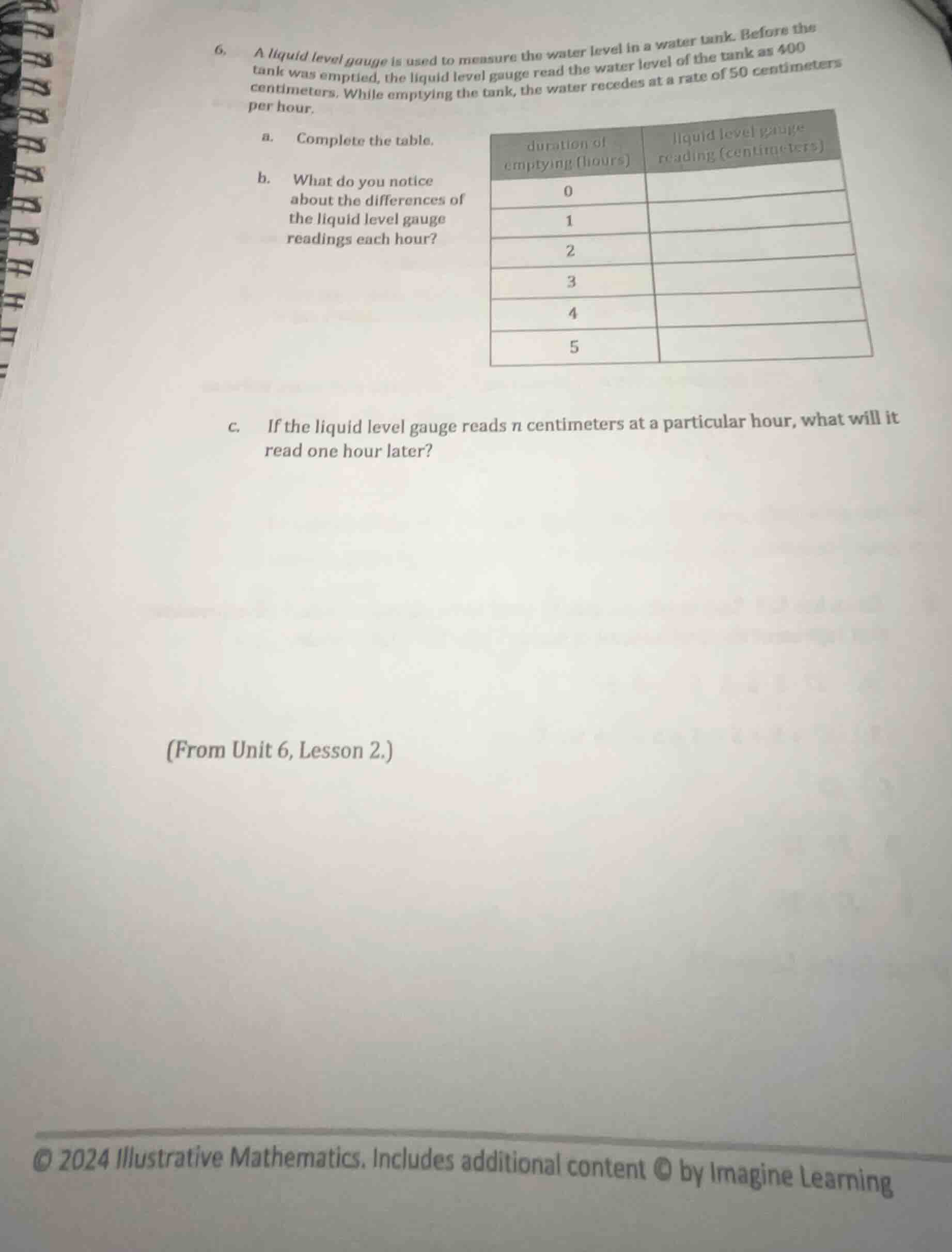
- a liquid level gauge is used to measure the water level in a water tank. before the tank was emptied, the liquid level gauge read the water level of the tank as 400 centimeters. while emptying the tank, the water recedes at a rate of 50 centimeters per hour.
a. complete the table.
b. what do you notice about the differences of the liquid level gauge readings each hour?
c. if the liquid level gauge reads ( n ) centimeters at a particular hour, what will it read one hour later?
(from unit 6, lesson 2.)
© 2024 illustrative mathematics. includes additional content © by imagine learning
Part (a)
Step1: Understand the initial level and rate
The initial water level (at 0 hours) is 400 cm. The water recedes at 50 cm per hour, so the level at time \( t \) hours is \( 400 - 50t \) cm.
Step2: Calculate for each time
- For \( t = 0 \): \( 400 - 50(0) = 400 \) cm.
- For \( t = 1 \): \( 400 - 50(1) = 350 \) cm.
- For \( t = 2 \): \( 400 - 50(2) = 300 \) cm.
- For \( t = 3 \): \( 400 - 50(3) = 250 \) cm.
- For \( t = 4 \): \( 400 - 50(4) = 200 \) cm.
- For \( t = 5 \): \( 400 - 50(5) = 150 \) cm.
The differences between consecutive gauge readings (e.g., 400 - 350, 350 - 300, etc.) are all 50 cm. This is because the water recedes at a constant rate of 50 cm per hour, so the change in level each hour is constant (a common difference in an arithmetic sequence).
Step1: Analyze the rate of change
If the gauge reads \( n \) centimeters at a particular hour, and the water recedes at 50 cm per hour, then one hour later, the level will decrease by 50 cm.
Step2: Formulate the new reading
The new reading will be \( n - 50 \) centimeters.

Snap & solve any problem in the app
Get step-by-step solutions on Sovi AI
Photo-based solutions with guided steps
Explore more problems and detailed explanations
(Table completion):
| duration of emptying (hours) | liquid level gauge reading (centimeters) |
|---|---|
| 1 | 350 |
| 2 | 300 |
| 3 | 250 |
| 4 | 200 |
| 5 | 150 |