QUESTION IMAGE
Question
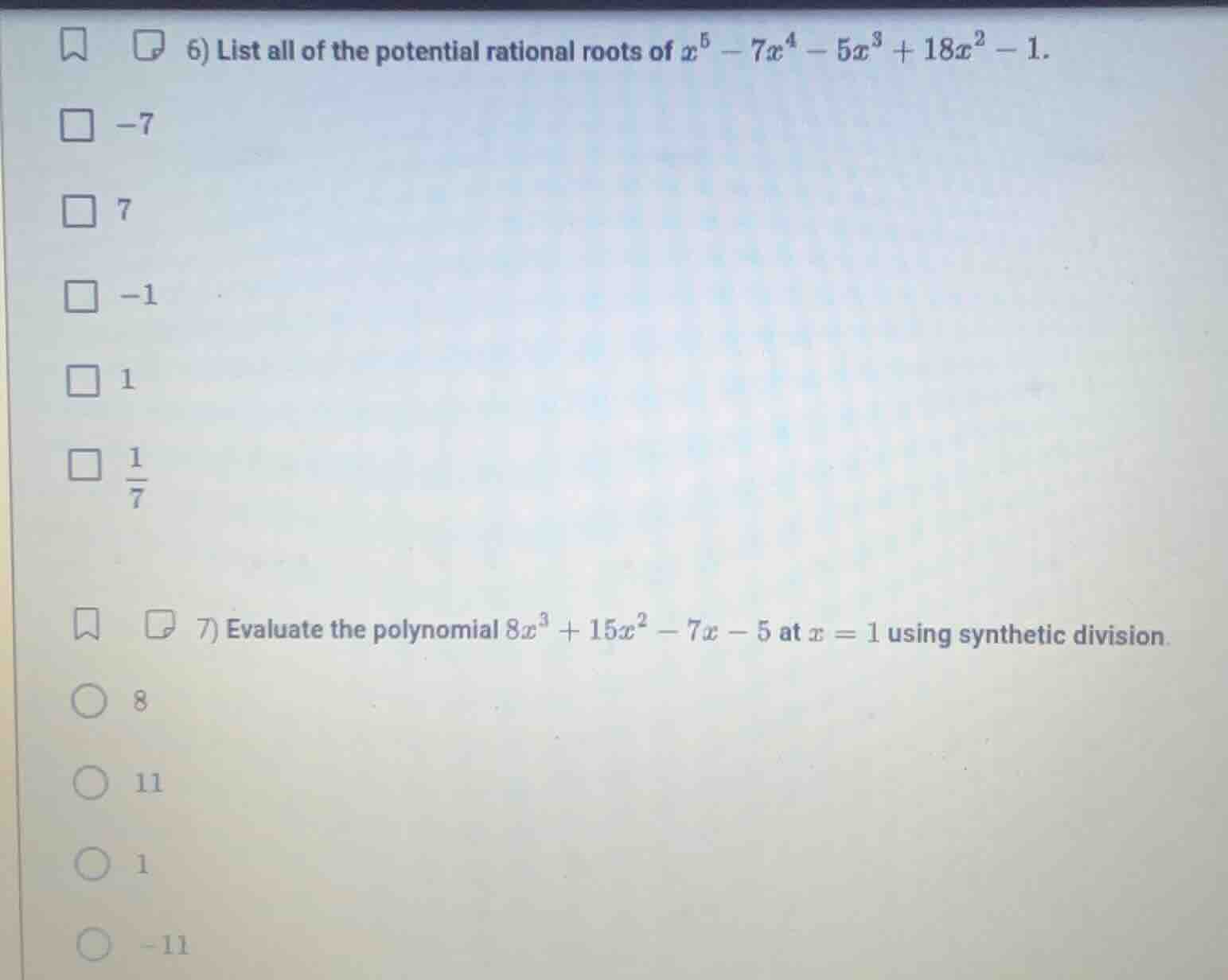
- list all of the potential rational roots of $x^5 - 7x^4 - 5x^3 + 18x^2 - 1$.
$\square$ $-7$
$\square$ $7$
$\square$ $-1$
$\square$ $1$
$\square$ $\frac{1}{7}$
- evaluate the polynomial $8x^3 + 15x^2 - 7x - 5$ at $x = 1$ using synthetic division.
$\bigcirc$ $8$
$\bigcirc$ $11$
$\bigcirc$ $1$
$\bigcirc$ $-11$
Question 6
To find the potential rational roots of a polynomial \( a_nx^n + a_{n - 1}x^{n - 1}+\dots+a_1x + a_0 \), we use the Rational Root Theorem. The possible rational roots are of the form \( \frac{p}{q} \), where \( p \) is a factor of the constant term \( a_0 \) and \( q \) is a factor of the leading coefficient \( a_n \).
Step 1: Identify \( a_0 \) and \( a_n \)
For the polynomial \( x^5 - 7x^4 - 5x^3 + 18x^2 - 1 \), the constant term \( a_0=- 1 \) and the leading coefficient \( a_n = 1 \) (the coefficient of \( x^5 \)).
Step 2: Find factors of \( a_0 \) and \( a_n \)
The factors of \( a_0=-1 \) are \( \pm1 \), and the factors of \( a_n = 1 \) are \( \pm1 \).
Step 3: Determine possible rational roots
Using the form \( \frac{p}{q} \), where \( p \) is a factor of \( - 1 \) and \( q \) is a factor of \( 1 \), we get \( \frac{\pm1}{\pm1}=\pm1 \). So the possible rational roots are \( 1 \) and \( - 1 \). The values \( - 7 \) and \( 7 \) are not possible because the factors of the constant term and leading coefficient do not produce these values.
To evaluate a polynomial \( f(x)=a_nx^n + a_{n - 1}x^{n - 1}+\dots+a_1x + a_0 \) at \( x = c \) using synthetic division, we set up the synthetic division with \( c \) and the coefficients of the polynomial.
Step 1: Identify coefficients and \( c \)
For the polynomial \( 8x^3+15x^2 - 7x - 5 \) and \( c = 1 \), the coefficients are \( 8,15,-7,-5 \).
Step 2: Set up synthetic division
We write the coefficients in a row and bring down the first coefficient:
\[
\]
- Bring down the \( 8 \).
- Multiply \( 8\times1 = 8 \), add to \( 15 \): \( 15 + 8=23 \).
- Multiply \( 23\times1=23 \), add to \( - 7 \): \( - 7+23 = 16 \).
- Multiply \( 16\times1 = 16 \), add to \( - 5 \): \( - 5+16=11 \).
The last number in the bottom row is the value of the polynomial at \( x = 1 \), which is \( f(1)=11 \).

Snap & solve any problem in the app
Get step-by-step solutions on Sovi AI
Photo-based solutions with guided steps
Explore more problems and detailed explanations
C. \(-1\), D. \(1\)